A Compendium of the Ancient Gods
Vohu Manah, plate

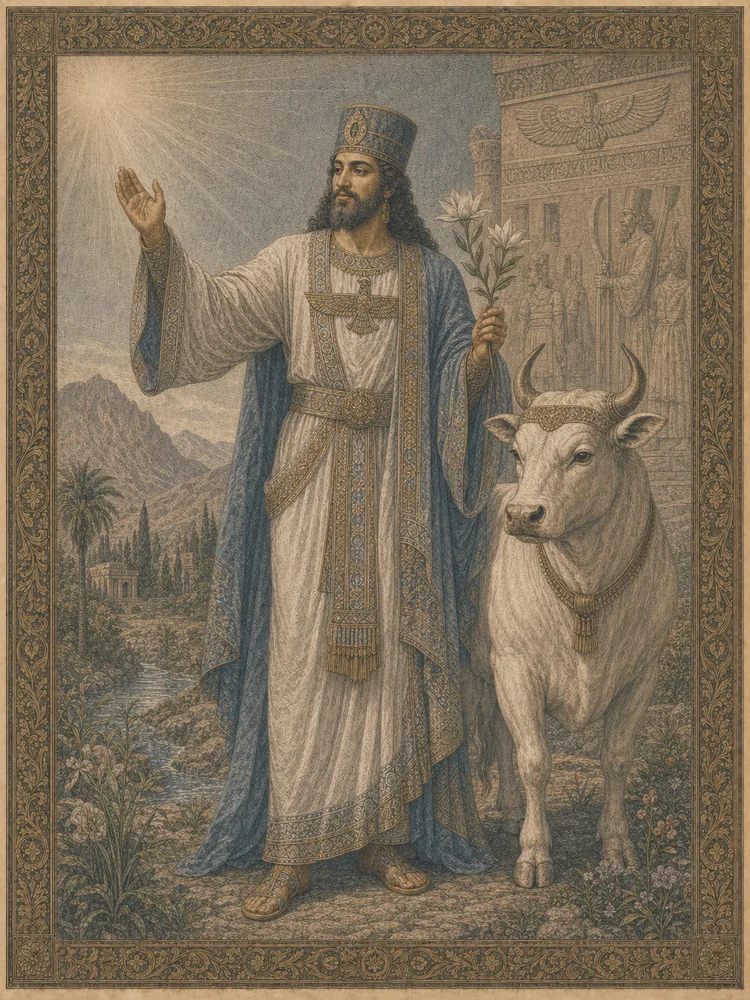
Vohu Manah — "Good Mind," or "Good Thought" — was the first of the Amesha Spentas after Ahura Mazda himself, and the foremost in dignity. He was the principle of right thinking, the inner clarity that allowed a man to perceive the truth and to choose accordingly. Where wisdom belonged to Ahura Mazda as the supreme being, the daily practice of good thought belonged to Vohu Manah and to those who imitated him.

He had been the first of the Amesha Spentas to come to Zarathushtra himself, when the prophet was in his thirtieth year and was wading at dawn into the Daiti river to fetch water for the haoma-rite. Vohu Manah appeared to him at the bank — a being nine times the size of a man, radiant with light — and led him into the presence of Ahura Mazda, where Zarathushtra received the revelation. So the prophet's career began through Good Mind, and Good Mind remained always the closest to him.

Vohu Manah's special domain was the cattle — the great wealth of the early Iranian peoples — and his festival fell at the season of the year when the cattle were most abundant. The connection between Good Mind and cattle was not arbitrary: the cattle were the wealth from which a man's good thought could flow, the gift of God that allowed the contemplative life. The opposition was Aka Manah, "Evil Mind," the demon who corrupted the thoughts of men and turned them toward the lie.

After death, the souls of the righteous were greeted by Vohu Manah at the entrance to paradise; he rose from his golden throne to welcome them and to lead them into the presence of Ahura Mazda. So Good Mind, who had received Zarathushtra at the start of his prophetic career, also received every righteous Iranian at the start of his eternal life. The reception was the seal of a life lived in the company of the Good Mind.
Curator’s note

What the sources say, and what later tradition added. The sources for this bay

Vohu Manah is described in the Gathas (Yasna 28.1, 30.7, 31.4, 43.16, etc.) and throughout the Yasna and Yashts. The vision-narrative of Vohu Manah's appearance to Zarathushtra is preserved chiefly in the Pahlavi books — the Denkard 7.3.51-62 gives the standard account. The reception in paradise is described in the Hadhokht Nask (a fragment of the Avesta) and in the Pahlavi Arda Viraf Namag. The opposition with Aka Manah is part of the standard Zoroastrian table of correspondences between Amesha Spentas and demonic counter-figures (Ardal Aka Manah; Asha vs. Indra; etc.); the system is set out in Bundahishn chapter 27.

Kin in the sources

Each tie is quoted from the entry that states it.

When the sources speak

Dated witnesses for The Amesha Spentas. A date marks when the evidence was written down, not when the belief began. The whole timeline

late 2nd–early 1st millennium BCE, debated
The Old Avestan Gathas and Yasna Haptanghaiti emerge in an eastern Iranian ritual-poetic setting; Zarathustra’s date remains disputed.
1st millennium BCE
Younger Avestan hymns, ritual texts, and legal-purity materials develop over a long period of oral transmission.
c. 550–330 BCE
Achaemenid inscriptions invoke Ahuramazda in imperial royal ideology; their relationship to later Zoroastrian orthodoxy requires care.
330 BCE–224 CE
Hellenistic and Parthian eras preserve Iranian cults through sparse and regionally varied evidence.
224–651 CE
Sasanian institutions sponsor priestly learning and the redactional organization associated with the Avesta and Zand.
7th–10th centuries CE
After the Islamic conquest, Middle Persian books record cosmology, law, exegesis, and summaries of lost material.
c. 9th century CE
The Bundahišn, Dēnkard, Wizīdagīhā ī Zādspram, and related works preserve systematic late antique and early Islamic syntheses.
c. 977–1010 CE
Ferdowsi composes the Shāhnāmeh from epic and royal traditions with both pre-Islamic and Islamic-period mediation.

Floor plan

The rooms follow one another in the order their peoples first appear in the written record.

  1. The Cradle of Citiesc. 3400 BCE to 395 CE. 115 works
  2. The Gift of the Nilec. 4000 BCE to 395 CE. 73 works
  3. The Olympian Orderc. 1600 BCE to 750 CE. 152 works
  4. The Persian Worldc. 2000 BCE to 1010 CE. 30 works
  5. The Levantine Borderlandsc. 1200 BCE to 500 CE. 20 works
  6. The Edges of Empirec. 2000 BCE to 1500 CE. 33 works
  7. The Etruscan Worldc. 900 BCE to 750 CE. 22 works
  8. The Roman Inheritancec. 1200 BCE to 500 CE. 58 works
  9. The Northern Inheritancec. 2000 BCE to 1600 CE. 131 works