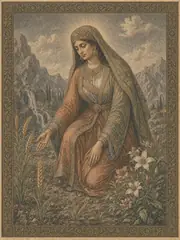
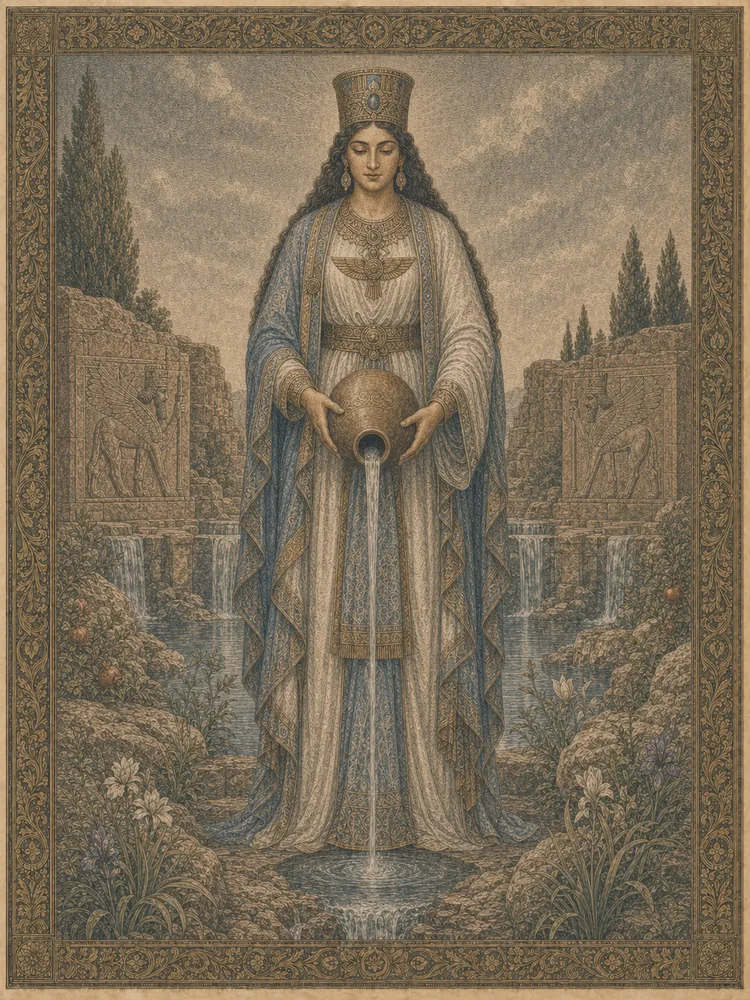
Haurvatat — "Wholeness," or "Perfection," or "Health" — was the Amesha Spenta of integrity, of being entire and unbroken, of physical and spiritual completeness. Her element was the waters, both the heavenly waters that brought rain and the earthly waters that flowed in rivers and stood in lakes. To preserve the waters from pollution was to honor Haurvatat; to drink clean water and to bathe in it was to participate in her gift; to provide water for the thirsty was to imitate her bounty.
She was paired in cult and in mythology with her sister Ameretat, "Immortality" — the two going always together, like Wholeness and Eternity, the temporary perfection that prefigures the permanent one. Together they were associated with the priestly libation, the zaothra, the offering of the haoma-juice mixed with water and milk that the priest poured at the close of the rite. So the two together blessed the libation, blessed the worshipper, and pointed forward to the final age when their gifts would be permanent and the renewed world would be wholly whole and eternally living.
Haurvatat's chief opposition was Tauru, the demon of hunger, and Zairi, the demon of thirst. The contamination or scarcity of water was an act of these demons against Haurvatat; the abundant flowing of water was her victory over them. The Zoroastrian was instructed never to spit into water, never to relieve himself in water, never to throw filth into water — these were attacks on Haurvatat. The various Iranian water-rites, particularly those associated with Anahita, were understood as cooperations with Haurvatat's protection of the cosmic waters.
Her day in the calendar was the seventh day of the month, and her month was the fourth, the season when the rivers of Iran ran fullest from the spring melt. Her name has had a long afterlife: it gave the Hebrew word for "life" (חי, ḥay, through Aramaic) some scholars have proposed, and certainly contributed to the Iranian-influenced Hebrew angelology of the post-exilic period.