A Compendium of the Ancient Gods
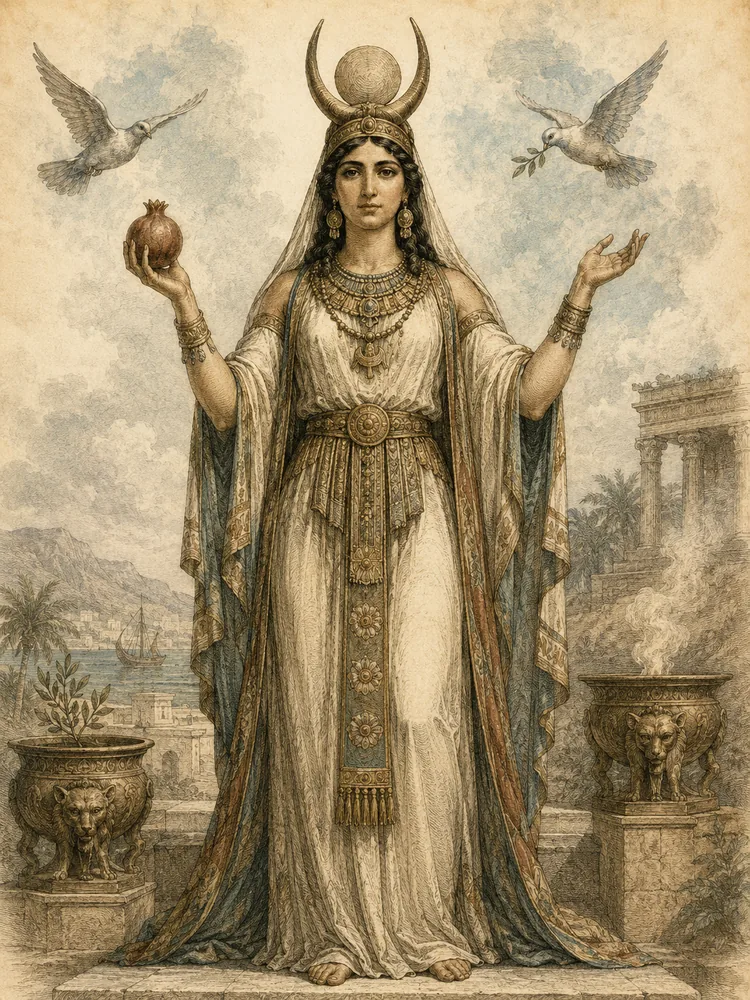
Tanit, plate

When Phoenician colonists from Tyre founded Carthage in the late ninth century BCE upon the African shore, they brought with them the gods of their mother-city; but in the centuries that followed, the goddess who rose to the highest place in Carthaginian religion was not the Tyrian Astarte but a goddess whose name and primary cult appear to be Punic-African in origin: Tanit, sometimes called Tinnit, whose epithet Pene Baal — "Face of Baal" — proclaimed her place at the right hand of the supreme god Baal Hammon.

She was depicted, in the votive stelae of the Carthaginian sanctuaries, as a tall conical figure with arms raised to heaven — a symbol so distinctive that it survives, in stylized form, on tens of thousands of stelae from her open-air sanctuary called the Tophet, where Carthaginian families dedicated offerings to her and to Baal Hammon. She was the goddess of fertility and of the moon; her sacred animals included the lion and the dove, and her sacred plants included the palm and the pomegranate. The Tophet of Carthage and similar sanctuaries at Motya, Sulcis, Tharros, and other Punic cities preserve her cult in great archaeological detail.

The Tophet is the source of one of the more painful disputes of ancient history. Greek and Latin writers — Diodorus Siculus, Plutarch, Tertullian, and others — accuse the Carthaginians of sacrificing their own children to Tanit and Baal Hammon, throwing them living into the flames of the goddess's altar. The archaeological evidence is mixed: the urns of the Tophet do contain the cremated remains of human infants and very young children, but whether these were sacrificial victims (as the Greco-Roman polemicists insisted), still-births buried in a sacred precinct (as some modern archaeologists have proposed), or some combination of the two, is a matter of vigorous and continuing scholarly debate. The Roman polemic against Carthage was sustained and one-sided, and skepticism about its accuracy is healthy; but the urns themselves are not propaganda, and the question is genuinely open.

After the destruction of Carthage by Rome in 146 BCE, Tanit's cult did not entirely die. The Romans, who refounded Carthage as a colony under Augustus, eventually re-admitted her under the Latinized name Caelestis, the "Heavenly Goddess," and her cult spread across Roman North Africa and beyond. By the third century CE, Caelestis was one of the great goddesses of the Roman empire; her temple at Roman Carthage was rebuilt; her cult outlasted, in some form, the Vandal conquest. The conical-arms-raised symbol of Punic Tanit is recognizable on objects of the Christian period, where her old followers still made the gesture in private piety.
Curator’s note

What the sources say, and what later tradition added. The sources for this bay

Tanit is documented in Carthaginian and Punic inscriptions from the eighth century BCE onward; in the votive stelae of the Tophet of Carthage and parallel sanctuaries at other Punic sites; and in Greek and Latin authors from at least the fourth century BCE. The Tophet sacrifice question is discussed in Diodorus Siculus 20.14, Plutarch De Superstitione 13, Tertullian Apologeticus 9, and elsewhere; the modern archaeological debate is best followed in the work of Lawrence Stager (who interprets the evidence as supporting child sacrifice) and his various interlocutors (who do not). The identification with Roman Caelestis is documented in numerous imperial-period inscriptions from Roman Africa Proconsularis. The Tanit-symbol — triangle, horizontal bar, circle, with raised arms — is among the most distinctive religious symbols of the ancient Mediterranean, and survives in stylized form on objects continuing into late antiquity.

Kin in the sources

Each tie is quoted from the entry that states it.

When the sources speak

Dated witnesses for Canaan and Phoenicia. A date marks when the evidence was written down, not when the belief began. The whole timeline

c. 3400–3000 BCE
Uruk-period writing and monumental temple economies create the earliest recoverable administrative setting for named divine institutions.
c. 2900–2350 BCE
Early Dynastic city-states preserve local cults, hymns, royal inscriptions, and god lists; later copies often transmit older compositions.
c. 2334–2154 BCE
The Akkadian Empire expands bilingual and imperial patterns of divine identification without erasing local cult titles.
c. 2112–2004 BCE
Ur III administration and scribal schooling standardize many Sumerian literary and liturgical forms.
c. 2000–1600 BCE
Old Babylonian schools copy major myths, laments, hymns, debates, and heroic narratives in the form most often used by modern editors.
c. 1650–1200 BCE
Hittite and Hurrian archives at Hattusa transmit Anatolian myths, imported Syrian materials, and ritual compositions.
c. 1400–1190 BCE
The tablets of Ugarit preserve the Baal Cycle, Kirta, Aqhat, ritual lists, and a dense Late Bronze Age West Semitic pantheon.
c. 1000–612 BCE
Neo-Assyrian and Neo-Babylonian empires collect, revise, and politically reinterpret older learned traditions.

Floor plan

The rooms follow one another in the order their peoples first appear in the written record.

  1. The Cradle of Citiesc. 3400 BCE to 395 CE. 115 works
  2. The Gift of the Nilec. 4000 BCE to 395 CE. 73 works
  3. The Olympian Orderc. 1600 BCE to 750 CE. 152 works
  4. The Persian Worldc. 2000 BCE to 1010 CE. 30 works
  5. The Levantine Borderlandsc. 1200 BCE to 500 CE. 20 works
  6. The Edges of Empirec. 2000 BCE to 1500 CE. 33 works
  7. The Etruscan Worldc. 900 BCE to 750 CE. 22 works
  8. The Roman Inheritancec. 1200 BCE to 500 CE. 58 works
  9. The Northern Inheritancec. 2000 BCE to 1600 CE. 131 works