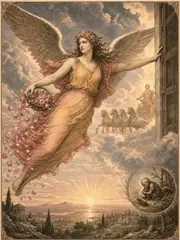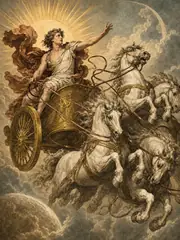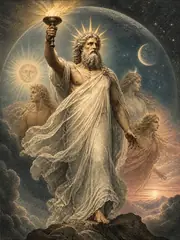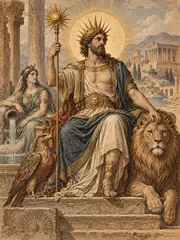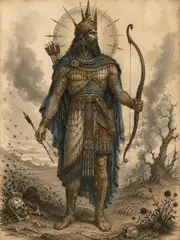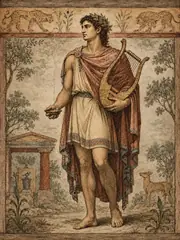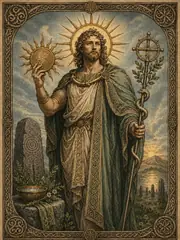
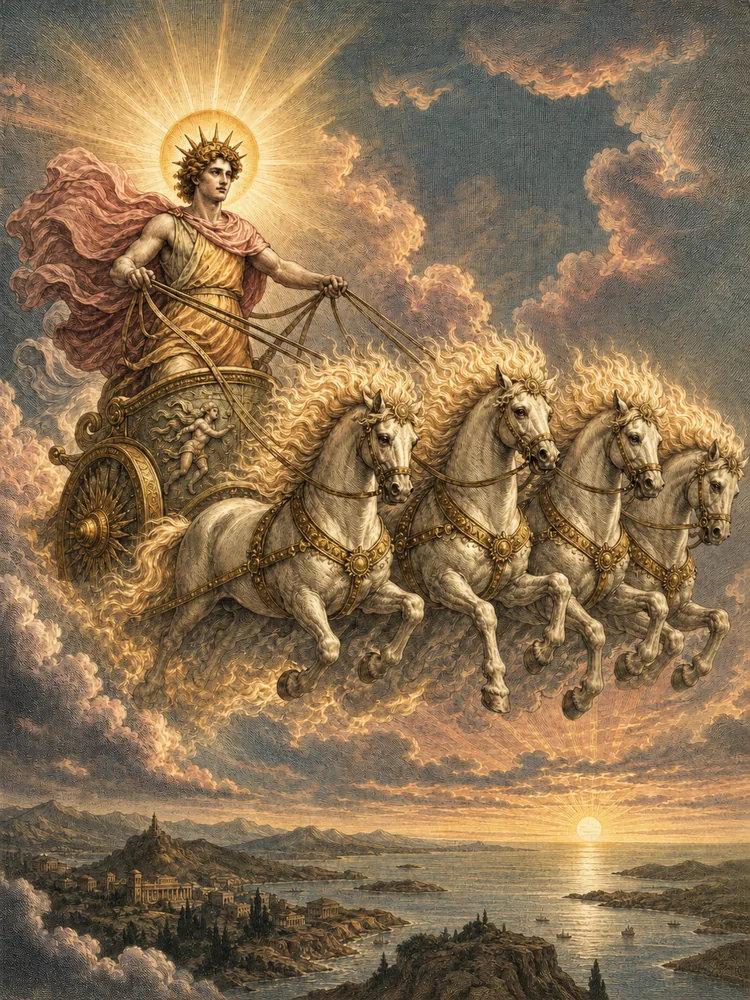
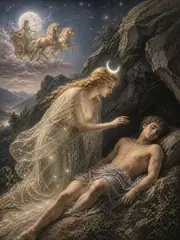
Helios was the sun — the actual physical sun in its daily course across the sky, conceived as a divine charioteer driving four horses (named Pyrois, Aeos, Aethon, and Phlegon) from his palace in the east each morning, across the heavens by day, and down into the western Ocean each evening, where he and his weary horses bathed before being carried back to the east by night in a great golden cup that floated upon the world-stream. His sister Eos preceded him as the dawn; his sister Selene followed him as the moon. He had a great palace and golden throne; he saw all things that men did beneath his light, and was therefore invoked as a witness in oaths.
The most famous Helios-narrative is that of his son Phaethon, the youth begotten upon the mortal Clymene, who at the age of manhood demanded of his father the proof of his paternity. Helios swore by the river Styx (the unbreakable oath of the gods) to grant him whatever he asked; and Phaethon asked to drive the sun-chariot for one day. Helios pleaded with him to choose any other gift; the boy was insistent; and the oath could not be revoked. So Phaethon mounted the chariot at dawn; the horses, sensing the unfamiliar hand, bolted; the chariot careered across the sky now too high (so that the earth froze) now too low (so that the earth burned, scorching black the skin of the Africans, drying up the rivers of Libya, and making the deserts that we still see today), until Zeus, fearing the destruction of the cosmos, struck Phaethon with a thunderbolt; the boy fell flaming into the river Eridanus, and his mourning sisters were transformed into poplars whose tears, falling, became amber.
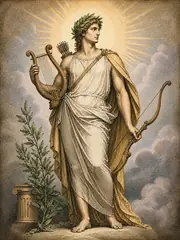
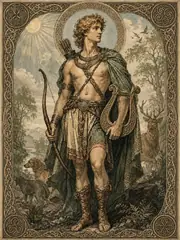
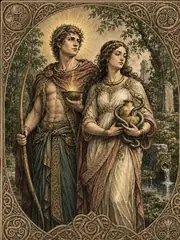
Helios was identified, from the late fifth century onward, with Apollo; the two had originally been distinct (Apollo was a god of music, prophecy, plague, and youth, and his solar associations are late), but the identification became standard in Hellenistic times and was systematized in late antiquity. Helios's principal cult was at Rhodes, where the great bronze Colossus of Rhodes — one of the Seven Wonders, completed about 280 BCE and destroyed by earthquake about 226 BCE — depicted him as the patron of the island.