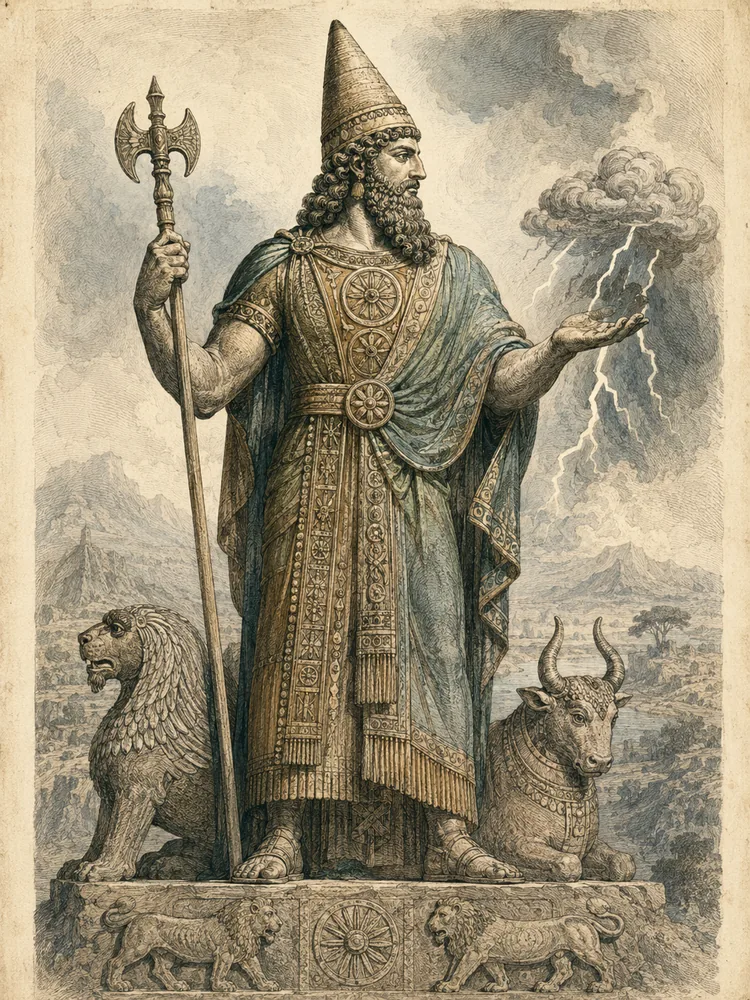
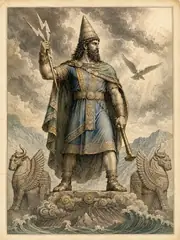
Tarhunza was the storm-god of the Luwians, the Indo-European-speaking people who occupied the southern and western reaches of Anatolia and who outlived the collapse of the Hittite empire by some centuries, ruling the so-called Neo-Hittite kingdoms of the Iron Age (c. 1180–700 BCE). His name and figure correspond to Hittite Tarhunt and to Hurrian Teshub; he stood upon his bull, and held the axe and the bunch of grapes, for he was patron of the vine as well as of the storm. The reliefs of the Neo-Hittite cities — Carchemish, Malatya, Karatepe, Aleppo — show him repeatedly, in a remarkably stable iconography that persists for half a millennium.
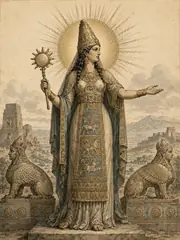 Before thisThe Sun Goddess of Arinna
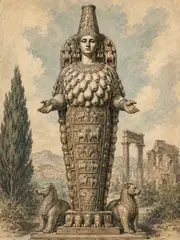 Next on the wallArtemis of Ephesus
Curator’s note
What the sources say, and what later tradition added. The sources for this bay
Tarhunza is best known from the hieroglyphic Luwian inscriptions of the Iron Age Neo-Hittite states, particularly the long bilingual inscription of Karatepe (c. 700 BCE), in which King Azatiwada of Adana boasts of his founding of the city Azatiwadaya "under the protection of Tarhunzas of the Vineyard." The cult of Tarhunza appears to have been the principal religious continuity between the Bronze Age Hittite world and the Iron Age Aramaean and Luwian successor kingdoms.
Kin in the sources
Each tie is quoted from the entry that states it.
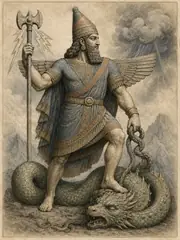 Named as the same god asTarhunt
His name and figure correspond to Hittite Tarhunt and to Hurrian Teshub
 Named as the same god asTeshub
His name and figure correspond to Hittite Tarhunt and to Hurrian Teshub
When the sources speak
Dated witnesses for Anatolia. A date marks when the evidence was written down, not when the belief began. The whole timeline
- c. 3400–3000 BCE
- Uruk-period writing and monumental temple economies create the earliest recoverable administrative setting for named divine institutions.
- c. 2900–2350 BCE
- Early Dynastic city-states preserve local cults, hymns, royal inscriptions, and god lists; later copies often transmit older compositions.
- c. 2334–2154 BCE
- The Akkadian Empire expands bilingual and imperial patterns of divine identification without erasing local cult titles.
- c. 2112–2004 BCE
- Ur III administration and scribal schooling standardize many Sumerian literary and liturgical forms.
- c. 2000–1600 BCE
- Old Babylonian schools copy major myths, laments, hymns, debates, and heroic narratives in the form most often used by modern editors.
- c. 1650–1200 BCE
- Hittite and Hurrian archives at Hattusa transmit Anatolian myths, imported Syrian materials, and ritual compositions.
- c. 1400–1190 BCE
- The tablets of Ugarit preserve the Baal Cycle, Kirta, Aqhat, ritual lists, and a dense Late Bronze Age West Semitic pantheon.
- c. 1000–612 BCE
- Neo-Assyrian and Neo-Babylonian empires collect, revise, and politically reinterpret older learned traditions.