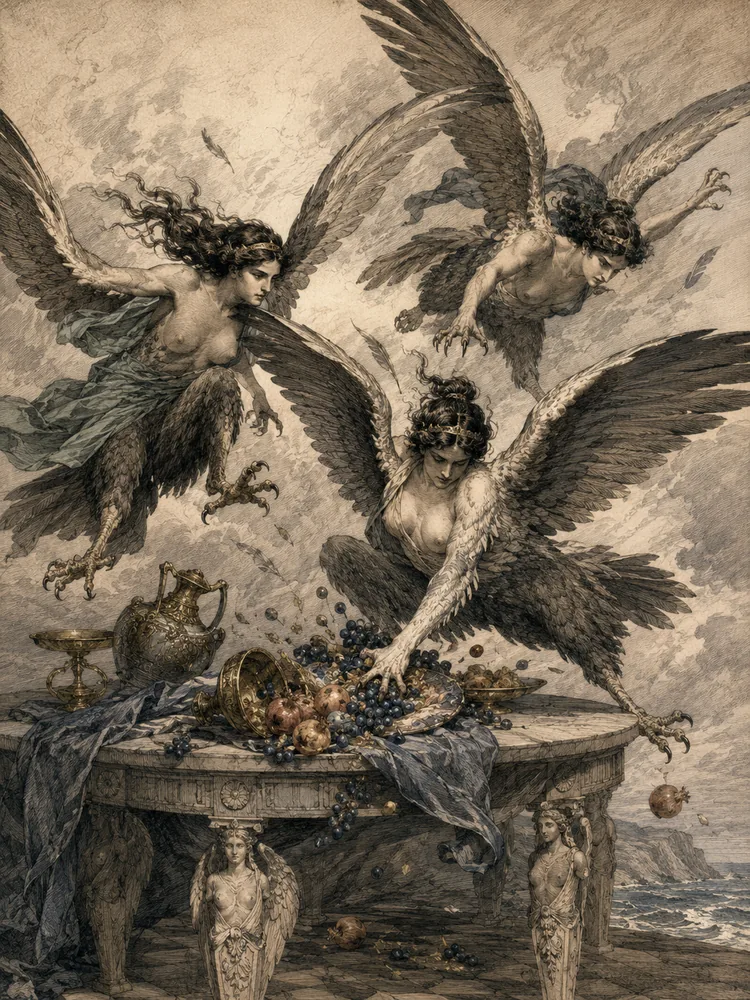
The Harpies were daughters of the sea-god Thaumas and the cloud-nymph Electra (and so sisters of Iris the rainbow-messenger), and there were two or three of them: Aello the Storm-swift, Ocypete the Wind-swift, and Celaeno the Dark — though Hesiod knew only the first two. They were depicted as winged women with the talons of birds, and they were swift as the wind itself; their name in Greek means simply "the Snatchers," for they snatched away food and persons and disappeared into the sky.
The most famous of their visitations was at the table of Phineus, the blind prophet-king of Thrace. Phineus had offended the gods (the reasons given vary), and as his punishment the Harpies were sent against him: whenever food was set before the king, they descended upon the table, seized what they could, and befouled what remained, so that he could not eat and was wasting away. When the Argonauts came to his coast, two of their company — Calais and Zetes, the winged sons of Boreas — drove the Harpies away through the air, pursuing them as far as the Strophades islands in the Ionian Sea, where Iris descended from heaven and forbade them to slay the creatures, who were, after all, the hounds of Zeus.
Thereafter the Harpies remained in their islands, and whether they continued to trouble men depended on which poet you read. Virgil places them at the Strophades in the Aeneid, where Aeneas's company stops to sail and is driven off by them with foul cries. To call a person a harpy in the Greek manner was to accuse them of greed and uncleanness; the word has not lost this sense in our own English.