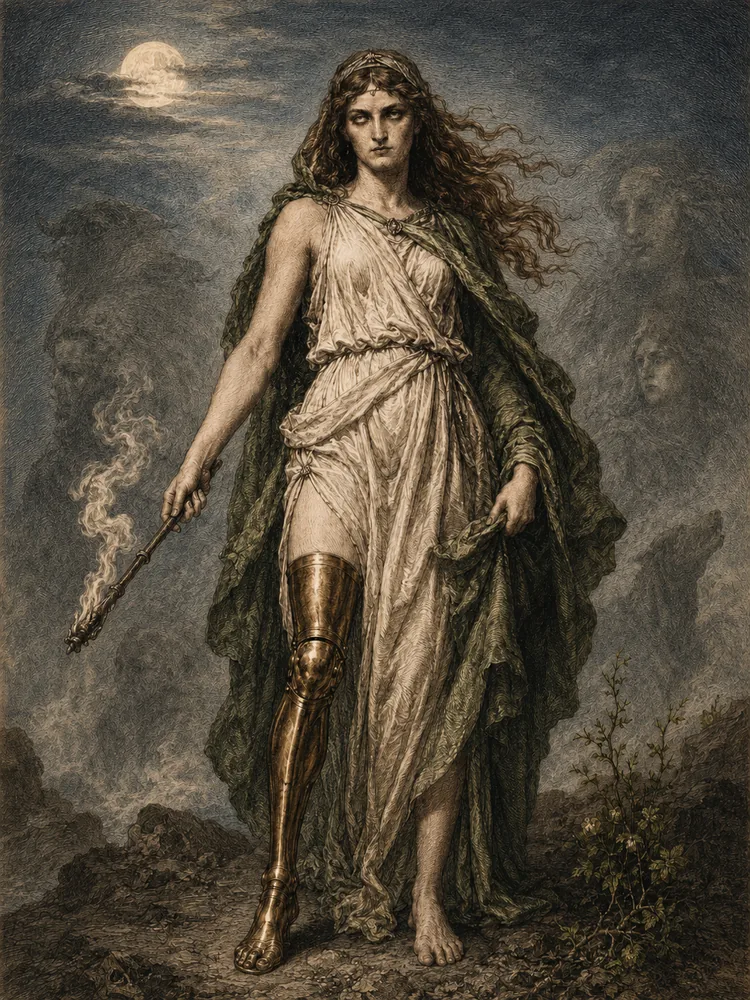
Empusa was a shape-shifting demon, a servant of Hecate, who appeared at crossroads and in lonely places at night — sometimes as a beautiful woman, sometimes as a hideous old hag, sometimes as a dog, sometimes as a cow, sometimes (in the Aristophanic version) with one bronze leg and one ass's leg. She drank the blood of young men whom she seduced; she could be driven away by insults (Aristophanes's hero Dionysus, encountering Empusa in the Frogs, drives her off by mocking her bronze leg). Like Lamia, she became in late tradition a generic name for a type of demon rather than a specific individual; the medieval succubus traces partly to her, through the long line of folkloric transmission that runs from the Hellenistic period through Byzantium into the Latin West.
 Before thisLamia
 Next on the wallThe Harpies
Curator’s note
What the sources say, and what later tradition added. The sources for this bay
Aristophanes, Frogs 285–311 (the comic encounter); Philostratus, Life of Apollonius 4.25 (where Empusa is the demon Apollonius drives off, with elements that Keats reused for his Lamia). The relationship of Empusa, Lamia, Mormo, and Gello — a quartet of female demons of similar function in Hellenistic tradition — is a topic of folkloric study; in practice the four are largely interchangeable, with regional variations of name.
Kin in the sources
Each tie is quoted from the entry that states it.
 Companion ofHecate
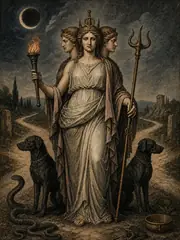
Empusa was a shape-shifting demon, a servant of Hecate, who appeared at crossroads
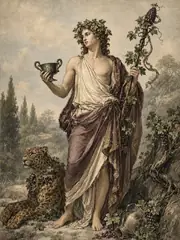 Rival ofDionysus
Aristophanes's hero Dionysus, encountering Empusa in the Frogs, drives her off by mocking her bronze leg
- Compared withLamia
Like Lamia, she became in late tradition a generic name for a type of demon
When the sources speak
Dated witnesses for The Heroic Bestiary. A date marks when the evidence was written down, not when the belief began. The whole timeline
- c. 1600–1100 BCE
- Mycenaean palace tablets in Linear B record offerings and divine names, but little continuous myth.
- c. 1100–800 BCE
- Post-palatial oral traditions and changing cult landscapes precede the surviving alphabetic epics.
- late 8th–7th centuries BCE
- The Iliad, Odyssey, Hesiodic Theogony and Works and Days give influential but non-exclusive divine orders.
- 7th–6th centuries BCE
- Homeric Hymns, lyric poetry, colonization, and local sanctuary traditions multiply regional narratives.
- 6th–5th centuries BCE
- Orphic, Pythagorean, and mystery materials develop alternative cosmogonies and afterlife doctrines.
- 5th century BCE
- Athenian tragedy and comedy recast heroic houses and divine justice for civic audiences.
- 4th century BCE
- Philosophers, antiquarians, and local historians interpret or criticize inherited myth.
- 323–31 BCE
- Hellenistic poets and scholars systematize variants across an enlarged Greek world.