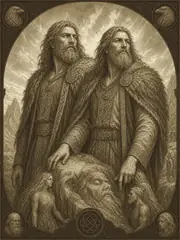
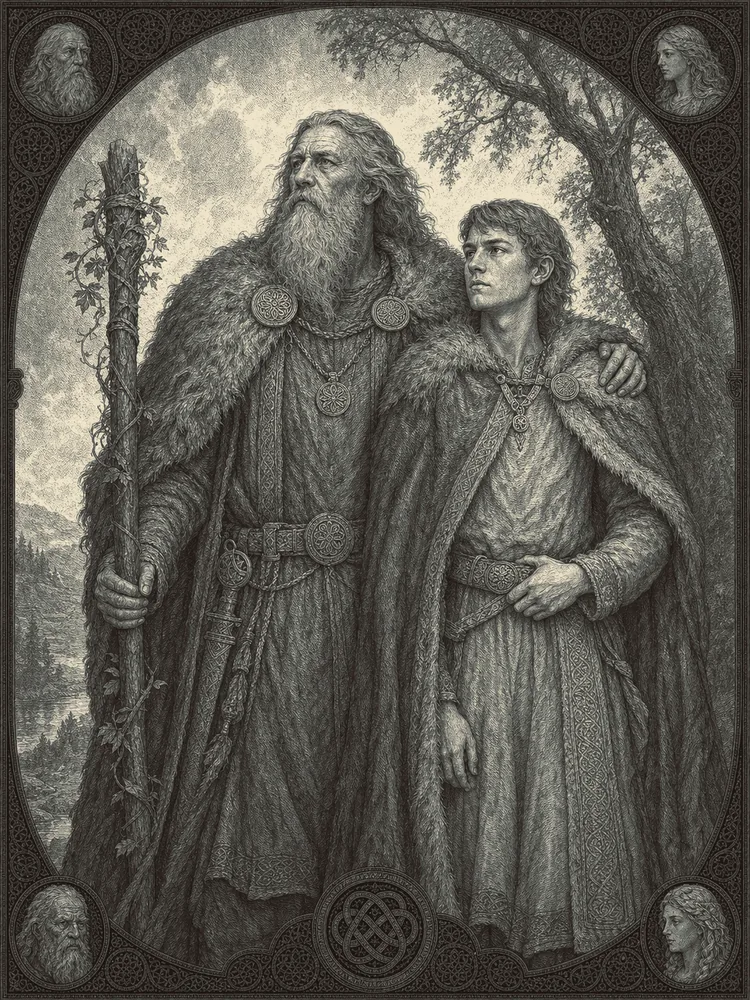
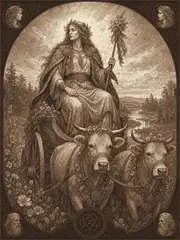
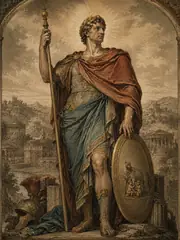
Long before Snorri Sturluson wrote down the Norse mythology, and long before the Vikings sailed, the Germans of the first century after our era had a cosmogonic tale of their own — and Tacitus, the Roman historian, has preserved it. "In their ancient lays," he wrote in his Germania, "which are their only kind of historical record, they celebrate Tuisto, a god born of the earth, and his son Mannus, the originator and founder of their nation." The earth-born god gave rise to the man, and the man to three sons, from whom were descended the three great groupings of the Germanic peoples — the Ingaevones along the coast, the Herminones of the interior, and the Istaevones of the south.
Tuisto's name probably means "the Twin" or "the Doubled" — a primordial androgyne, or a being containing two natures within one — and the figure has been linked by comparative mythologists to the Vedic Yama, the Iranian Yima, and other Indo-European "first man" figures. Mannus is simply "man" — the etymological ancestor of the German Mensch and the English man, the prototypical human. Of either god the Germans of Tacitus's day told stories; what those stories were we do not know, for the lays themselves are lost. Tacitus reports only the bare framework, and Snorri (writing twelve centuries later) seems to have had no knowledge of Tuisto or Mannus at all.
Curator’s note
What the sources say, and what later tradition added. The sources for this bay
Tuisto and Mannus are described by Tacitus in the Germania, chapter 2, written around 98 CE — the only ancient witness. The text reads "Celebrant carminibus antiquis, quod unum apud illos memoriae et annalium genus est, Tuistonem deum terra editum." The figures have been the subject of much comparative work; Georges Dumézil compared them with Yama and Yami in the Vedic tradition (Mythe et épopée, 1968-1973), with the Iranian Yima, and with the Roman Romulus-Remus pair. The disappearance of Tuisto and Mannus from the later Norse-Icelandic record, despite their evident centrality in the older Germanic continental tradition, is striking — perhaps a sign of how much was lost, or replaced, between the first century and the thirteenth.
When the sources speak
Dated witnesses for The Norse and Germanic Gods. A date marks when the evidence was written down, not when the belief began. The whole timeline
- 2nd–1st millennia BCE
- Indo-European language dispersals and regional Bronze Age cultures provide a remote comparative background, not a recoverable common canon.
- c. 500 BCE–1 CE
- Iron Age material culture, names, sanctuaries, and classical ethnography offer early but external evidence for Celtic and Germanic religions.
- 1st–4th centuries CE
- Roman inscriptions and provincial cults preserve many Celtic, Germanic, and local divine names.
- 4th–8th centuries CE
- Migration-period and early medieval conversion transform ritual institutions while heroic traditions continue.
- 8th–11th centuries CE
- Viking Age poetry, runic evidence, archaeology, and Scandinavian conversion form the core context of Norse myth.
- 9th–12th centuries CE
- Slavic, Baltic, and Finnic traditions enter chronicles and missionary accounts, often through hostile observers.
- 11th–14th centuries CE
- Irish, Welsh, and Icelandic manuscripts preserve major narrative corpora in Christian literary environments.
- 12th–16th centuries CE
- Saxo, saga compilers, Baltic chroniclers, and later antiquarians systematize or reinterpret older material.