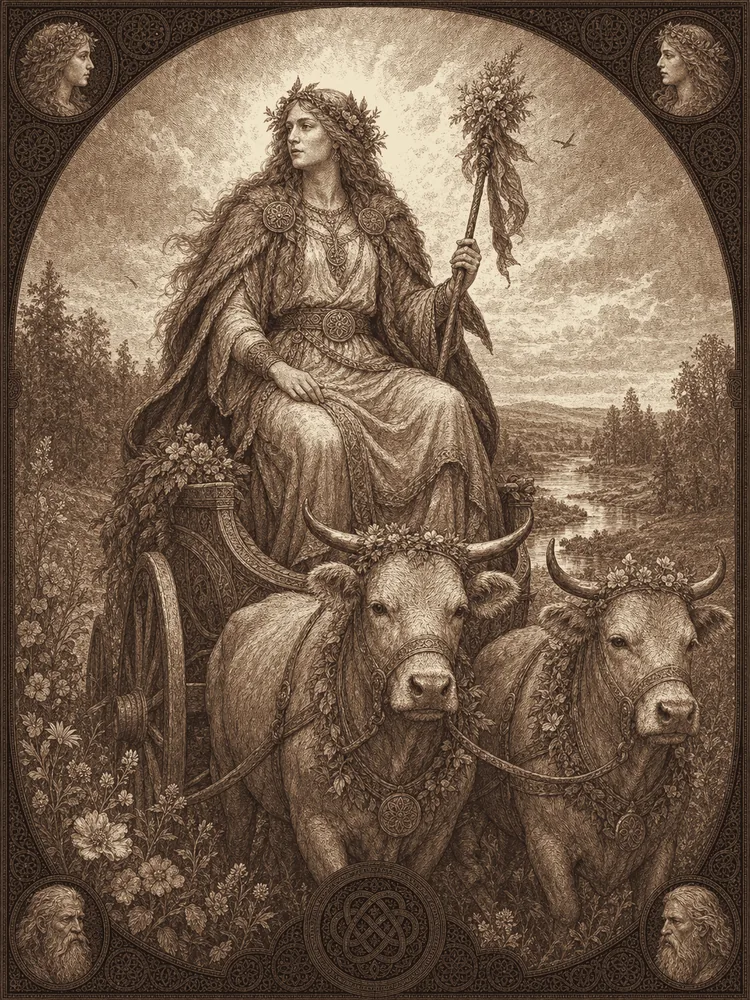
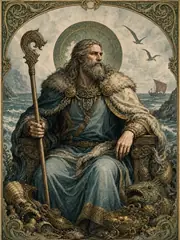
Among the Germanic peoples of the Baltic coast in Tacitus's day there was a great goddess called Nerthus, whom the historian identifies as Terra Mater, Mother Earth. Her sanctuary lay on a sacred island in the ocean, where her image was kept covered with a veil and her chariot was drawn by cows. When the priests perceived that the goddess was present in her shrine, they yoked the cows and led the chariot in procession through the lands of her worshippers; wherever it went, peace was kept (for no weapons might be carried during her progress), feasts were celebrated, and the first plowing of the year was begun.
When the goddess was tired of human company, she returned to her shrine, and her chariot, the cloth that veiled her, and the goddess herself were washed in a hidden lake — by slaves, who were thereafter drowned by the priests, that none might live to tell what they had seen. So secret was the rite that even the worshippers did not know what their goddess looked like; only the unveiled corpses, sunk in the lake, had ever beheld her face.
Nerthus's name is the linguistic ancestor of the Norse Njord — though by the Viking Age the gender had been reversed, and the great earth-mother of the Germanic Baltic peoples had become a male sea-god of the Norse pantheon, the father of Freyr and Freyja. The transformation is one of the most peculiar in the history of religion: a goddess of the first century becomes a god of the ninth, whose son and daughter take up between them many of the old goddess's functions. The change is perhaps a sign of how thoroughly the gods could be reshaped in the migrations and reorganizations that lay between the Germanic Iron Age and the Viking period.
Curator’s note
What the sources say, and what later tradition added. The sources for this bay
Nerthus is described by Tacitus in the Germania, chapter 40 — the most detailed surviving account of any Germanic ritual from the ancient world. The seven tribes Tacitus names as her worshippers (Reudigni, Aviones, Anglii, Varini, Eudoses, Suarines, Nuithones) include the Anglii, who would later become the Angles of the English nation; the cult of Nerthus thus stands somewhere in the prehistory of England as well as Denmark. The connection between Nerthus and Njord is one of the certainties of Germanic comparative mythology; the gender-reversal is parallel in some respects to the relationship between Vedic Diaus pitar (sky-father) and Norse Tyr (whose name etymologically means "god") and reflects the long instability of divine gender across millennia. Bog-bodies of the sort found at Tollund, Grauballe, and elsewhere in the Danish peat have been suggested as possibly the drowned slaves of Nerthus's rite — a suggestion that is plausible but not proved.
When the sources speak
Dated witnesses for The Norse and Germanic Gods. A date marks when the evidence was written down, not when the belief began. The whole timeline
- 2nd–1st millennia BCE
- Indo-European language dispersals and regional Bronze Age cultures provide a remote comparative background, not a recoverable common canon.
- c. 500 BCE–1 CE
- Iron Age material culture, names, sanctuaries, and classical ethnography offer early but external evidence for Celtic and Germanic religions.
- 1st–4th centuries CE
- Roman inscriptions and provincial cults preserve many Celtic, Germanic, and local divine names.
- 4th–8th centuries CE
- Migration-period and early medieval conversion transform ritual institutions while heroic traditions continue.
- 8th–11th centuries CE
- Viking Age poetry, runic evidence, archaeology, and Scandinavian conversion form the core context of Norse myth.
- 9th–12th centuries CE
- Slavic, Baltic, and Finnic traditions enter chronicles and missionary accounts, often through hostile observers.
- 11th–14th centuries CE
- Irish, Welsh, and Icelandic manuscripts preserve major narrative corpora in Christian literary environments.
- 12th–16th centuries CE
- Saxo, saga compilers, Baltic chroniclers, and later antiquarians systematize or reinterpret older material.