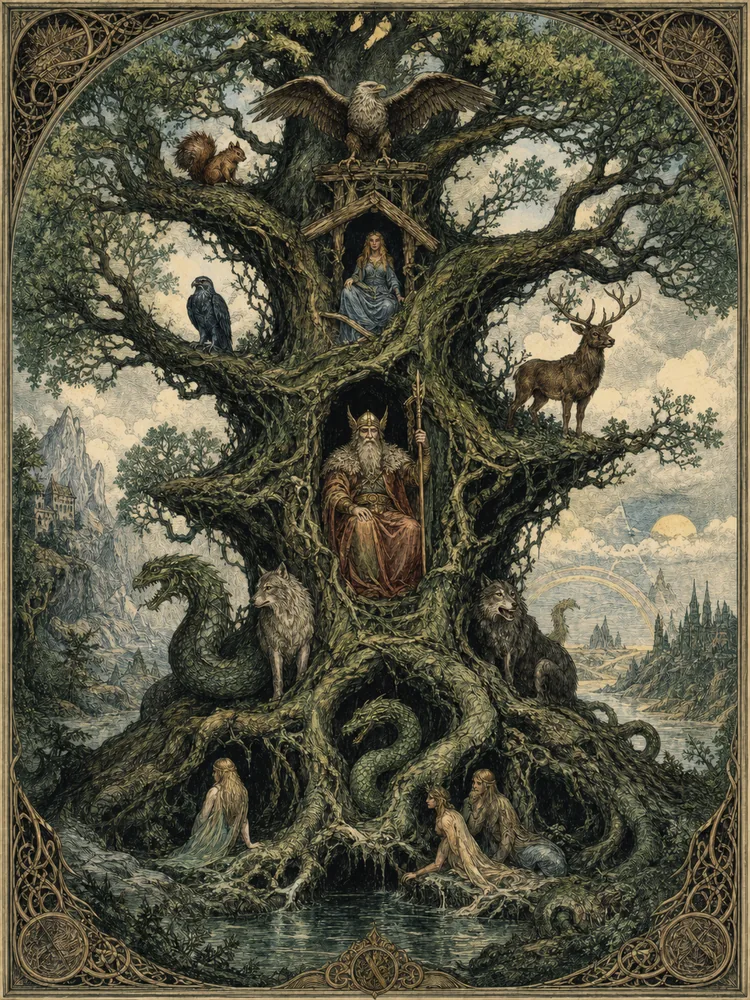
Yggdrasil was the great ash-tree at the center of the Norse cosmos, whose roots and branches held all the worlds. Three roots descended from it into three different places: one to Asgard the realm of the gods (where the Norns tended the well of Urd at its base), one to Jötunheim the realm of the giants (where Mimir's well of wisdom stood), and one to Niflheim the realm of the dead (where the dragon Nidhogg gnawed at the root). On its branches were the nine worlds — Asgard, Vanaheim, Alfheim, Midgard (the world of men), Jötunheim, Svartalfheim, Niflheim, Muspelheim, and Hel. An eagle sat at the top of the tree, a squirrel called Ratatosk ran up and down its trunk carrying insults between the eagle and Nidhogg below, and four stags grazed upon its leaves. The tree suffered: its bark was torn by the stags, its roots gnawed by the dragon and the serpents that gathered there, and yet it was sustained by the daily care of the Norns, who poured water from the well of Urd over its roots. Its name means "Odin's Steed" or "the Terrible One's Horse," because Odin had hung from it for nine nights to win the runes (told under his entry below).
 Next on the wallOdin
Curator’s note
What the sources say, and what later tradition added. The sources for this bay
The principal sources are the Poetic Edda's Völuspá (the Seeress's Prophecy) and Grímnismál (the Lay of Grimnir), and Snorri's Prose Edda (Gylfaginning chapters 15–16). The world-tree is among the most universal of Indo-European mythological motifs (the Vedic Aśvattha, the Iranian Gaokerena, the Slavic World-Tree of folk-belief), suggesting deep antiquity for the conception. The interpretation of Yggdrasil's name and the precise correspondence of the nine worlds varies between sources; Snorri's tabulation is the standard but not the only one.
Kin in the sources
Each tie is quoted from the entry that states it.
- Companion ofOdin
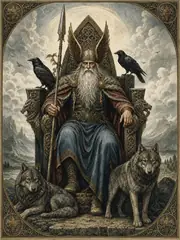
because Odin had hung from it for nine nights to win the runes
 Companion ofNorns
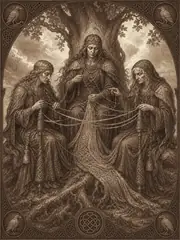
yet it was sustained by the daily care of the Norns, who poured water from the well of Urd over its roots
When the sources speak
Dated witnesses for The Norse and Germanic Gods. A date marks when the evidence was written down, not when the belief began. The whole timeline
- 2nd–1st millennia BCE
- Indo-European language dispersals and regional Bronze Age cultures provide a remote comparative background, not a recoverable common canon.
- c. 500 BCE–1 CE
- Iron Age material culture, names, sanctuaries, and classical ethnography offer early but external evidence for Celtic and Germanic religions.
- 1st–4th centuries CE
- Roman inscriptions and provincial cults preserve many Celtic, Germanic, and local divine names.
- 4th–8th centuries CE
- Migration-period and early medieval conversion transform ritual institutions while heroic traditions continue.
- 8th–11th centuries CE
- Viking Age poetry, runic evidence, archaeology, and Scandinavian conversion form the core context of Norse myth.
- 9th–12th centuries CE
- Slavic, Baltic, and Finnic traditions enter chronicles and missionary accounts, often through hostile observers.
- 11th–14th centuries CE
- Irish, Welsh, and Icelandic manuscripts preserve major narrative corpora in Christian literary environments.
- 12th–16th centuries CE
- Saxo, saga compilers, Baltic chroniclers, and later antiquarians systematize or reinterpret older material.