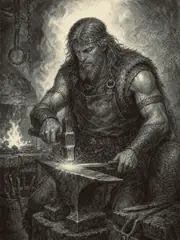
Sigurd was the greatest hero of the Norse-Germanic legend, the slayer of the dragon Fáfnir and the central figure of the Volsung cycle. His father Sigmund had died fighting against impossible odds; his mother Hjordis, pregnant with him, was rescued by King Alf of Denmark, and Sigurd was born and raised at Alf's court. There the smith Regin took him as foster-son and reforged for him the sword Gram from the broken pieces of Sigmund's blade; with this sword Sigurd would do all his great deeds.
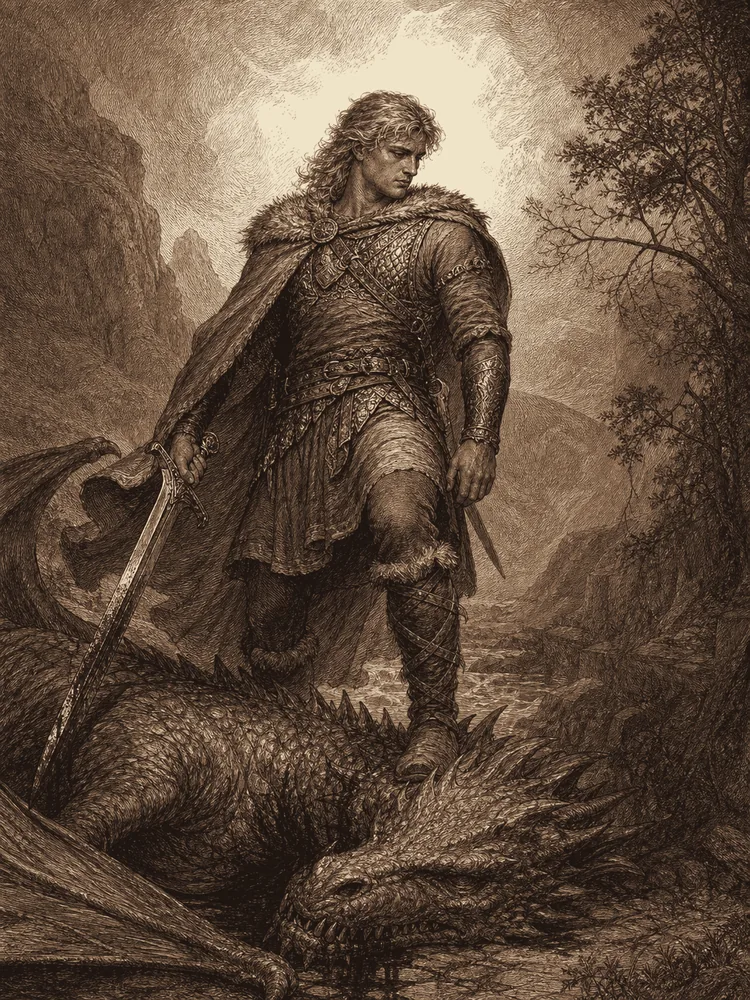
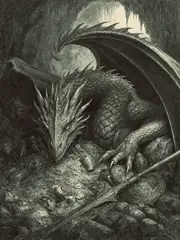
Regin had a brother — Fáfnir — who had taken the form of a dragon and lay coiled upon a great hoard of cursed gold, the gold that the Aesir had paid as wergild for the killing of their other brother Otr by Loki. Sigurd, urged by Regin, dug a pit upon the road by which Fáfnir went down to drink, and as the dragon passed over, Sigurd thrust upward with Gram and killed him. Regin asked Sigurd to roast the dragon's heart for him to eat. While Sigurd held the heart over the fire, he burnt his finger, and put it in his mouth to cool; and the dragon's blood touched his tongue. Suddenly he understood the speech of birds, and the birds in the trees were warning him: Regin meant to kill him for the gold. Sigurd struck off Regin's head, ate the heart himself, and took the cursed treasure.
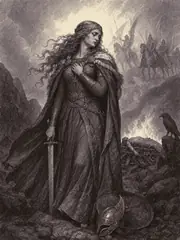
He rode on, and came to a mountain ringed with fire, where lay the valkyrie Brynhildr, who had been condemned by Odin to sleep until a hero awakened her. Sigurd rode through the fire, woke her, and pledged himself to her. But fate and the malice of others would separate them. He came to the court of the Burgundian king Gjuki and was given a potion of forgetfulness; he forgot Brynhildr and married Gjuki's daughter Gudrun, and tricked Brynhildr into marrying his brother-in-law Gunnar. Brynhildr, when she at last understood the deception, demanded Sigurd's death, and Sigurd was slain in his bed (or, in the German version, while drinking at a spring) by his other brother-in-law. Brynhildr afterward killed herself and was burnt with him on a single pyre. So the greatest of heroes met his death not from monsters but from kin and from the entanglements of love.
Curator’s note
What the sources say, and what later tradition added. The sources for this bay
Sigurd's story is preserved in the Eddic heroic poems (Reginsmál, Fáfnismál, Sigrdrífumál, Sigurðarkviða, Brot af Sigurðarkviðu, Guðrúnarkviða I-III, Helreið Brynhildar, etc.), in Snorri's Skáldskaparmál chapter 39, in the prose Vǫlsunga saga (thirteenth century, drawing on the Eddic poems and providing the connecting narrative for poems lost in the manuscript gap of the Codex Regius), and in the Middle High German Nibelungenlied (c. 1200). The German version differs from the Norse in many details — Siegfried is killed at a spring by Hagen, not in his bed; the cursed gold is the treasure of the Nibelungs, which sinks at last into the Rhine. Wagner's Ring cycle (1876) drew on both versions. The legend is a foundational text of Germanic heroic narrative and has been treated by William Morris (Sigurd the Volsung, 1876), J. R. R. Tolkien (Lay of Sigurd and Gudrun, posthumously published), and many others.
When the sources speak
Dated witnesses for The Norse and Germanic Gods. A date marks when the evidence was written down, not when the belief began. The whole timeline
- 2nd–1st millennia BCE
- Indo-European language dispersals and regional Bronze Age cultures provide a remote comparative background, not a recoverable common canon.
- c. 500 BCE–1 CE
- Iron Age material culture, names, sanctuaries, and classical ethnography offer early but external evidence for Celtic and Germanic religions.
- 1st–4th centuries CE
- Roman inscriptions and provincial cults preserve many Celtic, Germanic, and local divine names.
- 4th–8th centuries CE
- Migration-period and early medieval conversion transform ritual institutions while heroic traditions continue.
- 8th–11th centuries CE
- Viking Age poetry, runic evidence, archaeology, and Scandinavian conversion form the core context of Norse myth.
- 9th–12th centuries CE
- Slavic, Baltic, and Finnic traditions enter chronicles and missionary accounts, often through hostile observers.
- 11th–14th centuries CE
- Irish, Welsh, and Icelandic manuscripts preserve major narrative corpora in Christian literary environments.
- 12th–16th centuries CE
- Saxo, saga compilers, Baltic chroniclers, and later antiquarians systematize or reinterpret older material.