A Compendium of the Ancient Gods
Wayland, plate

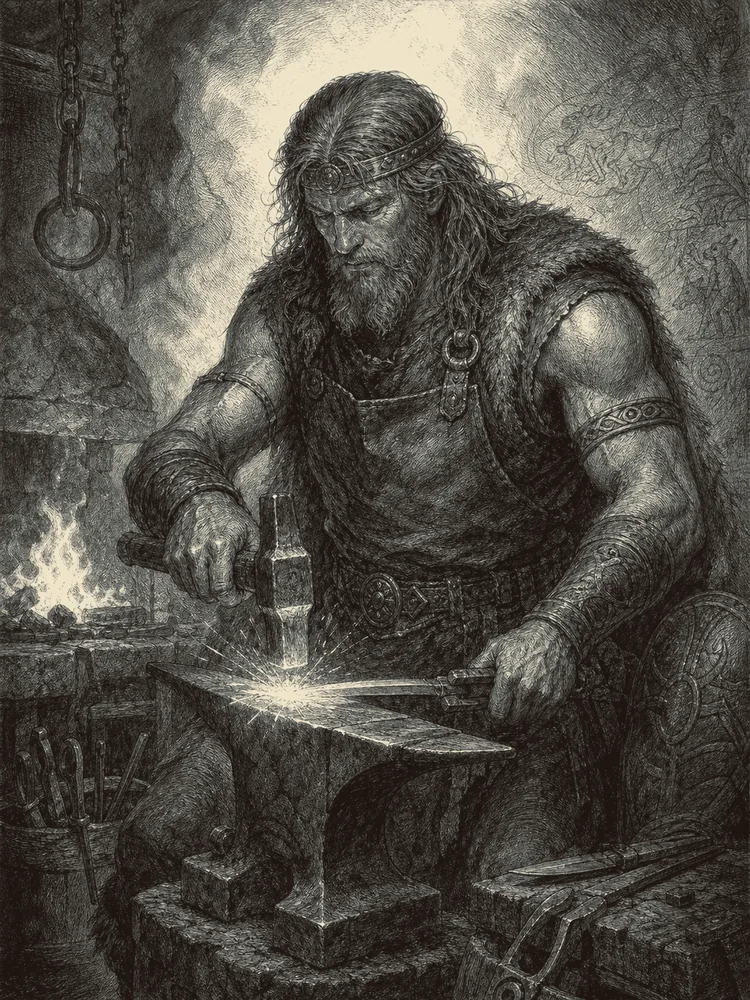
Wayland was the great smith of Germanic legend, called Völundr by the Norse and Welund by the Anglo-Saxons; the same figure, with the same story, ranged across Germanic Europe from the migration period onward. He was the son of a Finnish king and married to a swan-maiden, Hervör — but the swan-maiden flew away after seven years, as such wives do, and Wayland was left alone in his forest hall, working at his forge.

There he was captured by King Niðhad of Sweden, who coveted his great skill. The king cut the sinews of Wayland's hamstrings, that he might never escape, and set him on an island called Sævarstaðr, where he was forced to make treasures for the king alone. Wayland endured this captivity, but he plotted revenge. When the king's two young sons came secretly to his forge to beg jewels of him, Wayland slew them, made cups of their skulls, made jewels of their teeth and brooches of their eyes, and sent these gifts to the royal house. When the king's daughter Bǫðvildr came to him to repair a broken ring, he gave her drugged ale, and lay with her, and she conceived. Then Wayland fashioned for himself wings of feathers, took flight from the island, and rose into the air. Hovering above the king's hall, he disclosed all that he had done — the murder of the sons, the violation of the daughter — and flew away into the sky. The king was left with his grief and could not pursue him.

The figure of Wayland the Smith persisted long in Germanic folklore. Wayland's Smithy in Berkshire, England — a Neolithic long barrow on the Ridgeway — bears his name, and folk tradition held that if a horse needed shoeing one had only to leave it overnight at the smithy with a coin; in the morning the horse would be shod and the coin gone. Wayland's name is on coins, on church carvings, on the Franks Casket (the eighth-century whalebone box now in the British Museum, where the right-hand panel of the front depicts the murder of Niðhad's sons in detail). He was the Germanic Daedalus — the maker, the captive, the one who escaped on wings.

Curator’s note

What the sources say, and what later tradition added. The sources for this bay

Wayland's story is told in the Eddic poem Vǫlundarkviða, one of the heroic poems of the Codex Regius, probably composed in the tenth century. The Old English allusion is in Deor 1-7. The Franks Casket scene is the earliest visual representation, c. 700 CE. The Þiðreks saga of the thirteenth century gives a longer prose version with some variants. Wayland's Smithy, near Uffington in Oxfordshire (formerly Berkshire), is a real Neolithic long barrow that took on the name of the legendary smith probably in the early Anglo-Saxon period; the name is attested by 855 CE in a charter. The continuity of the legend across the entire Germanic-speaking world, from Sweden to Anglo-Saxon England, is one of the strongest indications that we have of a continental Germanic heroic tradition that long predated the Eddic poems.

When the sources speak

Dated witnesses for The Norse and Germanic Gods. A date marks when the evidence was written down, not when the belief began. The whole timeline

2nd–1st millennia BCE
Indo-European language dispersals and regional Bronze Age cultures provide a remote comparative background, not a recoverable common canon.
c. 500 BCE–1 CE
Iron Age material culture, names, sanctuaries, and classical ethnography offer early but external evidence for Celtic and Germanic religions.
1st–4th centuries CE
Roman inscriptions and provincial cults preserve many Celtic, Germanic, and local divine names.
4th–8th centuries CE
Migration-period and early medieval conversion transform ritual institutions while heroic traditions continue.
8th–11th centuries CE
Viking Age poetry, runic evidence, archaeology, and Scandinavian conversion form the core context of Norse myth.
9th–12th centuries CE
Slavic, Baltic, and Finnic traditions enter chronicles and missionary accounts, often through hostile observers.
11th–14th centuries CE
Irish, Welsh, and Icelandic manuscripts preserve major narrative corpora in Christian literary environments.
12th–16th centuries CE
Saxo, saga compilers, Baltic chroniclers, and later antiquarians systematize or reinterpret older material.

Floor plan

The rooms follow one another in the order their peoples first appear in the written record.

  1. The Cradle of Citiesc. 3400 BCE to 395 CE. 115 works
  2. The Gift of the Nilec. 4000 BCE to 395 CE. 73 works
  3. The Olympian Orderc. 1600 BCE to 750 CE. 152 works
  4. The Persian Worldc. 2000 BCE to 1010 CE. 30 works
  5. The Levantine Borderlandsc. 1200 BCE to 500 CE. 20 works
  6. The Edges of Empirec. 2000 BCE to 1500 CE. 33 works
  7. The Etruscan Worldc. 900 BCE to 750 CE. 22 works
  8. The Roman Inheritancec. 1200 BCE to 500 CE. 58 works
  9. The Northern Inheritancec. 2000 BCE to 1600 CE. 131 works