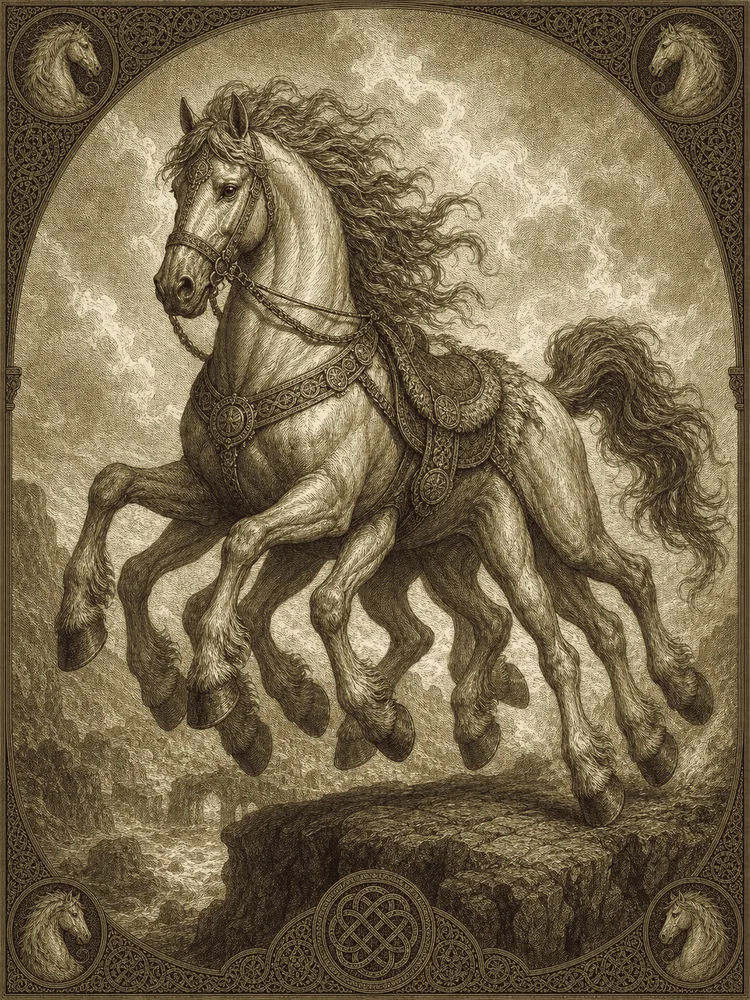
Sleipnir was the eight-legged horse of Odin, the swiftest steed in the nine worlds, capable of running on land, on water, and through the air, and of descending into the realm of the dead and returning. He had been born of Loki, who in mare-form had been impregnated by the giant stallion Svaðilfari during the curious episode in which the gods had hired a giant to build the wall of Asgard — the giant had brought his stallion as helper, and Loki, sent to slow the work that the giant might not complete it before the agreed deadline (and so claim Freyja, the sun, and the moon as payment, terms the gods regretted having agreed to), had transformed himself into a mare, lured Svaðilfari away, and returned in due course as the bearer of the resulting eight-legged foal. The foal was given to Odin as the gods' compensation for the awkward circumstances of his birth, and Sleipnir thereafter was the principal steed of the Aesir.
 Before thisJörmungandr
 Next on the wallValkyries
Curator’s note
What the sources say, and what later tradition added. The sources for this bay
Gylfaginning 42 (the wall-building and Sleipnir's birth). The eight-legged horse is unique in Indo-European mythological zoology; its significance is uncertain, with various proposed interpretations (the eight legs as four pairs, suggesting a horse drawing a bier carried by four pall-bearers, has been one influential reading, connecting Sleipnir to death-imagery).
Kin in the sources
Each tie is quoted from the entry that states it.
 Child ofLoki
He had been born of Loki, who in mare-form had been impregnated by the giant stallion Svaðilfari
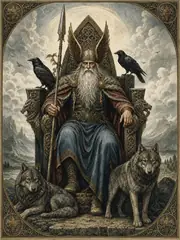 Companion ofOdin
Sleipnir was the eight-legged horse of Odin, the swiftest steed in the nine worlds
When the sources speak
Dated witnesses for The Norse and Germanic Gods. A date marks when the evidence was written down, not when the belief began. The whole timeline
- 2nd–1st millennia BCE
- Indo-European language dispersals and regional Bronze Age cultures provide a remote comparative background, not a recoverable common canon.
- c. 500 BCE–1 CE
- Iron Age material culture, names, sanctuaries, and classical ethnography offer early but external evidence for Celtic and Germanic religions.
- 1st–4th centuries CE
- Roman inscriptions and provincial cults preserve many Celtic, Germanic, and local divine names.
- 4th–8th centuries CE
- Migration-period and early medieval conversion transform ritual institutions while heroic traditions continue.
- 8th–11th centuries CE
- Viking Age poetry, runic evidence, archaeology, and Scandinavian conversion form the core context of Norse myth.
- 9th–12th centuries CE
- Slavic, Baltic, and Finnic traditions enter chronicles and missionary accounts, often through hostile observers.
- 11th–14th centuries CE
- Irish, Welsh, and Icelandic manuscripts preserve major narrative corpora in Christian literary environments.
- 12th–16th centuries CE
- Saxo, saga compilers, Baltic chroniclers, and later antiquarians systematize or reinterpret older material.