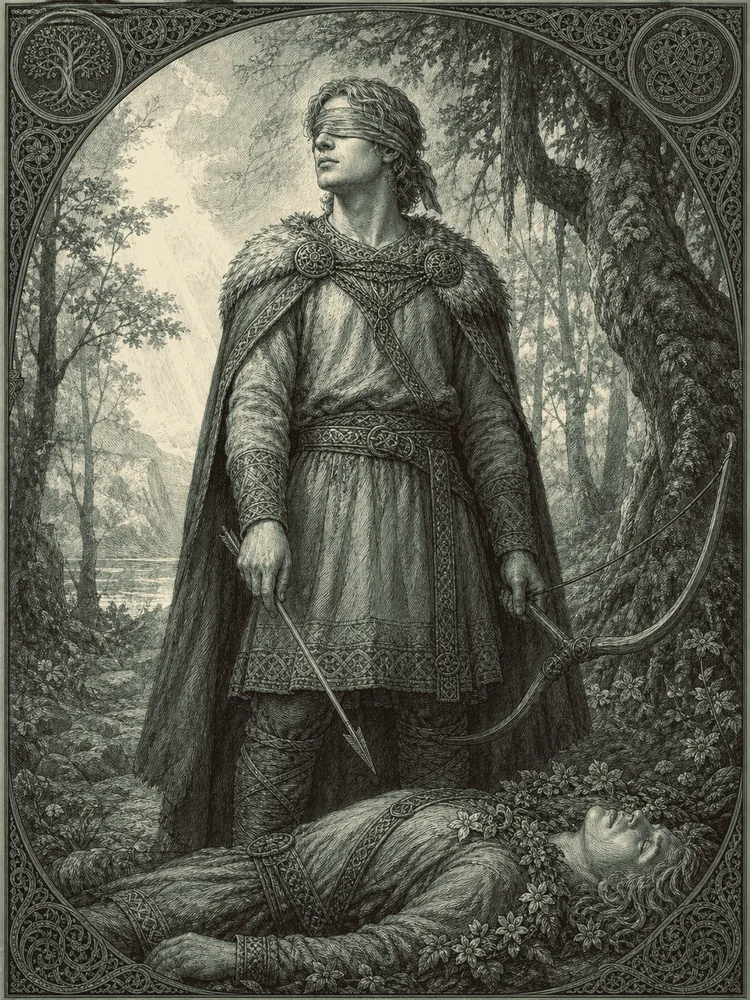
Hodr was a son of Odin, brother of Baldr, and blind. The Eddas give him no extended characterization beyond the role he plays in his brother's death-narrative: at the gathering where the gods amused themselves by throwing weapons at the invulnerable Baldr, Hodr stood apart as he could not see; Loki approached him with the mistletoe-dart and offered to guide his hand, that he too might honor his brother. Hodr threw; the dart struck; Baldr fell. He had not known what he was doing; but the killing was nonetheless his, and Vali — born for the purpose — killed him in turn at the age of one day. He would, however, return at Ragnarök's end alongside the resurrected Baldr in the new world.
 Before thisVali
 Next on the wallForseti
Curator’s note
What the sources say, and what later tradition added. The sources for this bay
Gylfaginning 49; Völuspá 33. Saxo's version (Gesta Danorum 3) makes Hothr a more prominent and morally ambiguous figure, a competitor with Baldr for the love of Nanna who kills him not by mistake but in deliberate combat; Saxo's heroic-historical version may preserve an older stratum of the tradition than Snorri's Christianizing tragic version.
Kin in the sources
Each tie is quoted from the entry that states it.
 Child ofOdin
Hodr was a son of Odin, brother of Baldr, and blind.
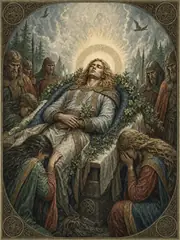 Sibling ofBaldr
Hodr was a son of Odin, brother of Baldr, and blind.
- SlewBaldr
Hodr threw; the dart struck; Baldr fell.
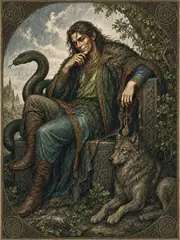 Rival ofLoki
Loki approached him with the mistletoe-dart and offered to guide his hand
- Slain byVali
Vali — born for the purpose — killed him in turn at the age of one day
When the sources speak
Dated witnesses for The Norse and Germanic Gods. A date marks when the evidence was written down, not when the belief began. The whole timeline
- 2nd–1st millennia BCE
- Indo-European language dispersals and regional Bronze Age cultures provide a remote comparative background, not a recoverable common canon.
- c. 500 BCE–1 CE
- Iron Age material culture, names, sanctuaries, and classical ethnography offer early but external evidence for Celtic and Germanic religions.
- 1st–4th centuries CE
- Roman inscriptions and provincial cults preserve many Celtic, Germanic, and local divine names.
- 4th–8th centuries CE
- Migration-period and early medieval conversion transform ritual institutions while heroic traditions continue.
- 8th–11th centuries CE
- Viking Age poetry, runic evidence, archaeology, and Scandinavian conversion form the core context of Norse myth.
- 9th–12th centuries CE
- Slavic, Baltic, and Finnic traditions enter chronicles and missionary accounts, often through hostile observers.
- 11th–14th centuries CE
- Irish, Welsh, and Icelandic manuscripts preserve major narrative corpora in Christian literary environments.
- 12th–16th centuries CE
- Saxo, saga compilers, Baltic chroniclers, and later antiquarians systematize or reinterpret older material.