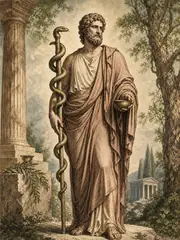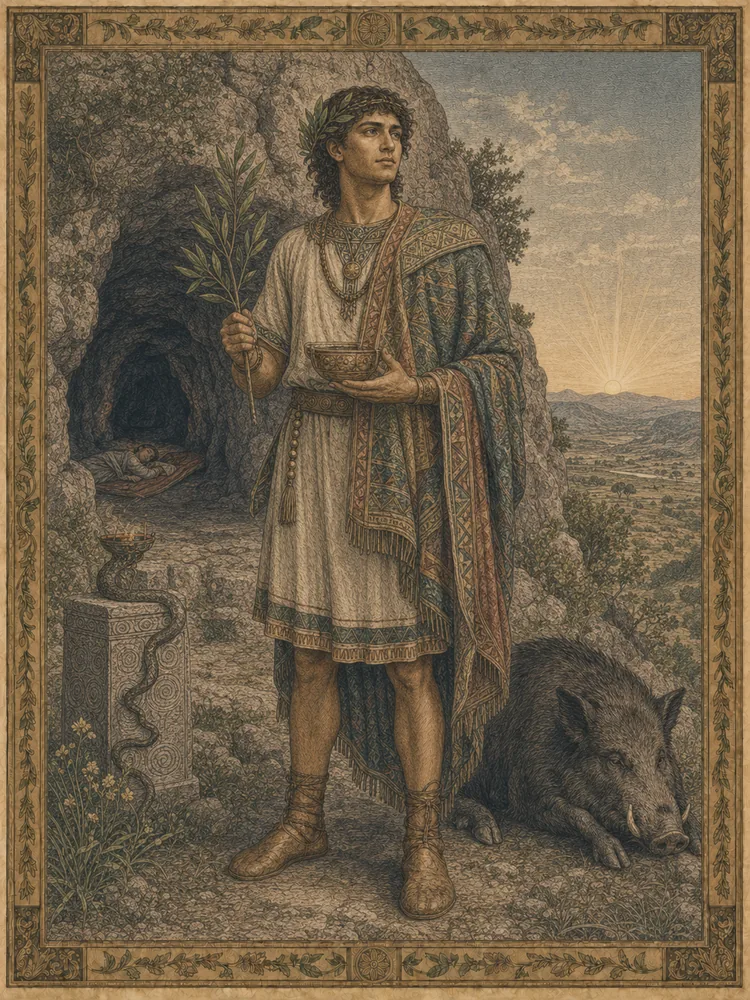
Endovelicus was the great healing-god of Lusitania, with his principal sanctuary at the hilltop site of Sao Miguel da Mota near Terena in the modern Portuguese Alentejo. The cult is documented through one of the largest corpora of dedicatory inscriptions of any local Iberian deity — over a hundred Latin inscriptions have been recovered from the sanctuary, dating from the first to the fourth centuries of our era — and through the votive iconography (busts, plaques, and small statuettes recovered from the site). He was a chthonic deity in some of his aspects (a god of the underworld, of the cave, of the depths from which healing comes) and a solar-celestial deity in others; the iconographic record shows him as a beardless young man, sometimes accompanied by a wild boar (his sacred animal) or a serpent.
The chief mode of worship at the sanctuary was incubation — the practice of sleeping in the temple precinct in order to receive healing or oracular guidance through dreams. The pilgrim seeking healing would arrive at the sanctuary, perform the prescribed purifications, and then sleep within the precinct; in his dream, Endovelicus would appear to him and either heal him directly or prescribe the regimen by which his healing would be accomplished. The practice has parallels with the Greek Asclepius-cult (particularly at Epidaurus) and with the various incubation-shrines of the Mediterranean world; whether Endovelicus's incubation-cult was indigenous or borrowed from Mediterranean models is debated.
The dedicatory inscriptions from Sao Miguel record the gratitude of those who had been healed — 'ex visu' (after a vision), 'ex jussu dei' (at the god's command), 'pro salute' (for the welfare of), with the names of the donors and their family members. The inscriptions are in Latin (with some Latin-Iberian bilingual elements), and they were set up by Romans and Romanized Lusitanians alike; the cult was thoroughly integrated into the religious life of the imperial province. Some inscriptions are by women (relatively unusual for the period), and the sanctuary appears to have been particularly resorted to by mothers seeking the healing of their children — a function that some scholars have proposed survives in the modern Portuguese Catholic devotion to Senhora da Boa Hora ('Our Lady of the Good Hour'), the patroness of childbirth, whose cult-site is in the same general region.
The cult continued into the fourth century before being absorbed into Christianity. The hilltop sanctuary was probably converted to a small Christian shrine in the late ancient period; the site was rediscovered and excavated in the nineteenth century, with the inscriptions and votives preserved in regional museums. The figure of Endovelicus is unique in the Roman-Iberian provincial record for the depth of documentation; he is the best-attested indigenous deity of the entire western Mediterranean, and the standard test-case for the study of how Roman provincial religion preserved and transformed indigenous traditions.