A Compendium of the Ancient Gods
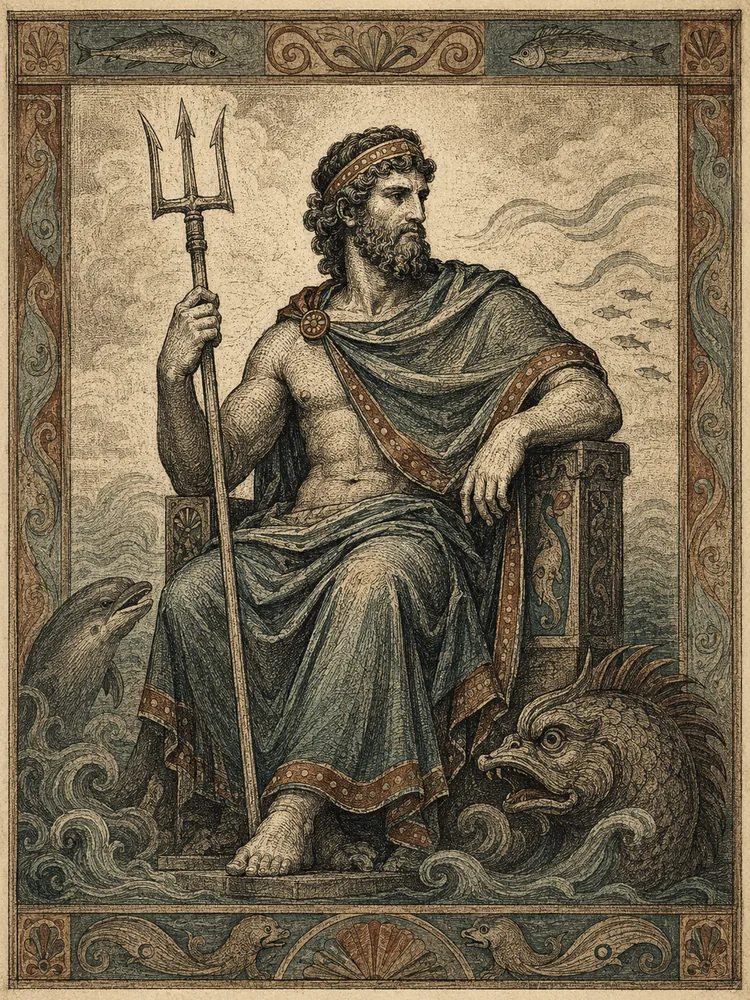
Nethuns, plate

Nethuns was the Etruscan god of the sea, of springs, and of the running waters of streams and rivers. His name is an indigenous Etruscan formation (perhaps from the same root as Latin natare, 'to swim') and is the source of the Roman name Neptunus. The Roman sea-god Neptune is in fact directly inherited from the Etruscan Nethuns, though the figure was secondarily syncretized with the Greek Poseidon and acquired a Greek mythology after the absorption of southern Italy into the Roman sphere.

Nethuns is depicted on bronze mirrors and on dedicatory plaques as a bearded man holding a trident — the Greek-Poseidon iconography — sometimes accompanied by sea-creatures. The trident may be an indigenous symbol or a Greek borrowing; the matter is debated. A mirror from Tuscania (now in the Florence Archaeological Museum) shows Nethuns with two female attendants and a fish, in a marine procession that is one of the clearest preserved Etruscan sea-god images.

His cult was particularly developed at the Etruscan port cities — Pyrgi (the port of Caere), Populonia (the iron-mining city on the Tyrrhenian coast), and Vetulonia — where the sea was the basis of commerce and where shipwreck or favorable winds were matters of constant concern. Sailors made offerings to Nethuns before voyages and after safe returns; the votive offerings recovered from harbor sanctuaries (small bronze ships, fish-shaped pendants, miniature anchors) give a vivid sense of the everyday sea-religion of the Etruscan trading world.

On the Piacenza Liver, Nethuns occupies a region in the periphery of the bronze model — corresponding probably to the boundaries of the world, where the great encircling ocean lies — though the precise placement varies among interpreters. After the Romanization, Nethuns was absorbed into Neptune; the Latin name preserves the Etruscan form almost unchanged.
Curator’s note

What the sources say, and what later tradition added. The sources for this bay

Nethuns is named on the Piacenza Liver, on bronze mirrors, and in numerous inscriptions. The Tuscania mirror is published in Larissa Bonfante's Reading the Past: Etruscan (1990). The etymology Nethuns > Neptunus is straightforward and documented in many places; the question of whether the indigenous Italian sea-god (under whatever earlier name) was originally distinct from a borrowing of Greek Poseidon is one of the debated points of Etruscan-Roman religious history. De Grummond's Etruscan Myth treats the matter; Mauro Cristofani's Dizionario gives the inscriptional evidence. The Piacenza Liver placement of Nethuns is discussed in van der Meer's Bronze Liver edition.

Kin in the sources

Each tie is quoted from the entry that states it.

When the sources speak

Dated witnesses for The Powers of the Sun, Moon and Earth. A date marks when the evidence was written down, not when the belief began. The whole timeline

c. 900–750 BCE
Villanovan communities establish the Iron Age background from which historically Etruscan cities emerge.
c. 750–600 BCE
Orientalizing exchange and urban growth transform elite ritual, iconography, writing, and sanctuary display.
c. 600–475 BCE
Etruscan city-states reach their widest political and artistic influence; temples and mythic imagery proliferate.
c. 474 BCE
The defeat at Cumae marks changing Etruscan power in Campania and the Tyrrhenian world.
5th–4th centuries BCE
Tomb painting, mirrors, votive deposits, and regional cults provide dense evidence for divine and funerary imagery.
396–264 BCE
Roman conquest progressively incorporates Etruscan cities while Etruscan priestly expertise remains prestigious.
2nd–1st centuries BCE
Late inscriptions and Roman antiquarian interest document cultural integration and the persistence of divinatory traditions.
1st century BCE–1st century CE
Cicero, Varro, Livy, Seneca, and others preserve testimony about haruspicy, lightning, and prodigies.

Floor plan

The rooms follow one another in the order their peoples first appear in the written record.

  1. The Cradle of Citiesc. 3400 BCE to 395 CE. 115 works
  2. The Gift of the Nilec. 4000 BCE to 395 CE. 73 works
  3. The Olympian Orderc. 1600 BCE to 750 CE. 152 works
  4. The Persian Worldc. 2000 BCE to 1010 CE. 30 works
  5. The Levantine Borderlandsc. 1200 BCE to 500 CE. 20 works
  6. The Edges of Empirec. 2000 BCE to 1500 CE. 33 works
  7. The Etruscan Worldc. 900 BCE to 750 CE. 22 works
  8. The Roman Inheritancec. 1200 BCE to 500 CE. 58 works
  9. The Northern Inheritancec. 2000 BCE to 1600 CE. 131 works