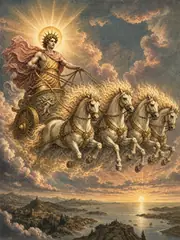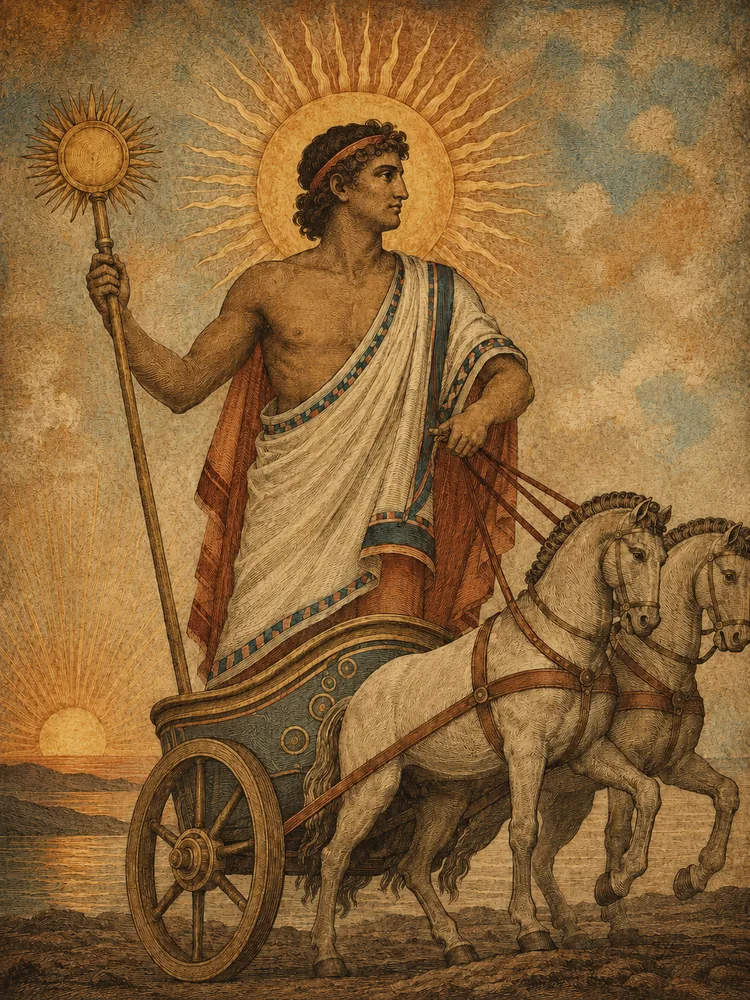
Usil was the Etruscan god of the sun, the rider of the solar chariot, the lord of the bright daylight. He was depicted on mirrors and in painted tombs as a young man rising from the eastern horizon, his head crowned with rays, his arms uplifted, sometimes with a fish-tail (in his aspect as the sun who rises from the sea) and sometimes with horses (in his aspect as the rider of the heavens). The iconography was largely borrowed from the Greek Helios — the great solar bronze of the Tomba dell'Orco at Tarquinia shows a Helios-type rising figure — but the underlying conception of a male sun deity, with his daily journey across the sky, was indigenous Etruscan and went back to the earliest period.
Usil's name is preserved on numerous mirrors and on the Piacenza Liver, where it occupies a region in the eastern (heavenly) hemisphere of the bronze model. He had no major temple of his own that we know of, but was honored throughout Etruria in the rites of dawn and at the openings of public business — for the rising of Usil was the proper moment for important undertakings, just as his setting marked the close of the day's affairs.
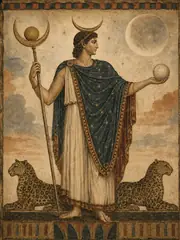
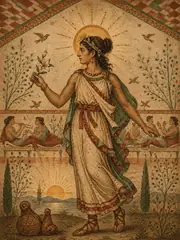
He was paired in some contexts with Tiur the moon-god (or moon-goddess; the gender of Tiur is uncertain), and in others with Catha, who may have been his sister or his daughter or another aspect of the solar cult. The relationship between Usil and Catha is one of the obscure points of Etruscan theology, and probably reflects either a cultic doubling (different cities or rites favoring one or the other), or a developmental layering (Catha being the older indigenous solar deity, Usil the Hellenized later overlay), or both.
After the Romanization of Etruria, Usil was absorbed into the Roman Sol; his distinct cult disappeared by the late Republic, though his iconography survived in funerary art, where the dawn-figure rising from the sea continued to appear in tomb paintings into the imperial period.