A Compendium of the Ancient Gods
Catha, plate

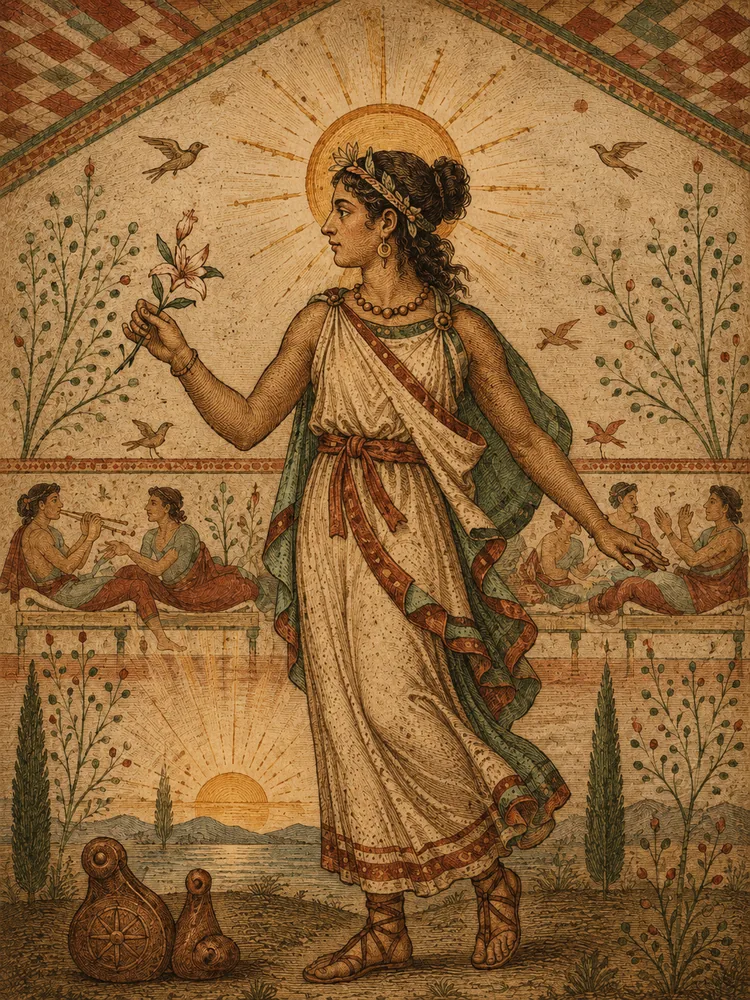
Catha was an Etruscan solar deity, distinct from Usil (the masculine sun) and somewhat enigmatic in her exact character. The inscriptions and the iconography give her a youthful aspect — sometimes she is called a daughter of the sun, sometimes she is the sun-child herself — and her domain was particularly the dawn-light, the moment when the sun's rays first appear over the horizon, distinguished from the full solar daylight that was Usil's domain. She had her own temple at Pyrgi (alongside the temple of Uni-Astarte), and dedicatory inscriptions to her have been found at Pyrgi, at Tarquinia, and elsewhere.

Her connection to the sun is firm but the precise nature of the connection is debated. Some scholars (notably Vincent Jolivet and Erika Simon) have argued that Catha is the indigenous Etruscan solar deity, with Usil being a later Hellenizing overlay imported from the Greek Helios. Others have argued that Catha and Usil are two aspects of a single solar cult — masculine and feminine, or full sun and dawn-light. Still others have proposed that Catha is essentially a chthonic solar deity, the sun in its underworld journey, distinct from the sky-traversing Usil; Catha-altars are sometimes found in connection with funerary contexts, supporting this reading.

The Pyrgi sanctuary, where Catha had a major temple alongside that of Uni-Astarte, is one of the most important Etruscan religious sites. The two temples (designated by archaeologists Temple A and Temple B) date from around 500 BCE and were among the great sanctuaries of southern Etruria. The sanctuary was destroyed by Roman armies under Dionysius I of Syracuse in 384 BCE, and its rich treasures (recorded by ancient sources as having included a great bronze statue of Eileithyia) were carried off; the foundations remain, however, and have been excavated systematically since the 1950s.

Catha's afterlife was minimal. She had no clear Roman counterpart and was absorbed indistinguishably into the broader solar cult of the imperial period; her name disappeared from inscriptions after the Romanization of Etruria. Yet her presence in the Etruscan religion, as a distinct and important deity in her own right, illustrates the complexity of the indigenous Italian religious world that the Roman imperial uniformity overwrote.

Curator’s note

What the sources say, and what later tradition added. The sources for this bay

Catha is named on the Piacenza Liver, in inscriptions from Pyrgi (where her temple is well-attested), and on a number of votive objects. Her relation to Usil is discussed in de Grummond, Etruscan Myth (2006); Vincent Jolivet's 'Le sanctuaire suburbain de Pyrgi' (1997) and Marina Cipriani's various publications on the Pyrgi excavations are key sources. The destruction of Pyrgi by Dionysius I is described by Diodorus Siculus (15.14) and Strabo (5.2.8). The iconography is partly reconstructed from terracotta antefixes from the sanctuary, depicting youthful solar figures. Erika Simon's chapter in Götter der Etrusker (1986) treats the question of Catha's nature carefully.

Kin in the sources

Each tie is quoted from the entry that states it.

When the sources speak

Dated witnesses for The Powers of the Sun, Moon and Earth. A date marks when the evidence was written down, not when the belief began. The whole timeline

c. 900–750 BCE
Villanovan communities establish the Iron Age background from which historically Etruscan cities emerge.
c. 750–600 BCE
Orientalizing exchange and urban growth transform elite ritual, iconography, writing, and sanctuary display.
c. 600–475 BCE
Etruscan city-states reach their widest political and artistic influence; temples and mythic imagery proliferate.
c. 474 BCE
The defeat at Cumae marks changing Etruscan power in Campania and the Tyrrhenian world.
5th–4th centuries BCE
Tomb painting, mirrors, votive deposits, and regional cults provide dense evidence for divine and funerary imagery.
396–264 BCE
Roman conquest progressively incorporates Etruscan cities while Etruscan priestly expertise remains prestigious.
2nd–1st centuries BCE
Late inscriptions and Roman antiquarian interest document cultural integration and the persistence of divinatory traditions.
1st century BCE–1st century CE
Cicero, Varro, Livy, Seneca, and others preserve testimony about haruspicy, lightning, and prodigies.

Floor plan

The rooms follow one another in the order their peoples first appear in the written record.

  1. The Cradle of Citiesc. 3400 BCE to 395 CE. 115 works
  2. The Gift of the Nilec. 4000 BCE to 395 CE. 73 works
  3. The Olympian Orderc. 1600 BCE to 750 CE. 152 works
  4. The Persian Worldc. 2000 BCE to 1010 CE. 30 works
  5. The Levantine Borderlandsc. 1200 BCE to 500 CE. 20 works
  6. The Edges of Empirec. 2000 BCE to 1500 CE. 33 works
  7. The Etruscan Worldc. 900 BCE to 750 CE. 22 works
  8. The Roman Inheritancec. 1200 BCE to 500 CE. 58 works
  9. The Northern Inheritancec. 2000 BCE to 1600 CE. 131 works