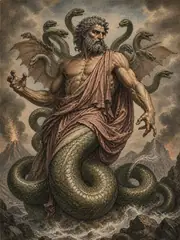
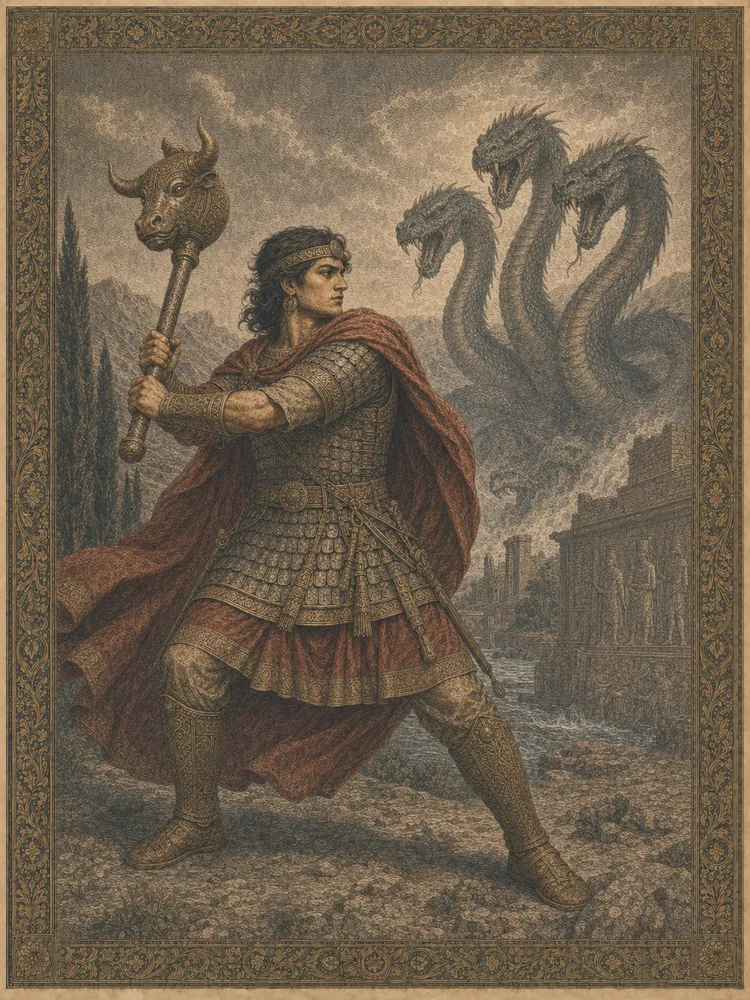
Thraetaona, son of Athwya, was the great dragon-slaying hero of the Iranian tradition. After the fall of Yima, the world had passed into the dominion of Aži Dahāka, the three-headed dragon, who reigned as a tyrant for a thousand years and devoured many of the men and women of Iran. Thraetaona, the appointed deliverer, prepared himself for the conquest by long worship of Anahita, of Verethragna, of all the yazatas of war and victory. Bearing a great mace and an arrow that could pierce the dragon's hide, he came at last upon Aži Dahāka and joined battle.
The fight was long and difficult. Thraetaona could not kill the dragon outright — for if Aži Dahāka had been killed, the foul creatures within his body (snakes, scorpions, lizards, frogs) would have been released to pollute the world. Instead, Thraetaona bound the dragon with chains, and imprisoned him beneath Mount Damavand, the great volcano of northern Iran, where Aži Dahāka has remained chained ever since. There he waits, gnawing at his chain, growing slowly weaker; and at the end of the world, when the chain at last breaks, he will burst forth one final time and ravage the earth, until Keresaspa the hero (or, in some versions, the Saoshyant) comes to slay him at the eschatological battle.
Thraetaona was also the great healer of Iranian tradition, the magician of healing-spells. Yasht 13 lists him among the chief practitioners of healing magic; he could expel the demons of disease, drive out the parasites that consumed the body, and restore the dead to life. The medical literature of the early Iranian world (the Pahlavi Madigan i Hazar Dadestan and the medical sections of the Bundahishn) attribute many remedies and procedures to him.
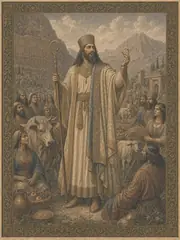
In the Shahnameh of Ferdowsi, Thraetaona becomes Faridun, the third king of the Pishdadian dynasty, the deliverer who overthrew the tyrant Zahhāk (= Aži Dahāka in Persianized form). Ferdowsi's account preserves the original mythological core but elaborates it as a heroic narrative in three parts: Faridun's hidden upbringing (he was raised by a magical cow named Birmaya in the mountains), his coming-of-age and gathering of an army, and his great victory over Zahhāk and the binding of him beneath Damavand. Faridun then ruled the world for five hundred years, dividing it before his death among his three sons — Salm, Tur, and Iraj — whose names became the eponyms of the three peoples (the Romans, the Turanians, and the Iranians) and whose murders of one another set in motion the great national-historical narrative of the Shahnameh. So Thraetaona, the dragon-slayer, became also the patriarch of the divided world.