A Compendium of the Ancient Gods
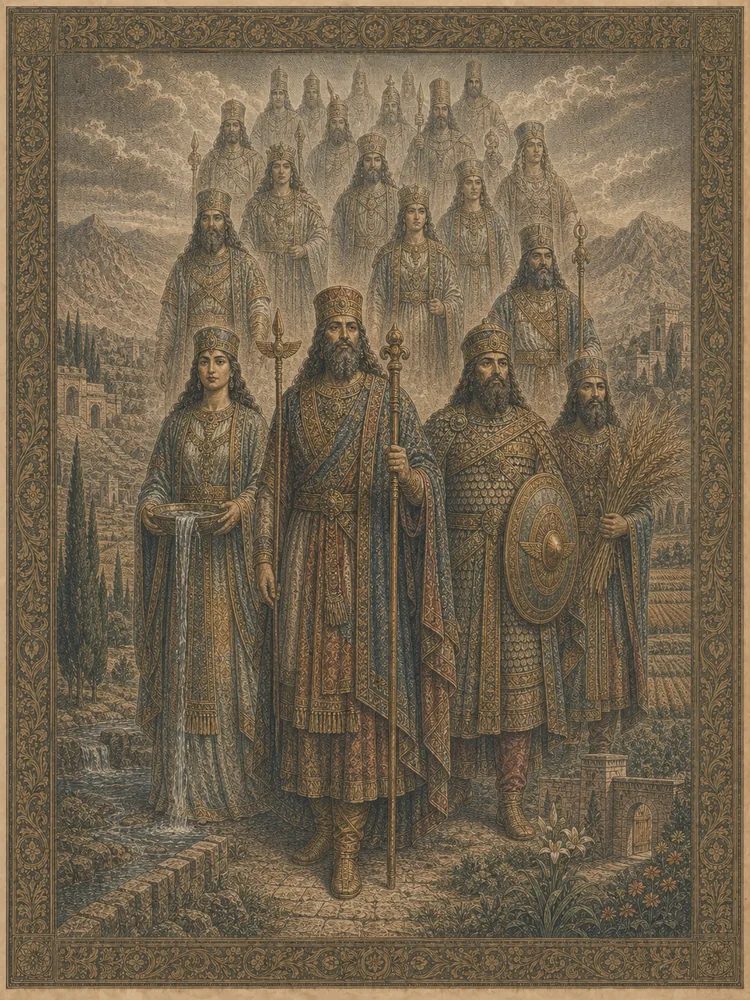
The Fravashis, plate

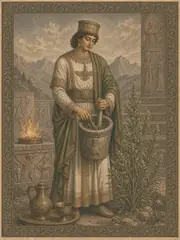
The Fravashis were among the most distinctive divine beings of the Iranian religion: pre-existent souls, guardian spirits, the ancestral beings who had existed before the creation of the material world, who descended into bodies at birth, and who returned to their original state after death. Every righteous person had his fravashi — his pre-existent and post-mortem soul — and the fravashis of all the righteous together formed a great heavenly host, an army of guardian spirits who fought beside Ahura Mazda in the cosmic war.

The Fravardin Yasht (Yasht 13) is the great catalog of the fravashis; over one hundred and fifty are named in it, including the fravashis of Zarathushtra and his early disciples, of the great heroes of Iranian history, of the kings of the Kayanian dynasty, and of the various foreign peoples who had embraced the Mazdean religion. The list is one of the most historically valuable passages in the Avesta, preserving names of figures who would otherwise be lost; many of the names listed are otherwise unattested in the surviving texts.

The fravashis were honored particularly during the last ten days of the Iranian year, the festival of Hamaspathmaedaya (modern Persian Farvardīgān), when they returned to their old homes to visit their living descendants. Households were cleaned, the family fire was rekindled, food was set out for the visiting fravashis, and prayers were offered for their continued protection. The festival was the Iranian equivalent of the various Mediterranean festivals of the dead (the Roman Parentalia, the Greek Genesia, the Hebrew rabbinic mourning practices), and it survived in folk practice into modern times.

The fravashis had a special role in the cosmic war. Before the creation of the material world, when Ahura Mazda was deciding whether to confront Angra Mainyu directly or to invite the unborn human souls to fight on his side, the fravashis themselves had voluntarily descended into bodies to take their part in the battle. They had not had to come; they had chosen to. So every human life was, in the Iranian conception, a voluntary enlistment in the cosmic war, undertaken before birth, lived out in the body, and consummated after death when the fravashi returned to its heavenly state.
Curator’s note

What the sources say, and what later tradition added. The sources for this bay

The Fravashis are the central concern of Yasht 13, the Fravardin Yasht — one of the longest and most comprehensive Yashts. The doctrine is also developed in the Pahlavi Bundahishn (chapter 3 on creation, chapter 26 on the divine beings) and in the Selections of Zadspram. The festival of Hamaspathmaedaya / Farvardīgān is documented in the Avestan calendar texts and in modern Parsi practice. Mary Boyce's articles "Fravashi" in the Encyclopaedia Iranica are standard. The doctrine of pre-existent souls who voluntarily incarnate has parallels in Platonic philosophy (the Phaedrus and Phaedo) and in Origen's controversial doctrine of pre-existent souls in Christian theology; the Iranian original may have influenced both indirectly through Hellenistic Jewish thought.

Kin in the sources

Each tie is quoted from the entry that states it.

When the sources speak

Dated witnesses for The Yazatas. A date marks when the evidence was written down, not when the belief began. The whole timeline

late 2nd–early 1st millennium BCE, debated
The Old Avestan Gathas and Yasna Haptanghaiti emerge in an eastern Iranian ritual-poetic setting; Zarathustra’s date remains disputed.
1st millennium BCE
Younger Avestan hymns, ritual texts, and legal-purity materials develop over a long period of oral transmission.
c. 550–330 BCE
Achaemenid inscriptions invoke Ahuramazda in imperial royal ideology; their relationship to later Zoroastrian orthodoxy requires care.
330 BCE–224 CE
Hellenistic and Parthian eras preserve Iranian cults through sparse and regionally varied evidence.
224–651 CE
Sasanian institutions sponsor priestly learning and the redactional organization associated with the Avesta and Zand.
7th–10th centuries CE
After the Islamic conquest, Middle Persian books record cosmology, law, exegesis, and summaries of lost material.
c. 9th century CE
The Bundahišn, Dēnkard, Wizīdagīhā ī Zādspram, and related works preserve systematic late antique and early Islamic syntheses.
c. 977–1010 CE
Ferdowsi composes the Shāhnāmeh from epic and royal traditions with both pre-Islamic and Islamic-period mediation.

Floor plan

The rooms follow one another in the order their peoples first appear in the written record.

  1. The Cradle of Citiesc. 3400 BCE to 395 CE. 115 works
  2. The Gift of the Nilec. 4000 BCE to 395 CE. 73 works
  3. The Olympian Orderc. 1600 BCE to 750 CE. 152 works
  4. The Persian Worldc. 2000 BCE to 1010 CE. 30 works
  5. The Levantine Borderlandsc. 1200 BCE to 500 CE. 20 works
  6. The Edges of Empirec. 2000 BCE to 1500 CE. 33 works
  7. The Etruscan Worldc. 900 BCE to 750 CE. 22 works
  8. The Roman Inheritancec. 1200 BCE to 500 CE. 58 works
  9. The Northern Inheritancec. 2000 BCE to 1600 CE. 131 works