A Compendium of the Ancient Gods
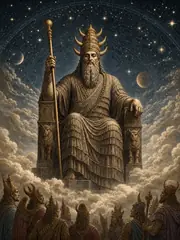
Kviria, plate

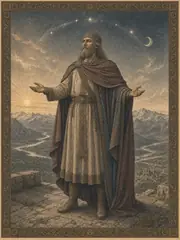
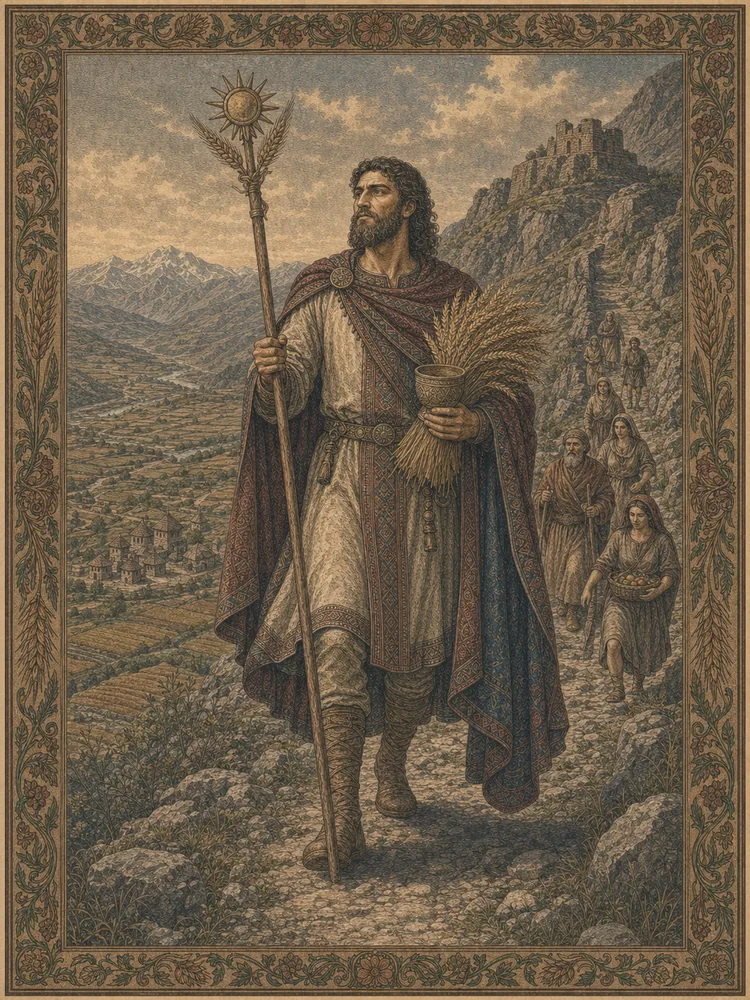
Kviria (sometimes Kviriae or Kviriake) was the mediator-god of the pre-Christian Georgian pantheon, the intermediary between the remote supreme deity Ghmerti and humankind. He was the divine functionary who carried prayers up to Ghmerti and who brought back Ghmerti's responses; he was the patron of harvest, of fertility, of the pilgrimage that brought worshippers to the sacred sites; he was the divine companion of the human community in its daily religious life. Where Ghmerti was the distant creator, Kviria was the engaged sustainer.

His name has a peculiar etymology. Kviria appears to be from a Greek-Christian source — kyrios, 'lord' — borrowed into Georgian during the early Christian period and then reabsorbed into the pre-Christian religious vocabulary as the name of an intermediary deity. The borrowing is a remarkable instance of religious-cultural give-and-take: the Christian missionaries used kyrios to translate the Hebrew Adonai and the Greek Christ, the term entered Georgian as Kviria, and the older Georgian religious imagination adopted Kviria as the name of its mediator-figure, who already existed as a religious need but had not had a stable name. So a Christian word became a pre-Christian deity's name in retroactive Georgian folk-religion.

Kviria's chief festival was the Kviria-oba, kept at midsummer and at harvest-time, with pilgrimages to particular hilltop sanctuaries (the chief at Kvirikoba in eastern Georgia). The rites involved ritual feasting, the drinking of wine in honor of the deity, processions to the sacred stones, and the offering of bread and dairy products. The festival has continued under Christian forms, with the Christian Saint Cyriacus (Kvirike in Georgian) absorbing the pre-Christian Kviria-cult almost entirely; the modern Georgian rural festivals of Saint Kvirike preserve elements of the older Kviria-veneration.

The structural relationship between Ghmerti and Kviria — supreme creator and active mediator — has parallels with various Mediterranean and Near Eastern theologies: the relationship of the Mesopotamian Anu and his various descendants, of the Greek Zeus and his messengers, of the Iranian Ahura Mazda and the Amesha Spentas. The Georgian articulation is distinctive in its Christian-loanword nomenclature for the mediator, but the underlying theological pattern (a remote high god with an active intermediary) is widespread.
Curator’s note

What the sources say, and what later tradition added. The sources for this bay

Kviria is documented in the medieval Georgian sources and in the modern ethnographic record. The standard treatment is in the various works of Tinatin Ochiauri and in the contributions to the Encyclopedia of Religion. The kyrios > Kviria etymology and the structural-comparative point are treated in Tamila Mgaloblishvili and Iulon Gagoshidze's various publications. The continuity into Saint Kvirike's cult is documented in the various ethnographic studies of Georgian rural religion.

Kin in the sources

Each tie is quoted from the entry that states it.

When the sources speak

Dated witnesses for The Caucasian Georgian Pantheon. A date marks when the evidence was written down, not when the belief began. The whole timeline

2nd–1st millennia BCE
Bronze and Iron Age regional cultures establish the archaeological backgrounds later labeled Thracian, Illyrian, Iberian, Caucasian, and Libyan.
8th–6th centuries BCE
Greek and Phoenician colonization creates new inscriptional, artistic, and commercial contact zones.
6th–4th centuries BCE
Classical authors begin describing frontier peoples and translating local gods into Greek categories.
3rd–1st centuries BCE
Hellenistic kingdoms, Carthage, and Rome intensify political and cultic exchange.
1st century BCE–3rd century CE
Roman provincial rule produces dedications, coins, reliefs, and interpretive equations across the Balkans, Iberia, Caucasus, and North Africa.
4th–7th centuries CE
Christianization and imperial change end or transform many public cult institutions while names persist in texts and places.
medieval period
Georgian chronicles and epic traditions, Iberian memory, and North African historical sources reshape pre-Christian inheritances.
1st millennium BCE–early CE
Kingdoms and regional cults develop amid Iranian, Anatolian, Greek, and local influences.

Floor plan

The rooms follow one another in the order their peoples first appear in the written record.

  1. The Cradle of Citiesc. 3400 BCE to 395 CE. 115 works
  2. The Gift of the Nilec. 4000 BCE to 395 CE. 73 works
  3. The Olympian Orderc. 1600 BCE to 750 CE. 152 works
  4. The Persian Worldc. 2000 BCE to 1010 CE. 30 works
  5. The Levantine Borderlandsc. 1200 BCE to 500 CE. 20 works
  6. The Edges of Empirec. 2000 BCE to 1500 CE. 33 works
  7. The Etruscan Worldc. 900 BCE to 750 CE. 22 works
  8. The Roman Inheritancec. 1200 BCE to 500 CE. 58 works
  9. The Northern Inheritancec. 2000 BCE to 1600 CE. 131 works