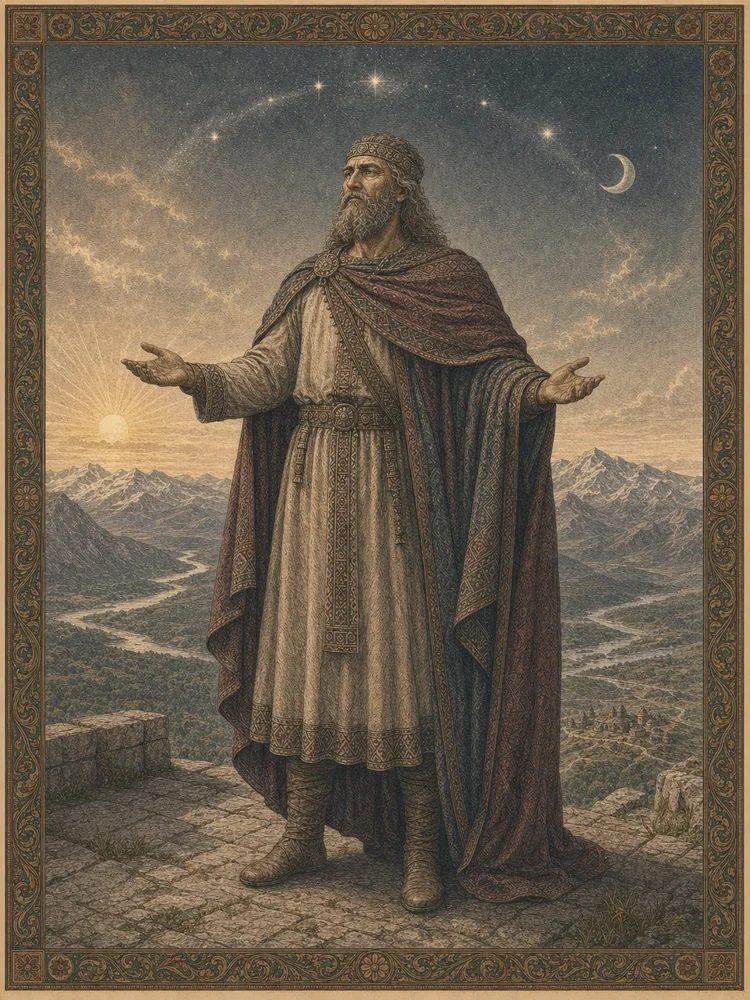
Ghmerti was the supreme being of the pre-Christian Georgian religion — the creator of the world, the lord of the heavens, the source of all good. His name (გმერთი in Georgian script, ghmerti in romanization) is from a Kartvelian root meaning approximately 'sky' or 'highest,' and the figure was the typical Indo-European-style sky-father transposed into the non-Indo-European Kartvelian linguistic and religious context — a remarkable case of religious-conceptual transmission across language families.
He sat enthroned upon the highest heaven, surrounded by his court of lesser deities and his angelic messengers; he had created the world, ordered it, established its laws, and presided over its continuance. The relations between Ghmerti and the lesser figures of the pantheon were variously articulated in different regional traditions: in some, Ghmerti was a remote deus otiosus who had withdrawn after creating the world and left the daily management to his subordinate Kviria (treated next); in others, he was actively involved, hearing prayers, dispatching judgments, and intervening in human affairs through his messengers.
His name's adoption as the Georgian Christian word for God was direct and uncontroversial. When the Christian missionaries (chiefly Saint Nino, the apostle to the Georgians, in the early fourth century) translated the Bible and the liturgical texts into Georgian, they used Ghmerti as the standard term for the Christian God — the same word, with the same theological core (supreme creator, lord of heaven, judge of all), simply with the Christian theological apparatus replacing the pre-Christian. The practice was made easier by the structure of Ghmerti's pre-Christian theology, which was monotheistic in tendency (or at least supremacist) rather than strongly polytheistic; the Christian theological revolution was less sharp than in cultures with more developed pantheons.
Elements of the pre-Christian Ghmerti-cult survived in Georgian folk religion well into the modern period, particularly in the highland regions where Christianity had been imperfectly imposed. The Ghmerti of the highland folk-prayers is the same word as the Christian God, but with rituals and invocations that go back to the pre-Christian tradition: prayers to the high mountains, libations of wine on sacred stones, festivals tied to the agricultural year and to the wandering of the flocks. The continuity is one of the clearest cases of pre-Christian religious vocabulary being absorbed wholesale into the Christian dispensation, with the deeper structures of belief and practice continuing alongside the surface conformity to the new religion.