A Compendium of the Ancient Gods
Medauros, plate

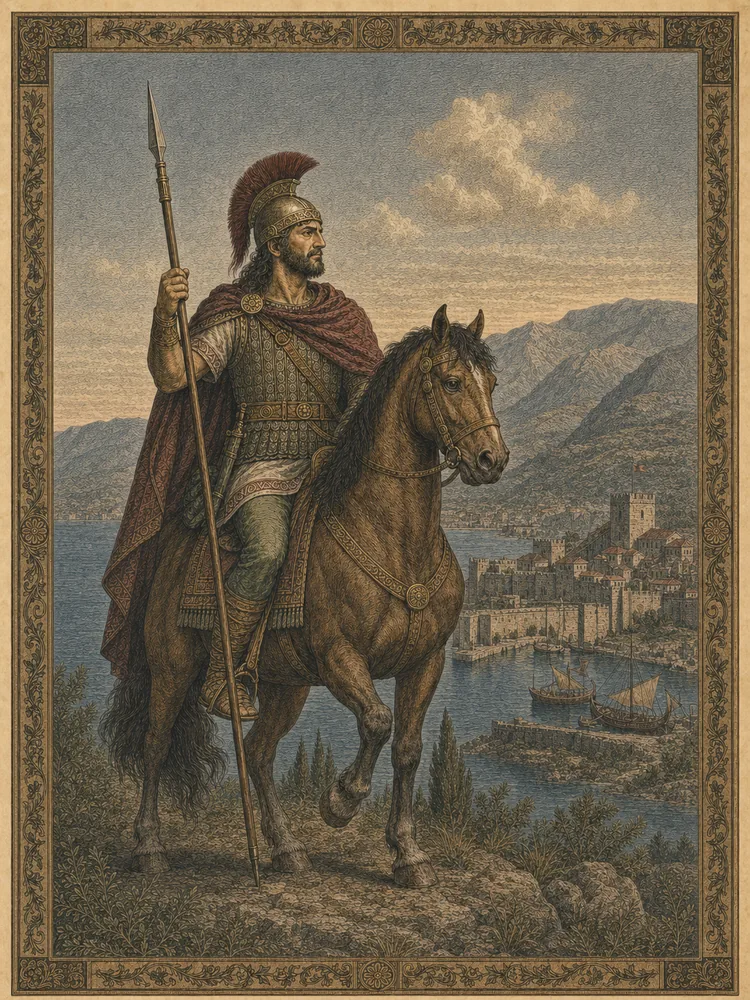
Medauros was the warrior-god of the Illyrian city of Risinium (modern Risan in Montenegro), at the head of the Bay of Kotor on the Adriatic coast. He was depicted in the surviving inscriptions as a horseman bearing a spear, the patron of the city's warriors, and the divine protector of the local political community. The Roman identifications of him with Mars are recorded in some inscriptions, but the indigenous name was preserved — and indeed proudly preserved, with dedications by Risinium's citizens deliberately maintaining the local form against the Roman alternative.

The most remarkable text concerning Medauros is the inscription set up at Lambaesis in North Africa by Quintus Plautius Sabinus, a senator and military commander born at Risinium, in the early third century of our era. The inscription, in elegiac couplets, addresses Medauros directly: 'Domi divus es, hic sumus tui, the patria's god you are, here we are your own,' and the donor commits his fortunes to the god of his birthplace despite his own service in distant Africa. The text is one of the most personal of all the Roman provincial inscriptions, and shows how local Illyrian deity-cult could remain the deepest religious commitment of a Roman senator a century after the political absorption of Illyria.

Medauros's iconography on Risinium coinage and in surviving reliefs preserves the warrior-horseman pattern that was widespread in the region. The figure has parallels with the Thracian Heros (treated in the previous book), with the broader pattern of Indo-European warrior-deities, and with the various local Genius-figures of the Roman provinces. What was distinctive about Medauros was his close identification with a specific city — he was Risinium's god, particular to that place, and his cult was a primary expression of the city's political and cultural identity.

The cult declined with the Christianization of the region in the fourth and fifth centuries; the city of Risinium became a Christian bishopric, and Medauros's sanctuary was probably converted to a Christian church, with the warrior-protection function transferred to one of the warrior-saints (Saint George or Saint Demetrius). The figure is preserved chiefly through the inscriptions and through the coinage; no narrative myth of Medauros survives.

Curator’s note

What the sources say, and what later tradition added. The sources for this bay

Medauros is documented in inscriptions from Risinium and from the Lambaesis inscription of Quintus Plautius Sabinus (CIL VIII 2581, 18086, with the elegiac dedication). The standard treatment is in Stipcevic's The Illyrians and in Géza Alföldy's Bevölkerung und Gesellschaft der römischen Provinz Dalmatien (1965). The Lambaesis inscription is widely discussed in the scholarship on Roman provincial religion and on the persistence of local cults; Géza Alföldy's article 'Die Personennamen in der römischen Provinz Dalmatia' (1969) treats the personal-cult dimension.

When the sources speak

Dated witnesses for The Illyrian Pantheon. A date marks when the evidence was written down, not when the belief began. The whole timeline

2nd–1st millennia BCE
Bronze and Iron Age regional cultures establish the archaeological backgrounds later labeled Thracian, Illyrian, Iberian, Caucasian, and Libyan.
8th–6th centuries BCE
Greek and Phoenician colonization creates new inscriptional, artistic, and commercial contact zones.
6th–4th centuries BCE
Classical authors begin describing frontier peoples and translating local gods into Greek categories.
3rd–1st centuries BCE
Hellenistic kingdoms, Carthage, and Rome intensify political and cultic exchange.
1st century BCE–3rd century CE
Roman provincial rule produces dedications, coins, reliefs, and interpretive equations across the Balkans, Iberia, Caucasus, and North Africa.
4th–7th centuries CE
Christianization and imperial change end or transform many public cult institutions while names persist in texts and places.
medieval period
Georgian chronicles and epic traditions, Iberian memory, and North African historical sources reshape pre-Christian inheritances.
1st millennium BCE
Regional Iron Age communities form the archaeological setting later called Illyrian.

Floor plan

The rooms follow one another in the order their peoples first appear in the written record.

  1. The Cradle of Citiesc. 3400 BCE to 395 CE. 115 works
  2. The Gift of the Nilec. 4000 BCE to 395 CE. 73 works
  3. The Olympian Orderc. 1600 BCE to 750 CE. 152 works
  4. The Persian Worldc. 2000 BCE to 1010 CE. 30 works
  5. The Levantine Borderlandsc. 1200 BCE to 500 CE. 20 works
  6. The Edges of Empirec. 2000 BCE to 1500 CE. 33 works
  7. The Etruscan Worldc. 900 BCE to 750 CE. 22 works
  8. The Roman Inheritancec. 1200 BCE to 500 CE. 58 works
  9. The Northern Inheritancec. 2000 BCE to 1600 CE. 131 works