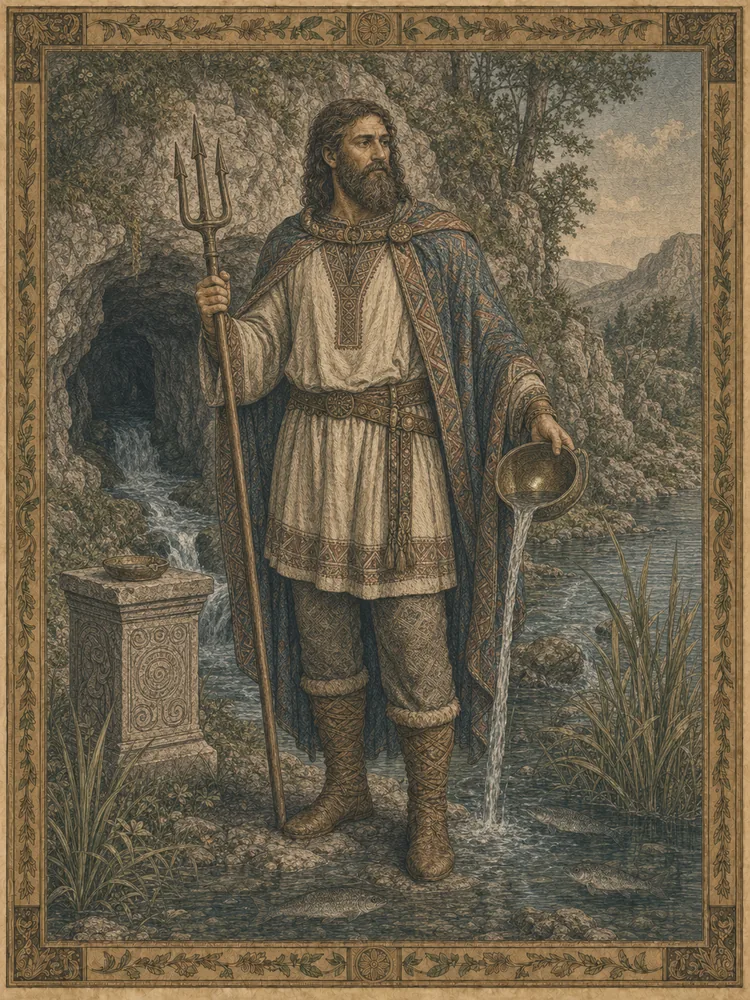

A Compendium of the Ancient Gods
Bindus, plate

Bindus was the chief water-god of the Iapodes, an Illyrian tribe of the upper Una valley in modern Bosnia and Herzegovina. His sanctuary stood at the great spring at Privlika, where the Una river rose from underground; the cult-site has been excavated in the modern period, and a substantial corpus of dedicatory inscriptions to Bindus from the second and third centuries of our era has been recovered. The Romans identified him with Neptune (Latin inscriptions read 'Bindo Neptuno'), and his function corresponded broadly to that of a Mediterranean water-god — patron of the spring, of the river, of the fishing and the navigation that depended on the waters.

His cult was modest in scale but locally significant. The great spring of the Una was the chief water-source of the region, and the Iapodes had developed Bindus's worship around it from at least the late Iron Age. The Roman annexation of the area in the first century before our era brought the cult into the imperial system, with the Latin inscriptions dating from the Roman provincial period; the form of the deity's name was preserved (the dedications use the Illyrian name Bindus alongside the Latin Neptune), suggesting that the cult retained its indigenous character even under Roman administration.

The figure is one of many local water-deities in the Illyrian-Pannonian region. Each of the major springs and rivers had its tutelary spirit, and the corpus of Roman provincial inscriptions preserves names of dozens of such deities (Aequorna, Adsalluta, Savus, and others). Bindus is among the better-attested because of the concentration of inscriptions at his sanctuary; most of the other regional water-deities are known from only one or two surviving names. The pattern is typical of the Indo-European water-religion of the western Balkans — a network of local divinities, each tied to a specific water-source, with broader regional cults emerging only sporadically.

After the Christianization of the region, Bindus's cult disappeared from the public record, but the spring at Privlika remained a sacred site through the medieval and early modern periods (with various Christian shrines and pilgrimage practices replacing the older cult). The continuity of holy waters across religious transitions is one of the deepest patterns of European folk religion, and the Una springs preserve in their Christian form some echoes of the older Bindus-veneration.

Curator’s note

What the sources say, and what later tradition added. The sources for this bay

Bindus is documented in the corpus of inscriptions from Privlika (now in the museum at Bihac); the standard reference is the Inscriptiones Daciae et Pannoniae (CIL III, the relevant volumes). The Privlika sanctuary is described in Aleksandar Stipcevic's Iliri (1974, English ed. The Illyrians, 1977), the standard general treatment of Illyrian archaeology and culture. The wider context of Illyrian-Pannonian water-religion is treated in Géza Alföldy's various works.

When the sources speak

Dated witnesses for The Illyrian Pantheon. A date marks when the evidence was written down, not when the belief began. The whole timeline

2nd–1st millennia BCE
Bronze and Iron Age regional cultures establish the archaeological backgrounds later labeled Thracian, Illyrian, Iberian, Caucasian, and Libyan.
8th–6th centuries BCE
Greek and Phoenician colonization creates new inscriptional, artistic, and commercial contact zones.
6th–4th centuries BCE
Classical authors begin describing frontier peoples and translating local gods into Greek categories.
3rd–1st centuries BCE
Hellenistic kingdoms, Carthage, and Rome intensify political and cultic exchange.
1st century BCE–3rd century CE
Roman provincial rule produces dedications, coins, reliefs, and interpretive equations across the Balkans, Iberia, Caucasus, and North Africa.
4th–7th centuries CE
Christianization and imperial change end or transform many public cult institutions while names persist in texts and places.
medieval period
Georgian chronicles and epic traditions, Iberian memory, and North African historical sources reshape pre-Christian inheritances.
1st millennium BCE
Regional Iron Age communities form the archaeological setting later called Illyrian.

Floor plan

The rooms follow one another in the order their peoples first appear in the written record.

  1. The Cradle of Citiesc. 3400 BCE to 395 CE. 115 works
  2. The Gift of the Nilec. 4000 BCE to 395 CE. 73 works
  3. The Olympian Orderc. 1600 BCE to 750 CE. 152 works
  4. The Persian Worldc. 2000 BCE to 1010 CE. 30 works
  5. The Levantine Borderlandsc. 1200 BCE to 500 CE. 20 works
  6. The Edges of Empirec. 2000 BCE to 1500 CE. 33 works
  7. The Etruscan Worldc. 900 BCE to 750 CE. 22 works
  8. The Roman Inheritancec. 1200 BCE to 500 CE. 58 works
  9. The Northern Inheritancec. 2000 BCE to 1600 CE. 131 works