A Compendium of the Ancient Gods
Medb, plate

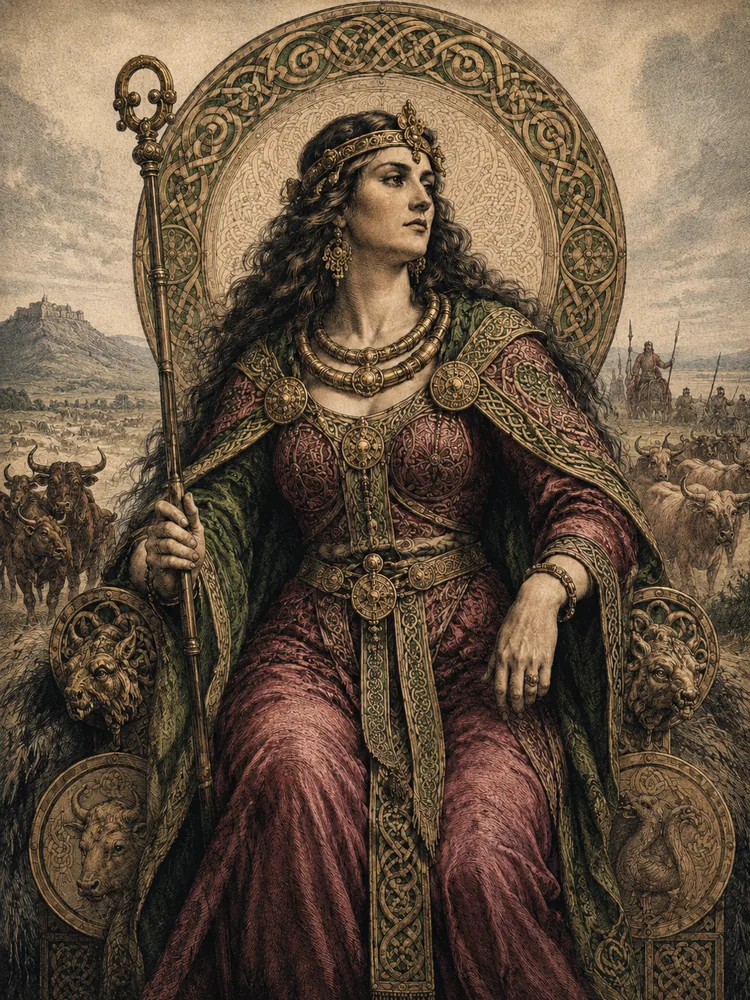
Medb was queen of Connacht in the heroic age of Ireland, and the central figure of the great Ulster Cycle saga the Táin Bó Cúailnge — "The Cattle Raid of Cooley." She was a queen in her own right, not merely a king's wife, and she ruled Connacht alongside (and over) her husband Ailill, a man of less impressive lineage who had married into her queenship.

The pillow-talk that opened the Táin became famous: Medb and Ailill argued one night over which of them was wealthier, and counted up their possessions side by side. Their wealth was equal in every category save one: Ailill possessed a magnificent white-horned bull, the Finnbennach, which had refused to be ruled by a woman and had transferred itself from Medb's herd to her husband's. Medb, refusing to be outdone, sent her messengers to seek throughout Ireland for a bull as great. They learned of one — the Donn Cuailnge, the Brown Bull of Cooley, in Ulster — and Medb sent to negotiate for its loan. When the negotiations broke down through the boasting of her envoys, Medb gathered the host of all Ireland and marched against Ulster to take the bull by force.

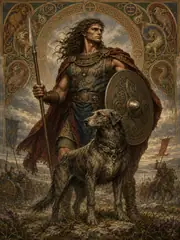
Against her stood the warriors of Ulster — but they had been laid under the curse of Macha, by which the men of Ulster suffered the pangs of childbirth at moments of greatest need; only the boy-warrior Cú Chulainn, exempt from the curse, could oppose Medb's army. Cú Chulainn's single-handed defense of the Ulster border by means of single combat, while the rest of Ulster lay groaning, is the great central episode of the Táin. The bull was at last taken into Connacht, but the white-horned and the brown bulls of the two queens fought one another to death; nothing of the war remained, and the cause of all the slaughter was reduced to bones.

Medb in the Táin is memorable for her fierceness, her shamelessness, and her authority. She offered her body and her daughter Findabair as bribes to warriors who would face Cú Chulainn; she menstruated three times during the campaign in such floods that whole armies had to halt; she took lover after lover; she ruled by force of personality alone. She is one of the most vividly drawn figures in any medieval European text, and was probably in some sense a goddess — a sovereignty-goddess of Ireland, by union with whom a king became legitimate — euhemerized into a queen by the saga writers.
Curator’s note

What the sources say, and what later tradition added. The sources for this bay

Medb is the central figure of the Táin Bó Cúailnge, the great prose epic of the Ulster Cycle, surviving in two main recensions (the Lebor na hUidre version of c. 1100 and the Book of Leinster version of c. 1150) that diverge significantly. Cecile O'Rahilly's editions and translations (1967, 1976) are standard. The argument that Medb is a sovereignty-goddess euhemerized was developed by Tomás Ó Cathasaigh and others; the etymology of her name (medb "the intoxicating one," cognate with mead) suggests an earlier divine figure of the marriage-feast of kingship. Modern reception has been considerable; Joyce's Ulysses references her, Yeats wrote a poem on the Táin, and Thomas Kinsella's 1969 translation has been widely read.

Kin in the sources

Each tie is quoted from the entry that states it.

When the sources speak

Dated witnesses for The Celtic Mythologies. A date marks when the evidence was written down, not when the belief began. The whole timeline

2nd–1st millennia BCE
Indo-European language dispersals and regional Bronze Age cultures provide a remote comparative background, not a recoverable common canon.
c. 500 BCE–1 CE
Iron Age material culture, names, sanctuaries, and classical ethnography offer early but external evidence for Celtic and Germanic religions.
1st–4th centuries CE
Roman inscriptions and provincial cults preserve many Celtic, Germanic, and local divine names.
4th–8th centuries CE
Migration-period and early medieval conversion transform ritual institutions while heroic traditions continue.
8th–11th centuries CE
Viking Age poetry, runic evidence, archaeology, and Scandinavian conversion form the core context of Norse myth.
9th–12th centuries CE
Slavic, Baltic, and Finnic traditions enter chronicles and missionary accounts, often through hostile observers.
11th–14th centuries CE
Irish, Welsh, and Icelandic manuscripts preserve major narrative corpora in Christian literary environments.
12th–16th centuries CE
Saxo, saga compilers, Baltic chroniclers, and later antiquarians systematize or reinterpret older material.

Floor plan

The rooms follow one another in the order their peoples first appear in the written record.

  1. The Cradle of Citiesc. 3400 BCE to 395 CE. 115 works
  2. The Gift of the Nilec. 4000 BCE to 395 CE. 73 works
  3. The Olympian Orderc. 1600 BCE to 750 CE. 152 works
  4. The Persian Worldc. 2000 BCE to 1010 CE. 30 works
  5. The Levantine Borderlandsc. 1200 BCE to 500 CE. 20 works
  6. The Edges of Empirec. 2000 BCE to 1500 CE. 33 works
  7. The Etruscan Worldc. 900 BCE to 750 CE. 22 works
  8. The Roman Inheritancec. 1200 BCE to 500 CE. 58 works
  9. The Northern Inheritancec. 2000 BCE to 1600 CE. 131 works