A Compendium of the Ancient Gods
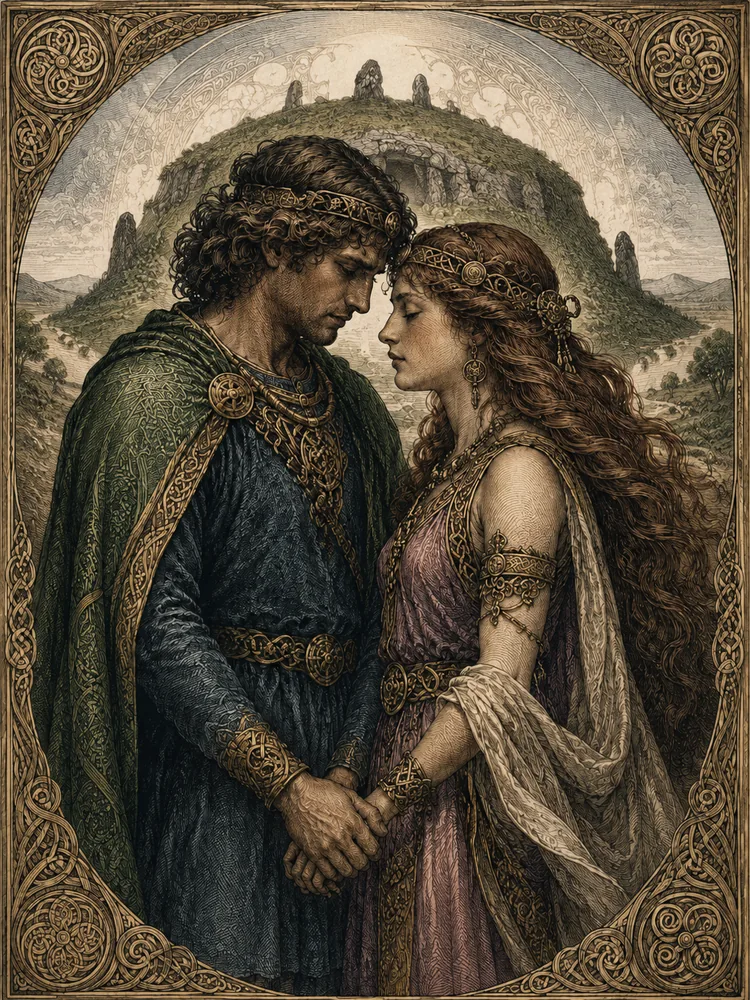
Midir and Étaín, plate

Midir was a king of the Tuatha Dé Danann, of the sídhe (the fairy mound) of Brí Léith, and Étaín was his second wife, of mortal birth and surpassing beauty. Midir's first wife Fúamnach grew jealous of Étaín, and one day struck her with a wand of rowan; Étaín was transformed into a pool of water, and from the pool into a worm, and from the worm into a beautiful purple fly. As a fly she still flew about Midir's hall, attending him as best she could in her changed shape — for the curse had transformed her body but not her love.

Fúamnach, learning that the fly was Étaín, raised a great storm and blew her out of Midir's hall and across all of Ireland for seven years. At last the fly fell exhausted into the cup of Étar, the wife of an Ulster nobleman; Étar drank her, and conceived; and a child was born to Étar that was Étaín reborn — but Étaín no longer remembered her divine life or her love for Midir.

Étaín grew up among mortals and married the High King of Ireland, Eochaid Airem. Midir, having spent a thousand years searching for her, came at last to Eochaid's court in disguise as a champion, played the king at chess, and won — for the wager — a kiss and an embrace from the queen. Eochaid, bound by the wager, agreed; Midir kissed Étaín, and at his kiss the memory of her divine life returned. Together they rose into the air through the smoke-hole of the hall, transformed into two swans, and flew away to the sídhe.

Eochaid did not give her up easily. He led his men to dig down into Midir's mound; for nine years they dug, and each night the mound was rebuilt by Midir's people; at last Midir surrendered Étaín, but with a ruse — he sent out fifty women of his court all in Étaín's likeness, and let the king choose. Eochaid, by skill or by ill chance, picked out a woman who was actually Étaín's daughter. Midir kept Étaín; Eochaid lived on with the daughter; and the marriage of mortal and immortal, even when twice undone, was ultimately preserved as Midir had wished.

Curator’s note

What the sources say, and what later tradition added. The sources for this bay

The story of Midir and Étaín is told in Tochmarc Étaíne ("The Wooing of Étaín"), one of the longer Old Irish prose tales, surviving in the Yellow Book of Lecan and elsewhere. The tale combines several distinct narrative episodes (the early life and transformations, the rebirth, the chess-game with Eochaid, the dig of the mound) which probably derive from separate sources. Étaín's sequence of transformations — water, worm, fly — and her rebirth from a swallowed insect parallel the Welsh Gwion-Taliesin story (and probably descend from a common Celtic substrate). The chess-game motif is widespread in early Irish saga (Diarmuid and Gráinne, Loegaire and the Cailleach Bhéarra) and may derive from a divine ordeal-game older than chess itself.

When the sources speak

Dated witnesses for The Celtic Mythologies. A date marks when the evidence was written down, not when the belief began. The whole timeline

2nd–1st millennia BCE
Indo-European language dispersals and regional Bronze Age cultures provide a remote comparative background, not a recoverable common canon.
c. 500 BCE–1 CE
Iron Age material culture, names, sanctuaries, and classical ethnography offer early but external evidence for Celtic and Germanic religions.
1st–4th centuries CE
Roman inscriptions and provincial cults preserve many Celtic, Germanic, and local divine names.
4th–8th centuries CE
Migration-period and early medieval conversion transform ritual institutions while heroic traditions continue.
8th–11th centuries CE
Viking Age poetry, runic evidence, archaeology, and Scandinavian conversion form the core context of Norse myth.
9th–12th centuries CE
Slavic, Baltic, and Finnic traditions enter chronicles and missionary accounts, often through hostile observers.
11th–14th centuries CE
Irish, Welsh, and Icelandic manuscripts preserve major narrative corpora in Christian literary environments.
12th–16th centuries CE
Saxo, saga compilers, Baltic chroniclers, and later antiquarians systematize or reinterpret older material.

Floor plan

The rooms follow one another in the order their peoples first appear in the written record.

  1. The Cradle of Citiesc. 3400 BCE to 395 CE. 115 works
  2. The Gift of the Nilec. 4000 BCE to 395 CE. 73 works
  3. The Olympian Orderc. 1600 BCE to 750 CE. 152 works
  4. The Persian Worldc. 2000 BCE to 1010 CE. 30 works
  5. The Levantine Borderlandsc. 1200 BCE to 500 CE. 20 works
  6. The Edges of Empirec. 2000 BCE to 1500 CE. 33 works
  7. The Etruscan Worldc. 900 BCE to 750 CE. 22 works
  8. The Roman Inheritancec. 1200 BCE to 500 CE. 58 works
  9. The Northern Inheritancec. 2000 BCE to 1600 CE. 131 works