A Compendium of the Ancient Gods
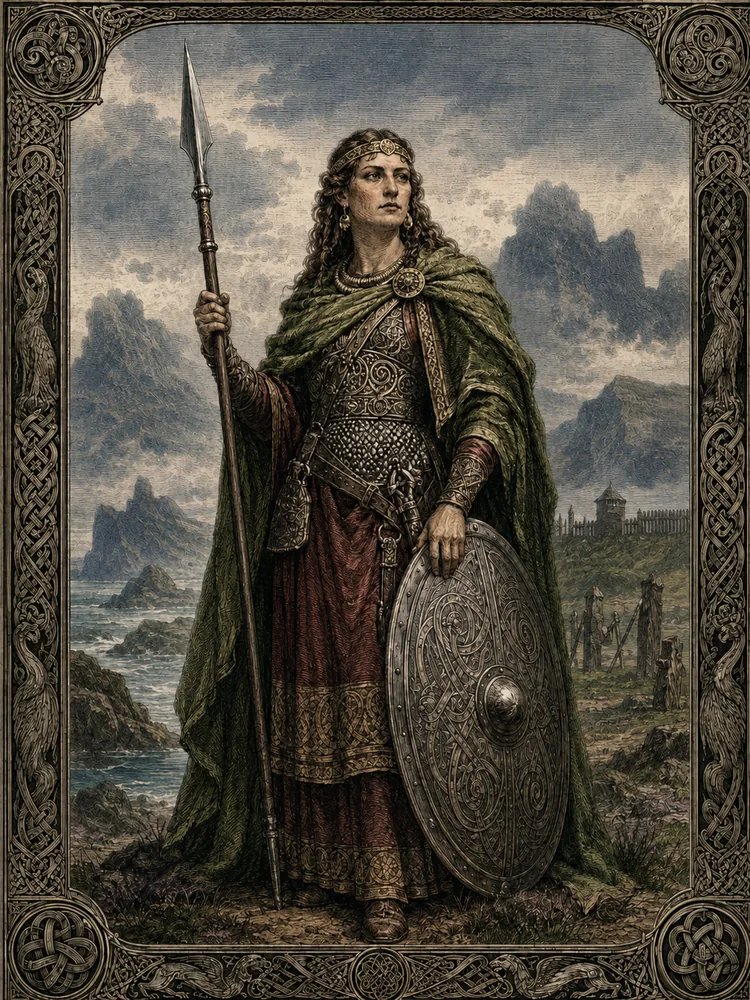
Scáthach, plate

Scáthach was a warrior-woman of the Land of Shadows — Dún Scaith, generally identified with the Isle of Skye in the Hebrides — who ran the greatest school of arms in the heroic age. To her came young warriors from Ireland and Britain to learn the most advanced arts of combat: the use of the spear in close quarters, the great battle-leap, the salmon-leap by which one might cross water without a boat, the cattle-feat by which one stood upon the head of a charging cow, the apple-feat, the thunder-feat, and above all the gae bolga — the spear of the belly — a weapon of unique terror that Scáthach alone taught.

When Cú Chulainn came to her court to study, he had to first cross the Bridge of the Cliff, which threw down anyone who walked it without proper preparation; Cú Chulainn made the salmon-leap and reached Scáthach by surprise. He pressed his sword to her breast and demanded the three things he had come for: instruction in arms, the hand of her daughter Uathach in marriage, and her own prophecy concerning his future. Scáthach yielded all three.

He stayed at her court a year and a day, learning every art she possessed; she also bound him by oath to fight beside her against her sister Aífe, an even greater warrior-woman with whom Scáthach was at war. In the duel of the two sisters' champions Cú Chulainn defeated Aífe (whom he could not have defeated by combat alone, but whom he tricked by calling out that her chariot-horses were dead — when she turned to look, he leaped and seized her). The duel was settled by Cú Chulainn lying with Aífe and obtaining from her three things: her son Connla (whom he must one day kill in a tragic encounter), peace between the sisters, and a year's freedom from Aífe's army's predation upon Scáthach's. So Cú Chulainn returned to Ireland, the most accomplished warrior of his age, taught by a woman.
Curator’s note

What the sources say, and what later tradition added. The sources for this bay

Scáthach is a major figure of the Ulster Cycle, particularly of the Tochmarc Emire ("The Wooing of Emer"), in which Cú Chulainn's training under her is recounted at length. The text is preserved in several Old Irish manuscripts, with the most important version in Lebor na hUidre. The Aoife / Connla episode foreshadows the Aided Óenfhir Aífe ("The Death of the Only Son of Aífe"), one of the most tragic of the Ulster sagas — Cú Chulainn unwittingly kills his own son Connla in single combat, having sworn never to reveal his name. Scáthach's name means "the Shadowy One"; her court at Dún Scaith on Skye is associated with a real Iron Age fortress at Tokavaig, and the medieval Gaels evidently had a strong tradition associating Skye with warrior-women's combat-instruction.

Kin in the sources

Each tie is quoted from the entry that states it.

When the sources speak

Dated witnesses for The Celtic Mythologies. A date marks when the evidence was written down, not when the belief began. The whole timeline

2nd–1st millennia BCE
Indo-European language dispersals and regional Bronze Age cultures provide a remote comparative background, not a recoverable common canon.
c. 500 BCE–1 CE
Iron Age material culture, names, sanctuaries, and classical ethnography offer early but external evidence for Celtic and Germanic religions.
1st–4th centuries CE
Roman inscriptions and provincial cults preserve many Celtic, Germanic, and local divine names.
4th–8th centuries CE
Migration-period and early medieval conversion transform ritual institutions while heroic traditions continue.
8th–11th centuries CE
Viking Age poetry, runic evidence, archaeology, and Scandinavian conversion form the core context of Norse myth.
9th–12th centuries CE
Slavic, Baltic, and Finnic traditions enter chronicles and missionary accounts, often through hostile observers.
11th–14th centuries CE
Irish, Welsh, and Icelandic manuscripts preserve major narrative corpora in Christian literary environments.
12th–16th centuries CE
Saxo, saga compilers, Baltic chroniclers, and later antiquarians systematize or reinterpret older material.

Floor plan

The rooms follow one another in the order their peoples first appear in the written record.

  1. The Cradle of Citiesc. 3400 BCE to 395 CE. 115 works
  2. The Gift of the Nilec. 4000 BCE to 395 CE. 73 works
  3. The Olympian Orderc. 1600 BCE to 750 CE. 152 works
  4. The Persian Worldc. 2000 BCE to 1010 CE. 30 works
  5. The Levantine Borderlandsc. 1200 BCE to 500 CE. 20 works
  6. The Edges of Empirec. 2000 BCE to 1500 CE. 33 works
  7. The Etruscan Worldc. 900 BCE to 750 CE. 22 works
  8. The Roman Inheritancec. 1200 BCE to 500 CE. 58 works
  9. The Northern Inheritancec. 2000 BCE to 1600 CE. 131 works