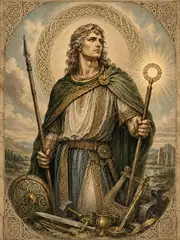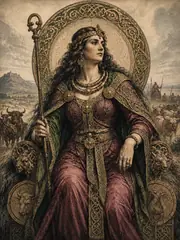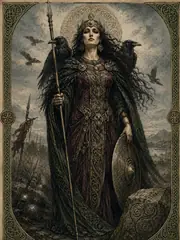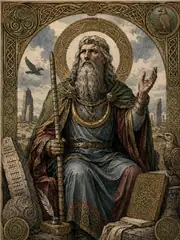
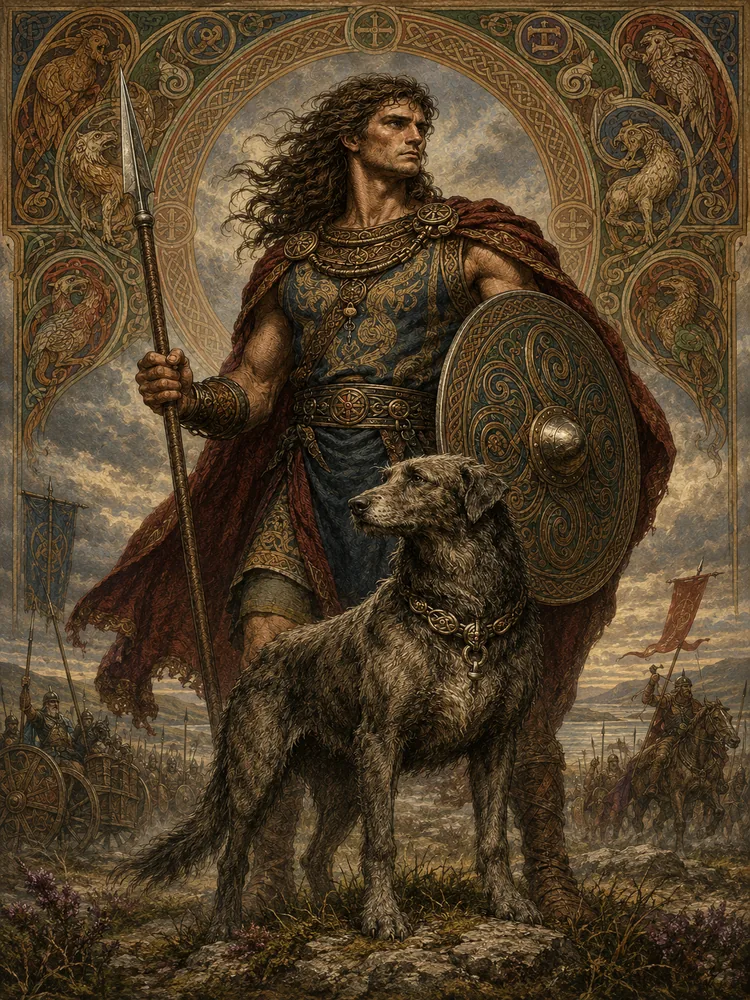
Cú Chulainn ("the Hound of Culann," his original name being Sétanta, renamed for an episode in his boyhood) was the great hero of the Ulster Cycle, the central narrative complex of medieval Irish heroic literature. He was the son of the god Lugh by the mortal Deichtine, sister of Conchobar mac Nessa king of Ulster — a divine paternity giving him supernatural capacities, while a parallel mortal paternity (his stepfather Sualtam) gave him a place in human society. As a small boy he killed the savage hound of the smith Culann with his bare hands and bronze hurling-stick; he then volunteered to take the dead hound's place as Culann's guard until a replacement could be raised, and so was renamed Cú Chulainn ("Culann's Hound"). He had been prophesied to a short life of immortal fame.
His characteristic battle-feature was the ríastrad, the warp-spasm or battle-fury, in which his body distorted into monstrous shape (one eye sucked into his head, the other bulging out like a saucer; his mouth twisted to behind his ear; smoke and sparks rising from his head; a column of blood spurting from his crown; his calf-muscles emerging through the back of his leg; his entire body shaking like a bell-rope). In this state he was nearly impossible to kill or to deal with, and the heroic narratives accordingly turn on the question of how he might be approached at all by his comrades.
His central narrative is the Táin Bó Cúailnge ("the Cattle-Raid of Cooley"), the great epic of the Ulster Cycle, in which Queen Medb of Connacht invaded Ulster to capture the Brown Bull of Cooley, while a curse upon the Ulstermen left them prostrate with debilitating birth-pangs (a curse from the goddess Macha for an old offense against her), and Cú Chulainn alone — too young to be subject to the curse — held the entire Connacht army at bay through a long succession of single combats at fords. The epic's most famous episode is his combat with Ferdiad, his foster-brother and dearest friend, who had been compelled to fight him; the duel lasted three days, the two warriors fighting at a ford by day and tending each other's wounds by night, until at last Cú Chulainn was forced to use the gae bolga (a fearsome belly-spear that opened in thirty barbs once embedded), and Ferdiad died in his arms.
Cú Chulainn's death came when he was at last destroyed by the combined enmity of those he had wronged. Defeated in battle by treacherous trick, mortally wounded, he tied himself to a standing stone with his own belt that he might die on his feet — and his enemies feared to approach him until a raven (the Morrígan in her crow-form) settled on his shoulder, signaling his death. The image of the dying hero tied to the pillar has been the subject of enormous modern Irish iconography (the bronze statue by Oliver Sheppard in the Dublin General Post Office, commemorating the 1916 Rising, is the most famous instance).