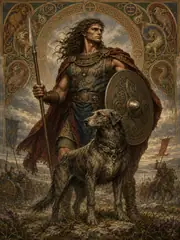
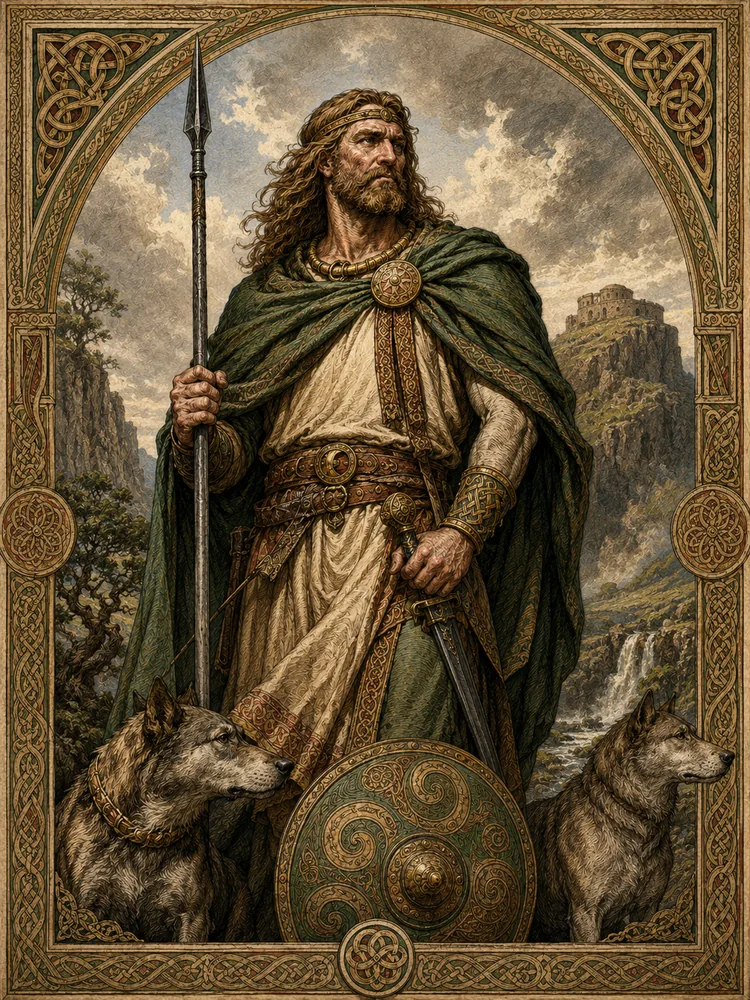
Fionn mac Cumhaill (anglicized Finn MacCool) was the leader of the Fianna, the band of warriors who in Irish tradition lived semi-independently of the kings, supporting themselves by hunting and fighting, defending Ireland against external threats. He was the central figure of the Fenian Cycle, the third great cycle of Irish heroic literature (after the Mythological and Ulster Cycles). His mythological character was somewhat different from Cú Chulainn's: where Cú Chulainn was an aristocratic hero of the king's household, Fionn was an outdoor hero of the wilderness, his exploits were more deeply tied to the land of Ireland itself, and his cycle had a more pastoral and naturalistic flavor. The Fenian narratives were enormously popular in the medieval and early-modern periods and continued in oral circulation in Irish-speaking Ireland and Scotland into the 20th century.
Fionn's youth involved the famous episode of the Salmon of Knowledge: he was apprenticed to the poet Finnegas at the river Boyne, where Finnegas had spent seven years trying to catch the salmon that ate the hazelnuts of wisdom from the nine sacred trees overhanging the well of knowledge — for whoever ate the salmon would gain the knowledge. Finnegas at last caught the salmon and gave it to Fionn to cook, with strict orders not to eat any of it. Fionn, turning the salmon on the spit, burned his thumb on the flesh and instinctively put his thumb in his mouth to cool it — and so received the knowledge that should have been Finnegas's. From then on, when Fionn put his thumb in his mouth (or in some versions sucked on a particular tooth), he received the knowledge of any matter he sought; the gesture was a recurring feature of the Fenian narratives.
His warband, the Fianna, were the elite warriors of legendary Ireland; admission required passing several severe trials (memorizing the twelve books of the poets, jumping over a stick at the height of one's brow, passing under a stick at the height of one's knee, running through a wood without breaking a twig underfoot or disturbing a hair of one's braid, and others). They lived by the High Court but were not part of it, hunting in the wilderness and gathering at appointed seasons. The dissolution of the Fianna at the Battle of Gabhra, after Fionn's death in old age, was the end of the heroic age of Ireland in the Fenian-cycle telling. James Macpherson's Ossian — the controversial 1760s publication that purported to be translations of an ancient Caledonian poet Ossian (Oisín, Fionn's son) — drew on real Scottish and Irish Fenian materials but freely embellished them; the Ossian controversy was one of the great literary disputes of the 18th century, and shaped the Romantic period's reception of all Celtic mythology.