A Compendium of the Ancient Gods
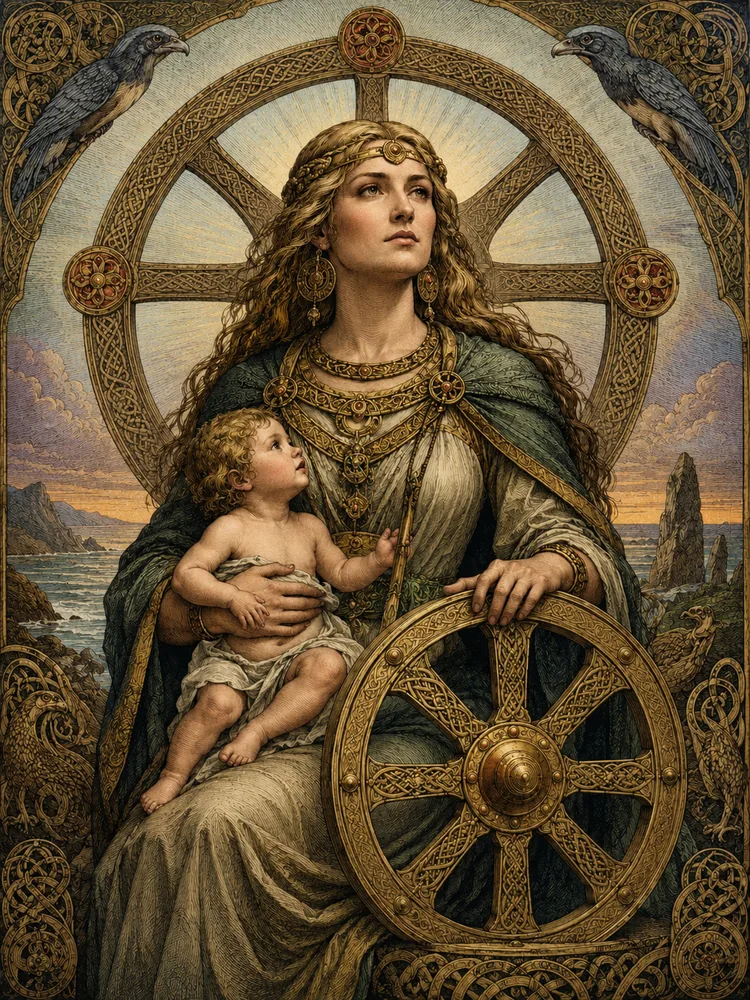
Arianrhod, plate

Arianrhod ("Silver Wheel") was a Welsh goddess of the Mabinogion's Fourth Branch, daughter of Dôn (the Welsh Danu) and sister of Gwydion. The narrative concerning her is among the more curious in medieval Welsh literature. She had been called as candidate for the office of foot-holder to her uncle Math, king of Gwynedd — an office that had to be held by a virgin, on whose lap the king kept his feet when not at war. Tested for her virginity by the magical wand, she was revealed not to be the virgin she had claimed: she gave birth on the spot to a fully formed boy (Dylan, who immediately fled to the sea and became a sea-divinity) and to a small embryonic mass that her brother Gwydion took up in a cloth and concealed in a chest at the foot of his bed. From this concealed embryo grew a second boy, whom Gwydion raised in secret.

Arianrhod, ashamed by the public revelation, refused to acknowledge her son. She laid three curses upon him: that he should never have a name unless she gave it; that he should never have arms unless she gave them to him; that he should never have a wife of any race now upon the earth. Gwydion, by various magical deceptions, defeated all three curses (he tricked her into naming the boy Lleu Llaw Gyffes, "the Bright One of the Skillful Hand," while she watched him hit a bird with a stone; he tricked her into arming the boy by a sham invasion that required arms be given; and he and Math made the boy a wife from the flowers of the oak, the broom, and the meadowsweet — Blodeuwedd, who would have her own subsequent narrative). Arianrhod was outwitted at every step; the boy Lleu corresponds linguistically to the Irish Lugh (treated above), and the Welsh narrative is plainly an alternative version of the same Indo-European mythological complex about the Bright One's birth and arming.
Curator’s note

What the sources say, and what later tradition added. The sources for this bay

The principal source is the Fourth Branch of the Mabinogi (Math fab Mathonwy), preserved in the Red Book of Hergest (c. 1382–1410) and the White Book of Rhydderch (c. 1350); the medieval Welsh manuscripts are 13th- and 14th-c. compilations of older oral material. Sioned Davies's translation (Oxford 2007) is the standard modern English version. The Lleu/Lugh equivalence is established in Patrick Sims-Williams's Irish Influence on Medieval Welsh Literature (2011) and elsewhere.

Kin in the sources

Each tie is quoted from the entry that states it.

When the sources speak

Dated witnesses for The Celtic Mythologies. A date marks when the evidence was written down, not when the belief began. The whole timeline

2nd–1st millennia BCE
Indo-European language dispersals and regional Bronze Age cultures provide a remote comparative background, not a recoverable common canon.
c. 500 BCE–1 CE
Iron Age material culture, names, sanctuaries, and classical ethnography offer early but external evidence for Celtic and Germanic religions.
1st–4th centuries CE
Roman inscriptions and provincial cults preserve many Celtic, Germanic, and local divine names.
4th–8th centuries CE
Migration-period and early medieval conversion transform ritual institutions while heroic traditions continue.
8th–11th centuries CE
Viking Age poetry, runic evidence, archaeology, and Scandinavian conversion form the core context of Norse myth.
9th–12th centuries CE
Slavic, Baltic, and Finnic traditions enter chronicles and missionary accounts, often through hostile observers.
11th–14th centuries CE
Irish, Welsh, and Icelandic manuscripts preserve major narrative corpora in Christian literary environments.
12th–16th centuries CE
Saxo, saga compilers, Baltic chroniclers, and later antiquarians systematize or reinterpret older material.

Floor plan

The rooms follow one another in the order their peoples first appear in the written record.

  1. The Cradle of Citiesc. 3400 BCE to 395 CE. 115 works
  2. The Gift of the Nilec. 4000 BCE to 395 CE. 73 works
  3. The Olympian Orderc. 1600 BCE to 750 CE. 152 works
  4. The Persian Worldc. 2000 BCE to 1010 CE. 30 works
  5. The Levantine Borderlandsc. 1200 BCE to 500 CE. 20 works
  6. The Edges of Empirec. 2000 BCE to 1500 CE. 33 works
  7. The Etruscan Worldc. 900 BCE to 750 CE. 22 works
  8. The Roman Inheritancec. 1200 BCE to 500 CE. 58 works
  9. The Northern Inheritancec. 2000 BCE to 1600 CE. 131 works