A Compendium of the Ancient Gods
Math Fab Mathonwy, Gwydion, plate

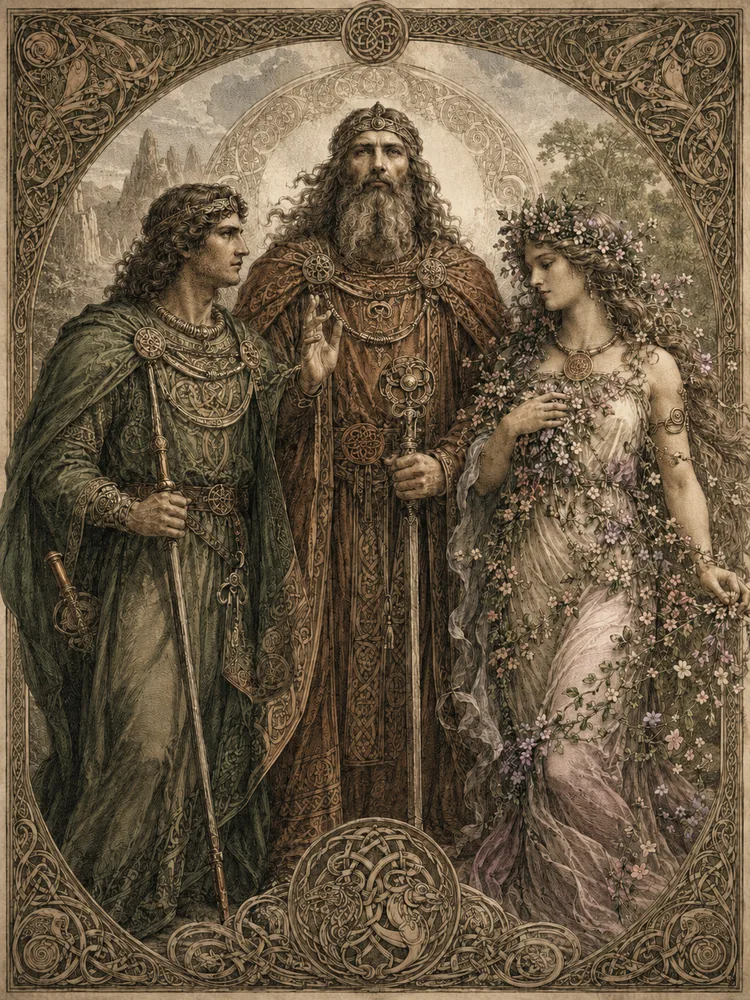
Math fab Mathonwy was the lord of Gwynedd in north Wales, and a great magician; but he was bound by a curious tabu — except in time of war, he might not live unless his feet were resting in the lap of a virgin. His foot-holder was the maiden Goewin, of much beauty. His nephew Gilfaethwy fell in love with Goewin, and his other nephew Gwydion (Gilfaethwy's brother) plotted to bring the matter about. Gwydion provoked a war with Pryderi prince of Dyfed by means of magical pigs; while Math was away at the war, Gilfaethwy raped Goewin in Math's bed.

When Math returned and learned what had been done, he punished his nephews not by killing them but by transforming them: for three years they lived as animals — first a stag and a hind, then a wild boar and a sow, then two wolves — and each year bore offspring to one another. After three years he restored them to human form and forgave them; but he needed a new foot-holder, and Gwydion proposed his sister Arianrhod. Math tested her by setting his magic wand upon the floor and asking her to step over it; as she stepped, two children fell from her — one was the boy who would become Dylan ail Don, the sea-spirit, and the other was a small lump of flesh that Gwydion hid in a chest until it grew to be the boy Lleu Llaw Gyffes, of whom Arianrhod swore she would never be the mother.

Arianrhod laid three curses upon Lleu: that he should have no name, no arms, and no human wife. Gwydion outwitted her in each. He tricked her into giving the boy his name ("the deft-handed lion"), tricked her into arming him, and at last, with Math's help, made for him a wife not of human birth — a woman conjured out of the flowers of oak, broom, and meadowsweet. Her name was Blodeuwedd ("Flower-Face"), and she was the most beautiful of all women. But she had not consented to the marriage, and when she fell in love with another man, Gronw Pebyr, she conspired with him to murder Lleu. Lleu was wounded by Gronw's spear under conditions of great elaboration (he could be killed only at twilight, neither inside nor outside, neither on horseback nor on foot, neither dressed nor naked), and he flew away as an eagle. Gwydion at last found him, restored him, and avenged the betrayal: Gronw was killed, and Blodeuwedd was transformed into an owl, condemned to fly only at night, hated by all other birds. So she remains.
Curator’s note

What the sources say, and what later tradition added. The sources for this bay

The tales of Math, Gwydion, Lleu, and Blodeuwedd are told in the Fourth Branch of the Mabinogi, one of the four great medieval Welsh prose tales, surviving in the White Book of Rhydderch (c. 1350) and the Red Book of Hergest (c. 1400) but going back substantially earlier. The tale's narrative complexity, with its interlocked transformations, curses, and ritual deaths, makes it one of the most sophisticated of Celtic survivals; W. J. Gruffydd's Math vab Mathonwy (1928) and Patrick Sims-Williams's various studies have explored its structure. Lleu Llaw Gyffes is cognate with Irish Lugh Lámfada and Gallo-Roman Lugus, suggesting a pan-Celtic divine figure of some antiquity. Blodeuwedd's transformation into an owl is etymologically motivated — blodeuwedd "flower-face" becomes blodeuedd, related to one of the Welsh names for "owl."

Kin in the sources

Each tie is quoted from the entry that states it.

When the sources speak

Dated witnesses for The Celtic Mythologies. A date marks when the evidence was written down, not when the belief began. The whole timeline

2nd–1st millennia BCE
Indo-European language dispersals and regional Bronze Age cultures provide a remote comparative background, not a recoverable common canon.
c. 500 BCE–1 CE
Iron Age material culture, names, sanctuaries, and classical ethnography offer early but external evidence for Celtic and Germanic religions.
1st–4th centuries CE
Roman inscriptions and provincial cults preserve many Celtic, Germanic, and local divine names.
4th–8th centuries CE
Migration-period and early medieval conversion transform ritual institutions while heroic traditions continue.
8th–11th centuries CE
Viking Age poetry, runic evidence, archaeology, and Scandinavian conversion form the core context of Norse myth.
9th–12th centuries CE
Slavic, Baltic, and Finnic traditions enter chronicles and missionary accounts, often through hostile observers.
11th–14th centuries CE
Irish, Welsh, and Icelandic manuscripts preserve major narrative corpora in Christian literary environments.
12th–16th centuries CE
Saxo, saga compilers, Baltic chroniclers, and later antiquarians systematize or reinterpret older material.

Floor plan

The rooms follow one another in the order their peoples first appear in the written record.

  1. The Cradle of Citiesc. 3400 BCE to 395 CE. 115 works
  2. The Gift of the Nilec. 4000 BCE to 395 CE. 73 works
  3. The Olympian Orderc. 1600 BCE to 750 CE. 152 works
  4. The Persian Worldc. 2000 BCE to 1010 CE. 30 works
  5. The Levantine Borderlandsc. 1200 BCE to 500 CE. 20 works
  6. The Edges of Empirec. 2000 BCE to 1500 CE. 33 works
  7. The Etruscan Worldc. 900 BCE to 750 CE. 22 works
  8. The Roman Inheritancec. 1200 BCE to 500 CE. 58 works
  9. The Northern Inheritancec. 2000 BCE to 1600 CE. 131 works