A Compendium of the Ancient Gods
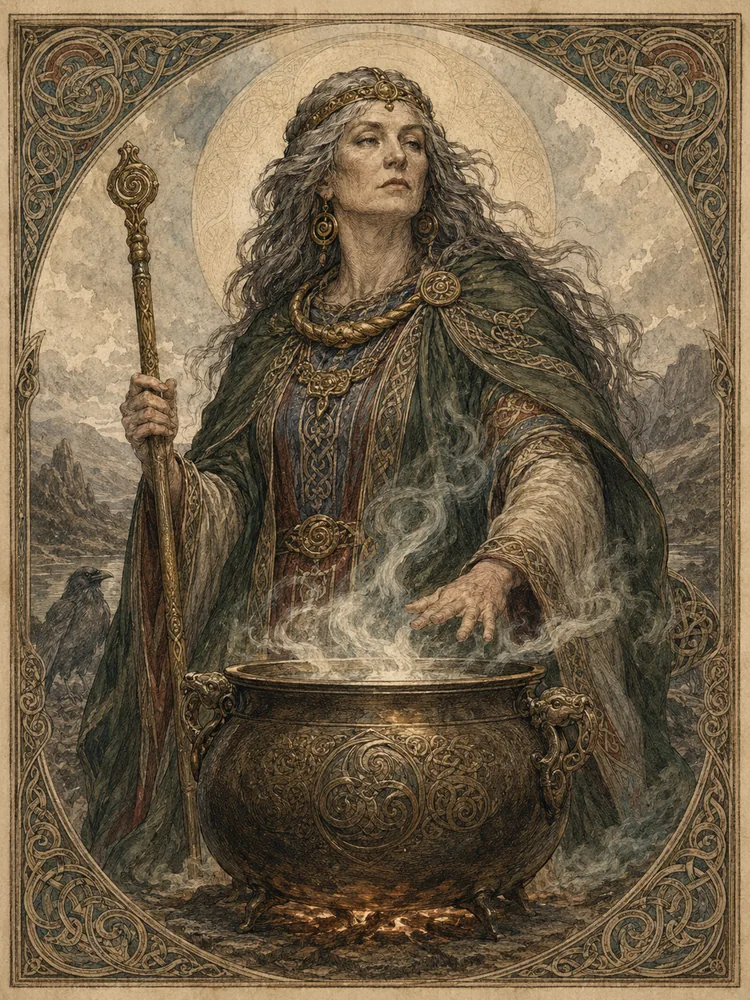
Ceridwen, plate

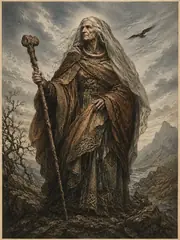
Ceridwen was a witch — or a goddess, or both — of the Welsh tradition, who dwelt by Lake Tegid (Bala Lake in Gwynedd) with her husband Tegid Foel and their children. She had two children of her own: Creirwy, the most beautiful girl in the world, and Morfran ("Sea Crow"), the ugliest boy. To make up for the boy's ugliness, Ceridwen determined to make him the wisest man in the world, and to this end she brewed in her great cauldron the awen, the inspiration of poetry — a brew that must boil for a year and a day, with proper herbs added at the proper hours.

She set Gwion Bach, a small boy, to stir the cauldron, and Morda the blind man to tend the fire beneath. At the end of the year, three drops flew from the cauldron and fell upon Gwion's thumb; he put the thumb in his mouth, and the wisdom of awen passed into him instead of into Morfran. The rest of the brew turned at once to deadly poison, splitting the cauldron and ruining the year's work. Gwion fled, and Ceridwen pursued him.

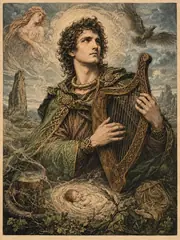
What followed was the great chase of Welsh tradition. Gwion turned himself into a hare; Ceridwen became a greyhound. Gwion became a fish; Ceridwen became an otter. Gwion became a bird; Ceridwen became a hawk. At last Gwion became a single grain of wheat in a heap of grain on a barn floor; Ceridwen became a black hen, picked the grain from the heap, and swallowed him. Nine months later she gave birth to a beautiful boy; she could not bring herself to kill him, and instead set him in a leather bag and cast him into the river Dyfi. The bag floated downstream, was caught in the salmon-weir of King Gwyddno Garanhir, and was opened by the king's son Elffin — who, finding the radiant child, named him Taliesin ("Shining Brow"). And Taliesin grew up to be the greatest of the Welsh bards.
Curator’s note

What the sources say, and what later tradition added. The sources for this bay

The story of Ceridwen and Gwion Bach / Taliesin is preserved in the prose Hanes Taliesin ("Story of Taliesin"), which survives in late manuscripts (the earliest from the sixteenth century) but is clearly older. The cauldron of awen and the chase-of-shapes appear in Welsh poetry of the twelfth and thirteenth centuries. The chase is a Welsh version of the widespread Indo-European "shapeshifting pursuit" motif (compare Greek Thetis and Peleus, Polish Krak and the Vodyanoy). Modern scholarship (Ifor Williams, Marged Haycock) distinguishes the historical Taliesin (a sixth-century Welsh bard) from the legendary Taliesin who descends from Gwion; both figures appear under the same name in the surviving Book of Taliesin (c. 1325).

Kin in the sources

Each tie is quoted from the entry that states it.

When the sources speak

Dated witnesses for The Celtic Mythologies. A date marks when the evidence was written down, not when the belief began. The whole timeline

2nd–1st millennia BCE
Indo-European language dispersals and regional Bronze Age cultures provide a remote comparative background, not a recoverable common canon.
c. 500 BCE–1 CE
Iron Age material culture, names, sanctuaries, and classical ethnography offer early but external evidence for Celtic and Germanic religions.
1st–4th centuries CE
Roman inscriptions and provincial cults preserve many Celtic, Germanic, and local divine names.
4th–8th centuries CE
Migration-period and early medieval conversion transform ritual institutions while heroic traditions continue.
8th–11th centuries CE
Viking Age poetry, runic evidence, archaeology, and Scandinavian conversion form the core context of Norse myth.
9th–12th centuries CE
Slavic, Baltic, and Finnic traditions enter chronicles and missionary accounts, often through hostile observers.
11th–14th centuries CE
Irish, Welsh, and Icelandic manuscripts preserve major narrative corpora in Christian literary environments.
12th–16th centuries CE
Saxo, saga compilers, Baltic chroniclers, and later antiquarians systematize or reinterpret older material.

Floor plan

The rooms follow one another in the order their peoples first appear in the written record.

  1. The Cradle of Citiesc. 3400 BCE to 395 CE. 115 works
  2. The Gift of the Nilec. 4000 BCE to 395 CE. 73 works
  3. The Olympian Orderc. 1600 BCE to 750 CE. 152 works
  4. The Persian Worldc. 2000 BCE to 1010 CE. 30 works
  5. The Levantine Borderlandsc. 1200 BCE to 500 CE. 20 works
  6. The Edges of Empirec. 2000 BCE to 1500 CE. 33 works
  7. The Etruscan Worldc. 900 BCE to 750 CE. 22 works
  8. The Roman Inheritancec. 1200 BCE to 500 CE. 58 works
  9. The Northern Inheritancec. 2000 BCE to 1600 CE. 131 works