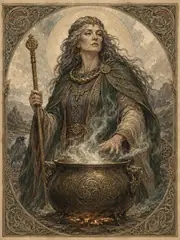
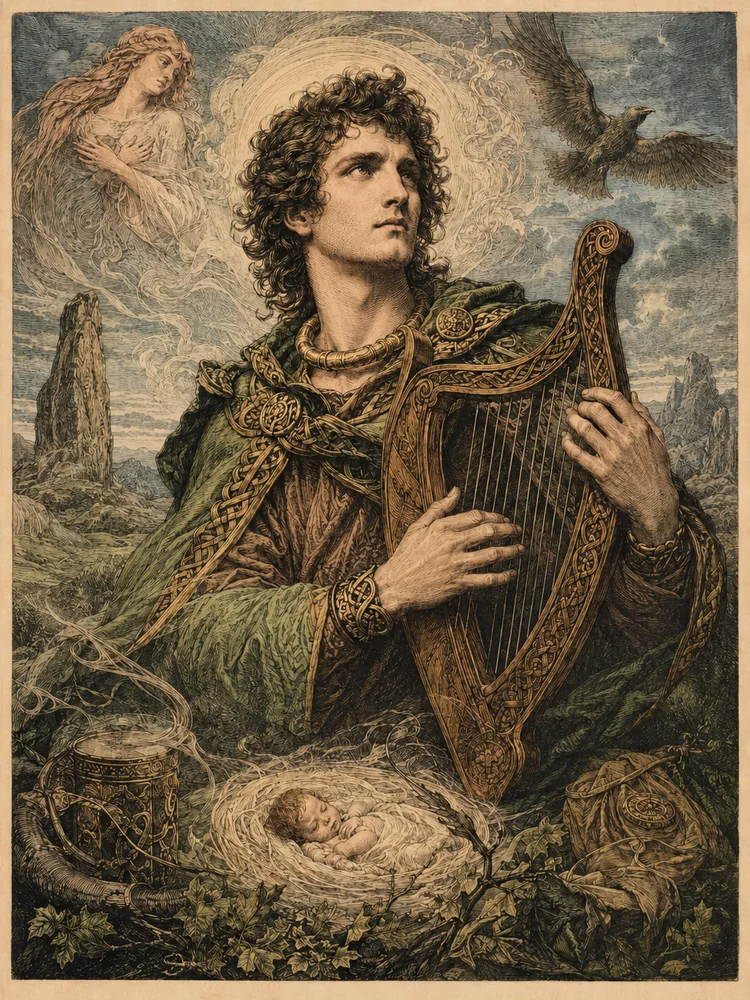
Taliesin was the greatest of the Welsh bards, and his twofold history is preserved both in legend and in fact. The legendary Taliesin was the boy Gwion Bach, who had stolen the three drops of awen from Ceridwen's cauldron (as told in the entry on Ceridwen above), been pursued through three transformations, swallowed by Ceridwen as a grain of wheat, reborn from her as a beautiful infant, set into a leather bag and cast on the river Dyfi, and recovered from the salmon-weir of King Gwyddno Garanhir by the king's son Elffin. As Gwyddno opened the bag and saw the radiant child, the boy was named Taliesin — "Shining Brow" — and he then immediately spoke a prophecy of his own future fame.
Taliesin grew up to become the chief bard of his foster-father Elffin, and afterward of King Maelgwn Gwynedd at Deganwy. He defeated all the bards of Maelgwn's court in contests of poetry, song, and learning, and obtained for his foster-father (whom Maelgwn had imprisoned) release and reward. The verses by which Taliesin defeated Maelgwn's bards are preserved in the Book of Taliesin — fragments of cosmological, prophetic, and gnomic poetry, in which the bard claims to have been present at every great event of Welsh and biblical history, to have served in the lord's army at Caer Vandwy and at the fall of Lucifer, to have been a bard at the court of King Brychan and to have ridden with Alexander the Great. "I have been many things," he sings, in the famous Cad Goddeu ("The Battle of the Trees"); the catalog of Taliesin's metempsychoses is one of the great Welsh poetic monuments.
The historical Taliesin was a sixth-century Welsh court-bard, attested in the early Welsh Annals and in the Historia Brittonum as one of the cynfeirdd, the "early poets," who flourished at the courts of Urien Rheged and his son Owain in north Britain. His authentic poems are concrete, occasion-specific, royal panegyrics — the Marwnad Owain, praising Urien's victories — and are very different in character from the legendary cosmological poems attributed to him in the later Book of Taliesin. The two Taliesins, the bard of history and the bard of legend, were already conflated by the eighth century and remain inseparable in the Welsh tradition.