A Compendium of the Ancient Gods
Rhiannon, plate

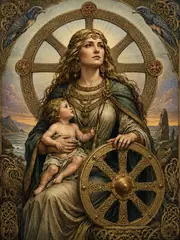
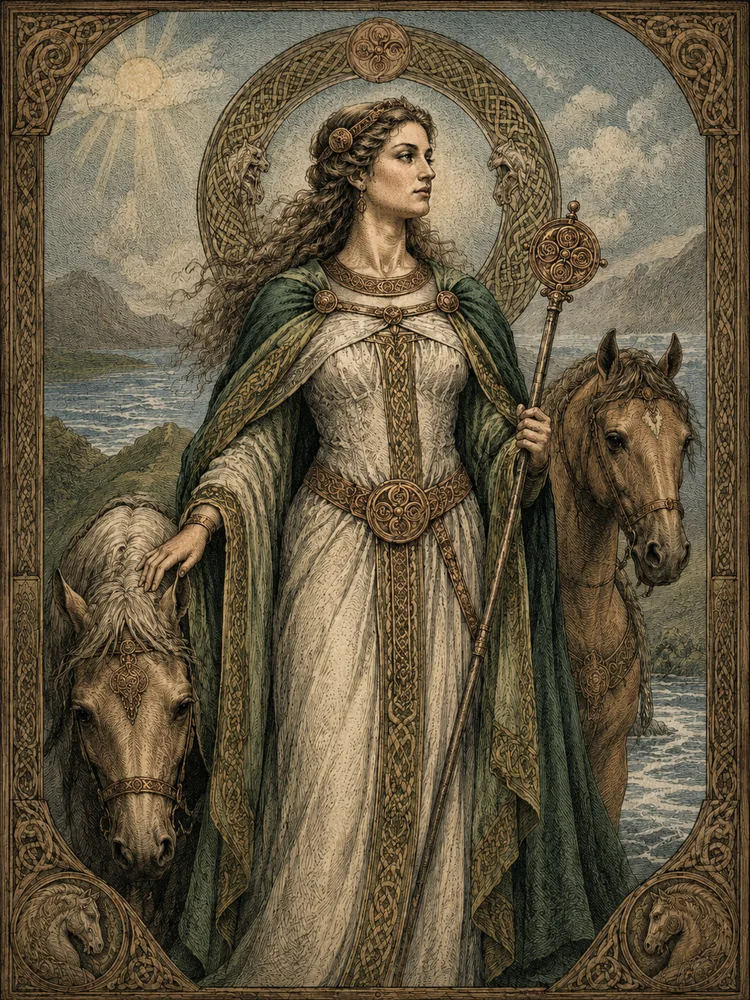
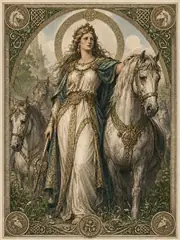
Rhiannon was a Welsh goddess of sovereignty and of horses, principal female figure of the First and Third Branches of the Mabinogi. She first appeared to Pwyll, prince of Dyfed, who had been sitting on the magical mound of Arberth where strange things were said to happen: a beautiful woman in golden silk rode past on a white horse at a slow walking pace, but no horse of Pwyll's company could catch her, however fast they galloped, until at length Pwyll himself called out to her and she stopped, scolded him for not having spoken sooner, and revealed that she was Rhiannon, daughter of Hyfaidd Hen, betrothed against her will to a man she did not want and seeking a husband who would help her escape him. Pwyll married her, after a not entirely creditable sequence of events involving Rhiannon's tricking the rival suitor at the wedding-feast.

Their son Pryderi was stolen on the night of his birth by a mysterious force; the nurses, accused, smeared the sleeping Rhiannon's face with the blood of puppies they had killed and accused her of having devoured her own child. Rhiannon was sentenced to a curious penance: she was to sit at the mounting-block outside the gate of Arberth, tell her story to every visitor, and offer to carry them on her back into the court. The penance was endured for many years before Pryderi was eventually recovered (he had been raised by the family of Teyrnon Twrf Liant, who had recovered him from the magical claw that had stolen him).

The image of Rhiannon as horse-woman, of the goddess associated with horses, and of the curious penance involving riding-on-the-back has connected her in the modern scholarly literature with the Continental Celtic horse-goddess Epona (treated next). The two are linguistically and functionally similar enough that an underlying Indo-European horse-goddess of sovereignty (the king's marriage to whom secured his right to rule) has been reconstructed; whether the connection is direct genetic descent or typological parallel is debated.
Curator’s note

What the sources say, and what later tradition added. The sources for this bay

Pwyll Pendefig Dyfed (First Branch of the Mabinogi); Manawydan fab Llŷr (Third Branch). The Rhiannon-Epona connection is in Mac Cana, Celtic Mythology (1970); Hutton, Pagan Britain (2014). Rhiannon's name has been etymologized as "Great Queen" (Rīgantonā), a reasonable but not certain reconstruction.

Kin in the sources

Each tie is quoted from the entry that states it.

When the sources speak

Dated witnesses for The Celtic Mythologies. A date marks when the evidence was written down, not when the belief began. The whole timeline

2nd–1st millennia BCE
Indo-European language dispersals and regional Bronze Age cultures provide a remote comparative background, not a recoverable common canon.
c. 500 BCE–1 CE
Iron Age material culture, names, sanctuaries, and classical ethnography offer early but external evidence for Celtic and Germanic religions.
1st–4th centuries CE
Roman inscriptions and provincial cults preserve many Celtic, Germanic, and local divine names.
4th–8th centuries CE
Migration-period and early medieval conversion transform ritual institutions while heroic traditions continue.
8th–11th centuries CE
Viking Age poetry, runic evidence, archaeology, and Scandinavian conversion form the core context of Norse myth.
9th–12th centuries CE
Slavic, Baltic, and Finnic traditions enter chronicles and missionary accounts, often through hostile observers.
11th–14th centuries CE
Irish, Welsh, and Icelandic manuscripts preserve major narrative corpora in Christian literary environments.
12th–16th centuries CE
Saxo, saga compilers, Baltic chroniclers, and later antiquarians systematize or reinterpret older material.

Floor plan

The rooms follow one another in the order their peoples first appear in the written record.

  1. The Cradle of Citiesc. 3400 BCE to 395 CE. 115 works
  2. The Gift of the Nilec. 4000 BCE to 395 CE. 73 works
  3. The Olympian Orderc. 1600 BCE to 750 CE. 152 works
  4. The Persian Worldc. 2000 BCE to 1010 CE. 30 works
  5. The Levantine Borderlandsc. 1200 BCE to 500 CE. 20 works
  6. The Edges of Empirec. 2000 BCE to 1500 CE. 33 works
  7. The Etruscan Worldc. 900 BCE to 750 CE. 22 works
  8. The Roman Inheritancec. 1200 BCE to 500 CE. 58 works
  9. The Northern Inheritancec. 2000 BCE to 1600 CE. 131 works