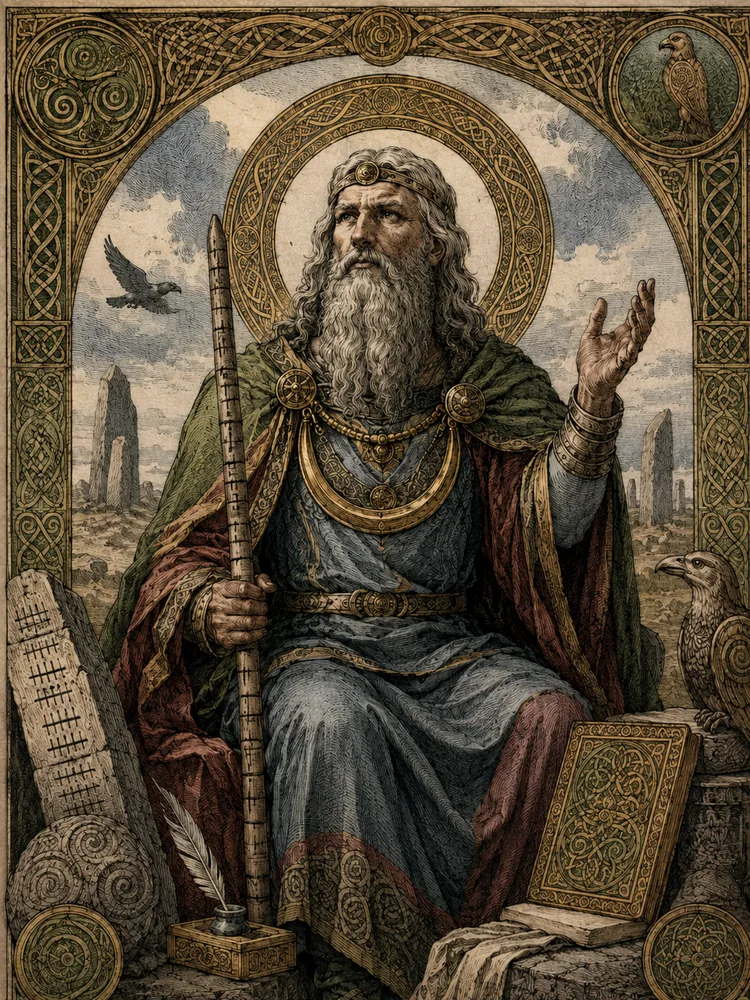
Ogma was the god of eloquence and of writing — specifically, of the ogham script, the early Irish writing-system of straight strokes incised across or beside a stem-line, used for inscriptions on stone (especially gravestones and boundary-markers, of which several hundred survive from the 4th to 6th centuries CE). The script was attributed in the Irish tradition to Ogma's invention; the modern philological view is that the script is real and ancient (4th-c. CE certainly, possibly older), but that the divine attribution is mythological aetiology rather than memory of an actual inventor. Ogma was the brother (or, in some genealogies, son) of the Dagda; he was a warrior of the Tuatha Dé as well as a wordsmith, and was killed at the Second Battle of Mag Tuired. His continental Gaulish counterpart Ogmios is described by the second-century-CE Greek satirist Lucian (Heracles 1–7), who reports that Ogmios was depicted as an old, sun-darkened, bald Heracles whose followers were drawn after him by golden chains running from his tongue to their ears — an image of the binding power of eloquence.
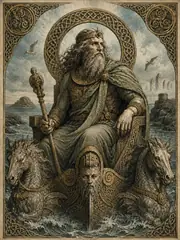 Before thisManannán Mac Lir
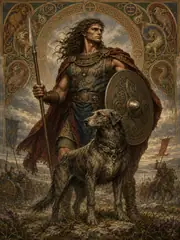 Next on the wallCú Chulainn
Curator’s note
What the sources say, and what later tradition added. The sources for this bay
The principal sources are Cath Maige Tuired and the Auraicept na n-Éces ("The Scholars' Primer," 7th–8th-c. tract on grammar and the ogham). Lucian's Heracles is the principal external source for the Gaulish Ogmios. The ogham script is real and well-attested archaeologically; the Damian McManus, A Guide to Ogam (1991), is the standard modern treatment.
Kin in the sources
Each tie is quoted from the entry that states it.
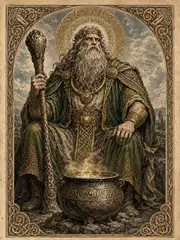 Sibling ofDagda
Ogma was the brother (or, in some genealogies, son) of the Dagda
- Parent ofDagda
Ogma was the brother (or, in some genealogies, son) of the Dagda
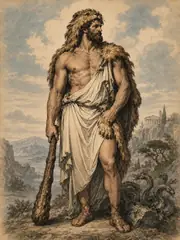 Compared withHeracles
Ogmios was depicted as an old, sun-darkened, bald Heracles
When the sources speak
Dated witnesses for The Celtic Mythologies. A date marks when the evidence was written down, not when the belief began. The whole timeline
- 2nd–1st millennia BCE
- Indo-European language dispersals and regional Bronze Age cultures provide a remote comparative background, not a recoverable common canon.
- c. 500 BCE–1 CE
- Iron Age material culture, names, sanctuaries, and classical ethnography offer early but external evidence for Celtic and Germanic religions.
- 1st–4th centuries CE
- Roman inscriptions and provincial cults preserve many Celtic, Germanic, and local divine names.
- 4th–8th centuries CE
- Migration-period and early medieval conversion transform ritual institutions while heroic traditions continue.
- 8th–11th centuries CE
- Viking Age poetry, runic evidence, archaeology, and Scandinavian conversion form the core context of Norse myth.
- 9th–12th centuries CE
- Slavic, Baltic, and Finnic traditions enter chronicles and missionary accounts, often through hostile observers.
- 11th–14th centuries CE
- Irish, Welsh, and Icelandic manuscripts preserve major narrative corpora in Christian literary environments.
- 12th–16th centuries CE
- Saxo, saga compilers, Baltic chroniclers, and later antiquarians systematize or reinterpret older material.