A Compendium of the Ancient Gods
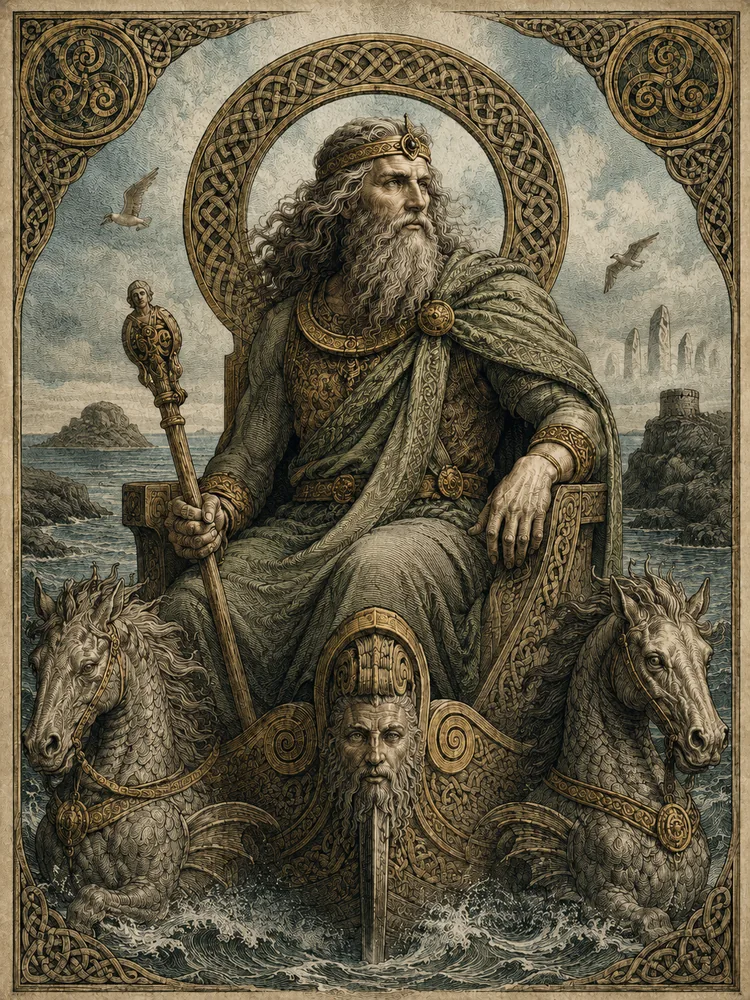
Manannán Mac Lir, plate

Manannán mac Lir ("Manannán son of the Sea") was the Irish god of the sea, of the otherworld islands, of the magical mists that veiled the Tuatha Dé from human sight in the Christian period when the Milesians had taken Ireland and the older divine race had retreated into the hollow hills (sídhe) and the islands beyond the western horizon. He drove a chariot drawn by horses across the surface of the sea (the waves were his pasturage); he had a magical cloak that could change color like the sea; he had a crane-bag of treasures (one of the great Irish mythological objects); his sword Fragarach ("the Answerer") could cut through any armor and once drawn could not be sheathed without striking. He was associated with the Isle of Man (whose name preserves his) and with Manannan's land — Tír Tairngire, the Land of Promise — one of the Irish otherworld realms, where the Tuatha Dé continued to hold their courts after their withdrawal from the human Ireland.

Manannán's role in the literary tradition was as the great magician of the otherworld, the host of those who passed beyond, the guardian of the boundaries between the seen and the unseen. He was the foster-father of Lugh; he was the husband of Fand, who in the Ulster Cycle had a brief attachment with the hero Cú Chulainn (the matter of Serglige Con Culainn, "The Wasting-Sickness of Cú Chulainn") before returning to Manannán at his urging.
Curator’s note

What the sources say, and what later tradition added. The sources for this bay

Manannán appears across the Mythological, Ulster, and Fenian Cycles; Serglige Con Culainn is one of the principal extended treatments. The Welsh cognate Manawydan fab Llŷr is the protagonist of the Third Branch of the Mabinogi. The Isle of Man's name, in Old Irish Manu, is securely connected to him.

Kin in the sources

Each tie is quoted from the entry that states it.

When the sources speak

Dated witnesses for The Celtic Mythologies. A date marks when the evidence was written down, not when the belief began. The whole timeline

2nd–1st millennia BCE
Indo-European language dispersals and regional Bronze Age cultures provide a remote comparative background, not a recoverable common canon.
c. 500 BCE–1 CE
Iron Age material culture, names, sanctuaries, and classical ethnography offer early but external evidence for Celtic and Germanic religions.
1st–4th centuries CE
Roman inscriptions and provincial cults preserve many Celtic, Germanic, and local divine names.
4th–8th centuries CE
Migration-period and early medieval conversion transform ritual institutions while heroic traditions continue.
8th–11th centuries CE
Viking Age poetry, runic evidence, archaeology, and Scandinavian conversion form the core context of Norse myth.
9th–12th centuries CE
Slavic, Baltic, and Finnic traditions enter chronicles and missionary accounts, often through hostile observers.
11th–14th centuries CE
Irish, Welsh, and Icelandic manuscripts preserve major narrative corpora in Christian literary environments.
12th–16th centuries CE
Saxo, saga compilers, Baltic chroniclers, and later antiquarians systematize or reinterpret older material.

Floor plan

The rooms follow one another in the order their peoples first appear in the written record.

  1. The Cradle of Citiesc. 3400 BCE to 395 CE. 115 works
  2. The Gift of the Nilec. 4000 BCE to 395 CE. 73 works
  3. The Olympian Orderc. 1600 BCE to 750 CE. 152 works
  4. The Persian Worldc. 2000 BCE to 1010 CE. 30 works
  5. The Levantine Borderlandsc. 1200 BCE to 500 CE. 20 works
  6. The Edges of Empirec. 2000 BCE to 1500 CE. 33 works
  7. The Etruscan Worldc. 900 BCE to 750 CE. 22 works
  8. The Roman Inheritancec. 1200 BCE to 500 CE. 58 works
  9. The Northern Inheritancec. 2000 BCE to 1600 CE. 131 works