A Compendium of the Ancient Gods
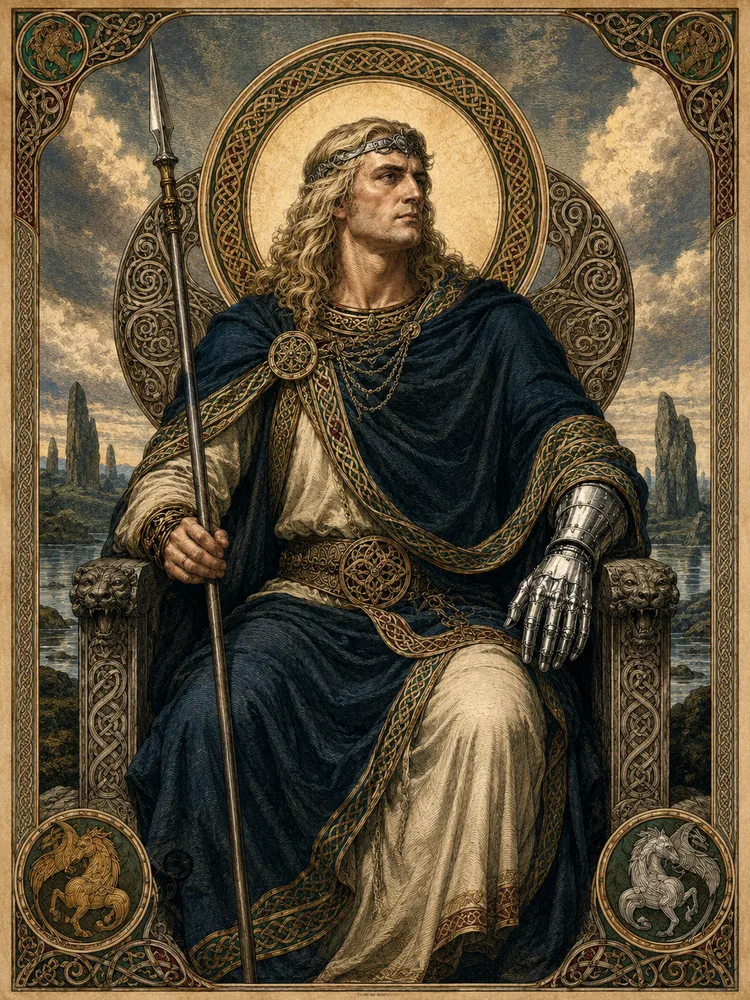
Nuada Airgetlám, plate

Nuada Airgetlám ("Nuada of the Silver Hand") was the king of the Tuatha Dé Danann at their arrival in Ireland and at the First Battle of Mag Tuired, in which they defeated the Fir Bolg (the previous mythological inhabitants); but he lost his hand in that battle, and Tuatha Dé law (which the Irish texts repeatedly insist upon as a preserved ancient custom) required that the king be physically perfect, so Nuada had to abdicate. The physician Dian Cécht made him a silver hand which he wore for seven years; eventually Dian Cécht's son Miach made him a hand of flesh that grew naturally onto his arm (a rivalry between father and son that ended when Dian Cécht killed his son in jealousy at being surpassed). Nuada was thereafter restored to the kingship — until, as told in Lugh's entry, he yielded the throne to the multi-skilled Lugh at the time of the Second Battle of Mag Tuired, where Nuada was killed by Balor's evil eye before Lugh struck him down.

Nuada's name corresponds to the Welsh Nudd (often called Nudd Llaw Eraint, Nudd of the Silver Hand, the same epithet) and to the Romano-British Nodens, attested in inscriptions and at the great healing temple at Lydney Park in Gloucestershire (1st-4th c. CE), which gives some indication of the cult's substance in pre-Christian Britain. The continuity of name through three Celtic traditions makes Nuada one of the most clearly inherited Indo-European Celtic deities.
Curator’s note

What the sources say, and what later tradition added. The sources for this bay

Cath Maige Tuired (the Mag Tuired narrative); Lebor Gabála Érenn. The Romano-British Nodens at Lydney is attested in inscriptions excavated in the 1920s and 1930s; the temple complex was studied by Sir Mortimer Wheeler (1932), with Tolkien (then a young Anglo-Saxonist) writing the etymological appendix on the divine name.

Kin in the sources

Each tie is quoted from the entry that states it.

When the sources speak

Dated witnesses for The Celtic Mythologies. A date marks when the evidence was written down, not when the belief began. The whole timeline

2nd–1st millennia BCE
Indo-European language dispersals and regional Bronze Age cultures provide a remote comparative background, not a recoverable common canon.
c. 500 BCE–1 CE
Iron Age material culture, names, sanctuaries, and classical ethnography offer early but external evidence for Celtic and Germanic religions.
1st–4th centuries CE
Roman inscriptions and provincial cults preserve many Celtic, Germanic, and local divine names.
4th–8th centuries CE
Migration-period and early medieval conversion transform ritual institutions while heroic traditions continue.
8th–11th centuries CE
Viking Age poetry, runic evidence, archaeology, and Scandinavian conversion form the core context of Norse myth.
9th–12th centuries CE
Slavic, Baltic, and Finnic traditions enter chronicles and missionary accounts, often through hostile observers.
11th–14th centuries CE
Irish, Welsh, and Icelandic manuscripts preserve major narrative corpora in Christian literary environments.
12th–16th centuries CE
Saxo, saga compilers, Baltic chroniclers, and later antiquarians systematize or reinterpret older material.

Floor plan

The rooms follow one another in the order their peoples first appear in the written record.

  1. The Cradle of Citiesc. 3400 BCE to 395 CE. 115 works
  2. The Gift of the Nilec. 4000 BCE to 395 CE. 73 works
  3. The Olympian Orderc. 1600 BCE to 750 CE. 152 works
  4. The Persian Worldc. 2000 BCE to 1010 CE. 30 works
  5. The Levantine Borderlandsc. 1200 BCE to 500 CE. 20 works
  6. The Edges of Empirec. 2000 BCE to 1500 CE. 33 works
  7. The Etruscan Worldc. 900 BCE to 750 CE. 22 works
  8. The Roman Inheritancec. 1200 BCE to 500 CE. 58 works
  9. The Northern Inheritancec. 2000 BCE to 1600 CE. 131 works