A Compendium of the Ancient Gods
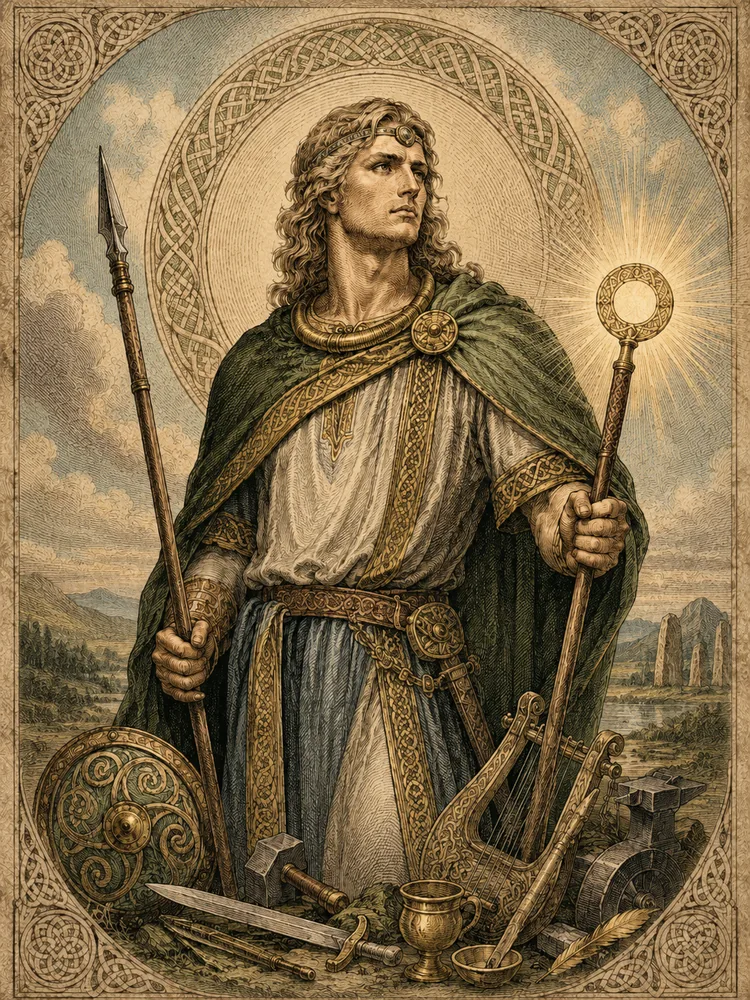
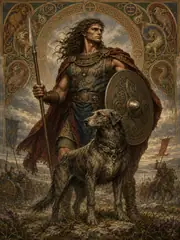
Lugh, plate

Lugh ("Lugh Lámfhada," Lugh of the Long Arm, sometimes Lugh Samildánach, "of all skills") was a god of light, of crafts, of warfare, of kingship — the most clearly Indo-European-paralleled of the Irish gods, his name corresponding linguistically to the Welsh Lleu Llaw Gyffes (treated below in connection with Arianrhod) and to the Gaulish Lugus. He was the son of Cian of the Tuatha Dé and Ethniu of the Fomorians, and so stood between the two divine races. He came to the Tuatha Dé court at Tara when Nuada was king, was at first refused entry by the gatekeeper (who admitted only those with a skill the household lacked), and won admission by demonstrating that he was the master of every skill — wright, smith, champion, harper, hero, sorcerer, healer, cup-bearer, brazier — for which the gatekeeper, refusing them in turn, was at last forced to confess that the household had no man master of all skills together. Lugh accordingly was admitted, and his coming was the turning-point in the war against the Fomorians.

At the Second Battle of Mag Tuired, Lugh killed his maternal grandfather Balor of the Evil Eye — the great Fomorian whose single eye, when opened, killed everything within its range — by hurling a slingstone (or in some versions a spear) through it as it began to open. The kill brought the Fomorians' defeat. Lugh's festival, Lughnasadh, was held on August 1, the beginning of the harvest; it was one of the four great Irish quarter-festivals (Imbolc, Bealtaine, Lughnasadh, Samhain) and gave its name to the modern Irish word for August (Lúnasa). His name is preserved in many continental Celtic place-names (Lugdunum became Lyon; Lugudunum became Laon and London? — the latter etymology is contested), and Caesar's interpretatio romana identified him with Mercury as "the chief god of the Gauls," inventor of all the arts.
Curator’s note

What the sources say, and what later tradition added. The sources for this bay

The principal Irish source is Cath Maige Tuired. The continental Lugus is attested in inscriptions and in Caesar, Bellum Gallicum 6.17 (the "Mercury" of the interpretatio). The Lyon-Lugdunum etymology is securely established; the London etymology from Lugus is one of several proposals (others derive London from Brythonic *Londinion, of uncertain meaning) and is not securely demonstrated.

Kin in the sources

Each tie is quoted from the entry that states it.

When the sources speak

Dated witnesses for The Celtic Mythologies. A date marks when the evidence was written down, not when the belief began. The whole timeline

2nd–1st millennia BCE
Indo-European language dispersals and regional Bronze Age cultures provide a remote comparative background, not a recoverable common canon.
c. 500 BCE–1 CE
Iron Age material culture, names, sanctuaries, and classical ethnography offer early but external evidence for Celtic and Germanic religions.
1st–4th centuries CE
Roman inscriptions and provincial cults preserve many Celtic, Germanic, and local divine names.
4th–8th centuries CE
Migration-period and early medieval conversion transform ritual institutions while heroic traditions continue.
8th–11th centuries CE
Viking Age poetry, runic evidence, archaeology, and Scandinavian conversion form the core context of Norse myth.
9th–12th centuries CE
Slavic, Baltic, and Finnic traditions enter chronicles and missionary accounts, often through hostile observers.
11th–14th centuries CE
Irish, Welsh, and Icelandic manuscripts preserve major narrative corpora in Christian literary environments.
12th–16th centuries CE
Saxo, saga compilers, Baltic chroniclers, and later antiquarians systematize or reinterpret older material.

Floor plan

The rooms follow one another in the order their peoples first appear in the written record.

  1. The Cradle of Citiesc. 3400 BCE to 395 CE. 115 works
  2. The Gift of the Nilec. 4000 BCE to 395 CE. 73 works
  3. The Olympian Orderc. 1600 BCE to 750 CE. 152 works
  4. The Persian Worldc. 2000 BCE to 1010 CE. 30 works
  5. The Levantine Borderlandsc. 1200 BCE to 500 CE. 20 works
  6. The Edges of Empirec. 2000 BCE to 1500 CE. 33 works
  7. The Etruscan Worldc. 900 BCE to 750 CE. 22 works
  8. The Roman Inheritancec. 1200 BCE to 500 CE. 58 works
  9. The Northern Inheritancec. 2000 BCE to 1600 CE. 131 works