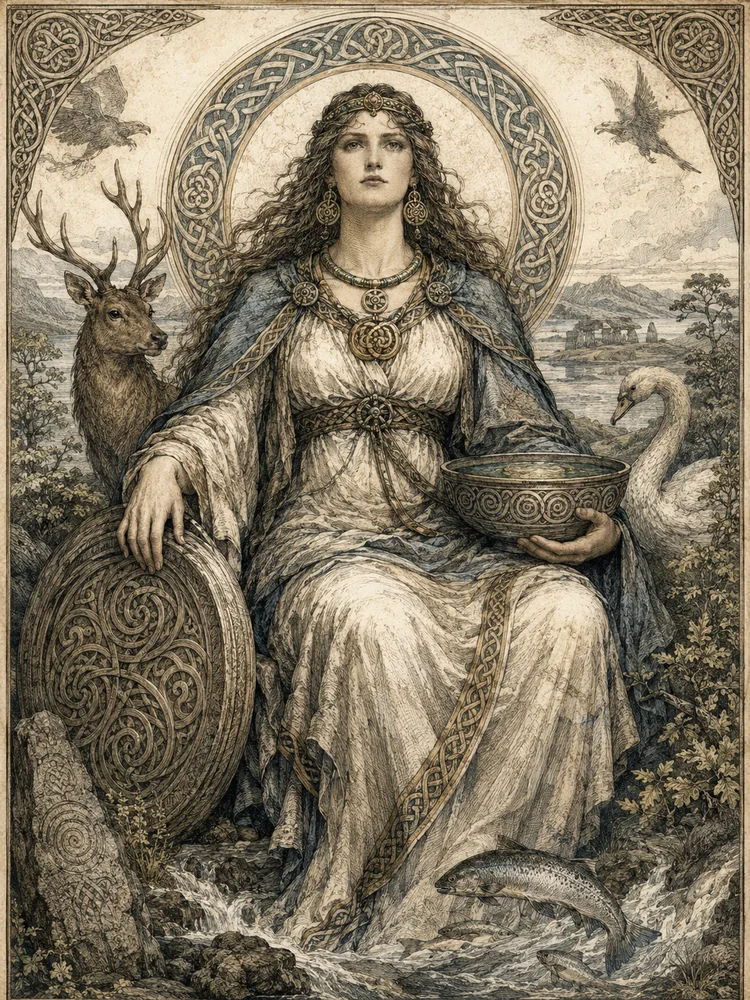
Danu (also called Anu, Ana, Donu) was the mother goddess of the Tuatha Dé Danann — "the People of the Goddess Danu," the divine race that ruled Ireland in mythological time before the coming of the Milesians (the human Irish). She was the eponymous mother of the divine race; her name appears in their collective designation, but she herself appears in the surviving Irish texts only obliquely — her cult-centers are mentioned (the Paps of Anu, two breast-shaped hills in County Kerry, are named for her), and she is acknowledged as ancestress, but no extended narrative concerning her survives. The figure has been related to the Continental Celtic Dānu (preserved in the river-name Danube, the great river of central European Celtic territory) and to the Vedic Dānu (a primordial mother in Rigvedic mythology); the Indo-European matronymic *deh₂nu- as a primordial-mother name has been reconstructed by Indo-European linguists with considerable confidence, making Danu one of the oldest recoverable Indo-European theological names.
 Next on the wallDagda
Curator’s note
What the sources say, and what later tradition added. The sources for this bay
The principal sources for Danu/Anu in the Irish tradition are the Lebor Gabála Érenn (Book of Invasions, 11th c.) and Cormac's Glossary (10th c.), where Anu is glossed as "mother of the gods of Ireland." The Indo-European reconstruction is in Calvert Watkins, How to Kill a Dragon (1995), and in standard handbooks of Indo-European religion. The Welsh cognate is Dôn, mother of the divine family in the Mabinogion's Fourth Branch.
When the sources speak
Dated witnesses for The Celtic Mythologies. A date marks when the evidence was written down, not when the belief began. The whole timeline
- 2nd–1st millennia BCE
- Indo-European language dispersals and regional Bronze Age cultures provide a remote comparative background, not a recoverable common canon.
- c. 500 BCE–1 CE
- Iron Age material culture, names, sanctuaries, and classical ethnography offer early but external evidence for Celtic and Germanic religions.
- 1st–4th centuries CE
- Roman inscriptions and provincial cults preserve many Celtic, Germanic, and local divine names.
- 4th–8th centuries CE
- Migration-period and early medieval conversion transform ritual institutions while heroic traditions continue.
- 8th–11th centuries CE
- Viking Age poetry, runic evidence, archaeology, and Scandinavian conversion form the core context of Norse myth.
- 9th–12th centuries CE
- Slavic, Baltic, and Finnic traditions enter chronicles and missionary accounts, often through hostile observers.
- 11th–14th centuries CE
- Irish, Welsh, and Icelandic manuscripts preserve major narrative corpora in Christian literary environments.
- 12th–16th centuries CE
- Saxo, saga compilers, Baltic chroniclers, and later antiquarians systematize or reinterpret older material.