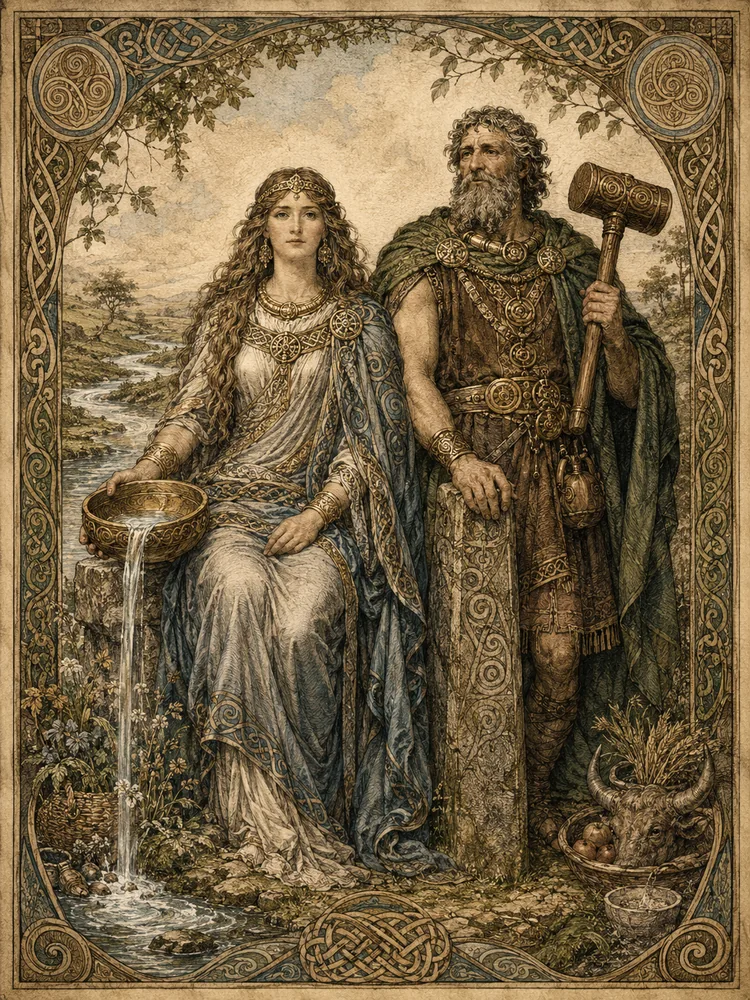
Nantosuelta — "the Winding Stream," or "She of the Sun-warmed Valley" — was a Gallic goddess depicted with a small house upon a pole (perhaps a beehive, perhaps a dovecote, perhaps a model of a temple) and with a raven beside her. She was a goddess of domestic abundance, hearth-fire, and prosperity, but with chthonic associations — the raven being a bird of death — that complicated the simple domestic reading.
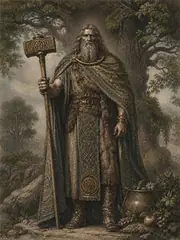
Her consort was Sucellus — "the Good Striker" — who carried a great long-handled mallet and a small olla (jar), and who was identified by the Romans sometimes with Silvanus, sometimes with Dis Pater. The mallet was the distinctive attribute; whether it was for striking down fruit from trees, for striking the dead to confirm their death, for thunder, or for some other purpose, the iconography did not make clear. Most likely the mallet had multiple meanings, the divine attribute condensing several functions into a single emblem.
Nantosuelta and Sucellus appear together on a number of monuments throughout Gallic territory, from the Mosel and Rhine valleys to central Gaul; the pair was particularly venerated by the wine-making peoples of Burgundy, and the bunch of grapes (sometimes the small grape-cluster on Sucellus's olla) attests to a Bacchic dimension. They had no surviving narrative — the Gauls did not write down their myths — and their cult is known only through the inscriptions and reliefs. They represent the Celtic divine pair at its most domestic and least adventuresome: householders, providers of abundance, perhaps also receivers of the dead. The name Sucellus survives also in personal names and place-names through France, particularly in the form Sucel, Sucelo, and (with regional variation) Sucell-.