A Compendium of the Ancient Gods
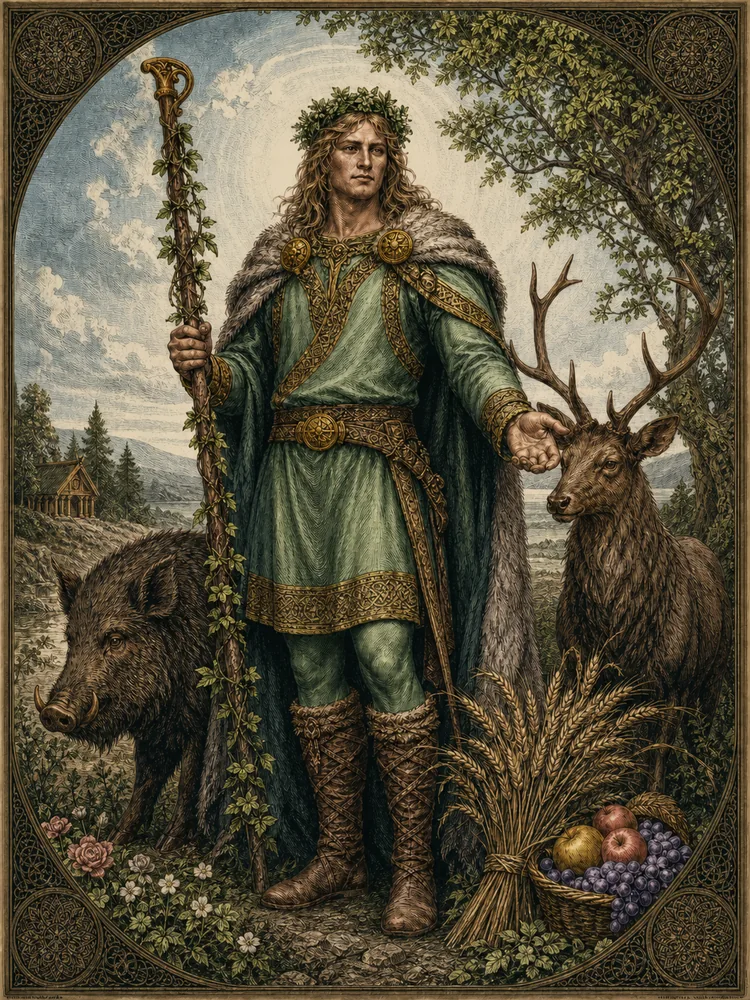
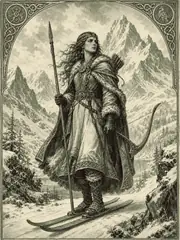
Freyr, plate

Freyr (Old Norse Freyr, "Lord") was the principal male god of the Vanir, the second divine race of Norse mythology, originally distinct from the Aesir but joined to them after the war between the two divine families. He was a son of Njord (the sea-god, treated below) and the giantess Skadi (or, in other accounts, of Njord and his unnamed sister, the Vanir practicing sibling-marriages that the Aesir disapproved of); brother of the goddess Freyja. He was the god of fair weather, of the harvest, of fertility and male potency, of peace; his cult was particularly strong in Sweden, where the great temple at Uppsala held a phallic image of him alongside the images of Odin and Thor (the three principal gods of the Swedish state-religion as Adam of Bremen described it about 1075). His sacred animal was the boar (he rode a golden boar called Gullinbursti, forged for him by the dwarves), and the boar's image on the helmets of warriors was a Freyr-symbol.

His most famous narrative is the wooing of Gerðr, a giantess whose beauty he had glimpsed from Odin's high seat (which gave a view of all the worlds, but at the cost — for those not Odin — of seeing things that troubled them). Freyr fell instantly into hopeless love. He sent his servant Skírnir to woo her on his behalf, giving Skírnir his own marvelous sword (which struck of itself against the giants); Skírnir threatened, cajoled, and at last won Gerðr's reluctant consent. The marriage was agreed; but Freyr, having given away his sword, was thereafter weaponless against the giants — and at Ragnarök he would die fighting the fire-giant Surtr without it, a death the Eddas treat as the consequence of his earlier passion.
Curator’s note

What the sources say, and what later tradition added. The sources for this bay

The principal sources are Skírnismál (the Lay of Skírnir, the wooing-narrative) in the Poetic Edda; Gylfaginning and Skáldskaparmál in the Prose Edda; Adam of Bremen's Gesta Hammaburgensis Ecclesiae Pontificum 4.26–27 (the Uppsala temple description, c. 1075). The Vanir-Aesir war is mentioned in Völuspá but is not narrated in detail; modern scholarship has variously interpreted the war as memory of an actual conflict between cult-traditions or as a mythological pattern with no historical referent. Freyr's Swedish associations and his connection with the Yngling royal line are in Snorri's Heimskringla (Ynglinga saga).

Kin in the sources

Each tie is quoted from the entry that states it.

When the sources speak

Dated witnesses for The Norse and Germanic Gods. A date marks when the evidence was written down, not when the belief began. The whole timeline

2nd–1st millennia BCE
Indo-European language dispersals and regional Bronze Age cultures provide a remote comparative background, not a recoverable common canon.
c. 500 BCE–1 CE
Iron Age material culture, names, sanctuaries, and classical ethnography offer early but external evidence for Celtic and Germanic religions.
1st–4th centuries CE
Roman inscriptions and provincial cults preserve many Celtic, Germanic, and local divine names.
4th–8th centuries CE
Migration-period and early medieval conversion transform ritual institutions while heroic traditions continue.
8th–11th centuries CE
Viking Age poetry, runic evidence, archaeology, and Scandinavian conversion form the core context of Norse myth.
9th–12th centuries CE
Slavic, Baltic, and Finnic traditions enter chronicles and missionary accounts, often through hostile observers.
11th–14th centuries CE
Irish, Welsh, and Icelandic manuscripts preserve major narrative corpora in Christian literary environments.
12th–16th centuries CE
Saxo, saga compilers, Baltic chroniclers, and later antiquarians systematize or reinterpret older material.

Floor plan

The rooms follow one another in the order their peoples first appear in the written record.

  1. The Cradle of Citiesc. 3400 BCE to 395 CE. 115 works
  2. The Gift of the Nilec. 4000 BCE to 395 CE. 73 works
  3. The Olympian Orderc. 1600 BCE to 750 CE. 152 works
  4. The Persian Worldc. 2000 BCE to 1010 CE. 30 works
  5. The Levantine Borderlandsc. 1200 BCE to 500 CE. 20 works
  6. The Edges of Empirec. 2000 BCE to 1500 CE. 33 works
  7. The Etruscan Worldc. 900 BCE to 750 CE. 22 works
  8. The Roman Inheritancec. 1200 BCE to 500 CE. 58 works
  9. The Northern Inheritancec. 2000 BCE to 1600 CE. 131 works