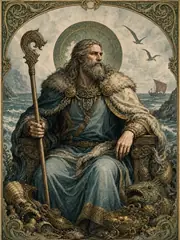
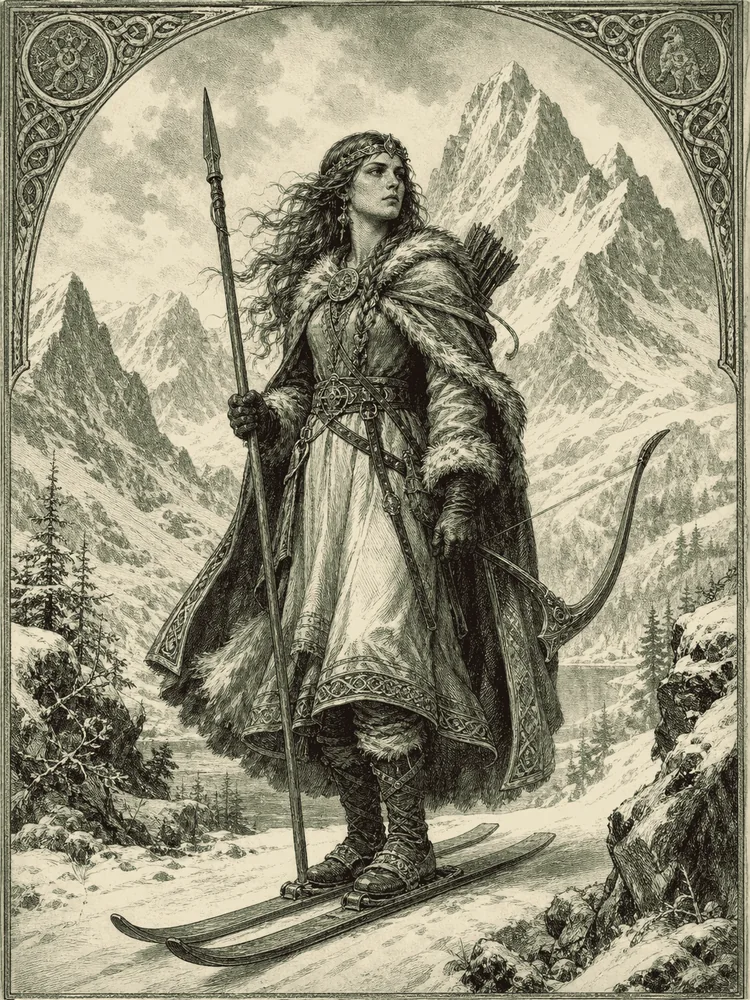
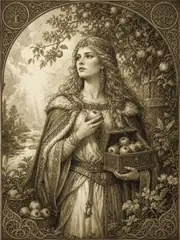
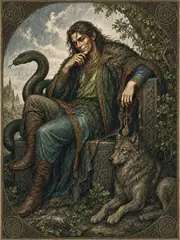
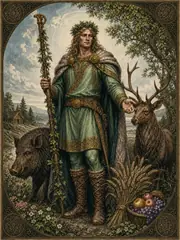
Skadi was a giantess (jötunn-woman), daughter of the giant Þjazi, who came to Asgard to demand compensation for her father's killing by the Aesir (the gods had killed Þjazi when he had abducted Idunn and her apples). The compensation was that she should choose a husband from among the gods, but only by his feet (so that she could not specifically choose Baldr, whom she desired); she chose a beautiful pair of feet that she thought must be Baldr's, but turned out to be Njord's; the resulting unhappy marriage is told in Njord's entry above. As her further compensation, the gods made her laugh — a thing she had been told was impossible — by the device of Loki tying his testicles to a goat's beard, the resulting tug-of-war producing such an absurd spectacle that Skadi could not help laughing.
She was associated with skiing, with hunting, with the wolves of the mountains; the Eddic poems say she lived alone in her father's old mountain home, hunting on skis with bow and arrow. She has been speculated to be the eponym of Scandinavia (Skadi-navia, "Skadi's land"), but the etymological case is uncertain.
When the sources speak
Dated witnesses for The Norse and Germanic Gods. A date marks when the evidence was written down, not when the belief began. The whole timeline
- 2nd–1st millennia BCE
- Indo-European language dispersals and regional Bronze Age cultures provide a remote comparative background, not a recoverable common canon.
- c. 500 BCE–1 CE
- Iron Age material culture, names, sanctuaries, and classical ethnography offer early but external evidence for Celtic and Germanic religions.
- 1st–4th centuries CE
- Roman inscriptions and provincial cults preserve many Celtic, Germanic, and local divine names.
- 4th–8th centuries CE
- Migration-period and early medieval conversion transform ritual institutions while heroic traditions continue.
- 8th–11th centuries CE
- Viking Age poetry, runic evidence, archaeology, and Scandinavian conversion form the core context of Norse myth.
- 9th–12th centuries CE
- Slavic, Baltic, and Finnic traditions enter chronicles and missionary accounts, often through hostile observers.
- 11th–14th centuries CE
- Irish, Welsh, and Icelandic manuscripts preserve major narrative corpora in Christian literary environments.
- 12th–16th centuries CE
- Saxo, saga compilers, Baltic chroniclers, and later antiquarians systematize or reinterpret older material.