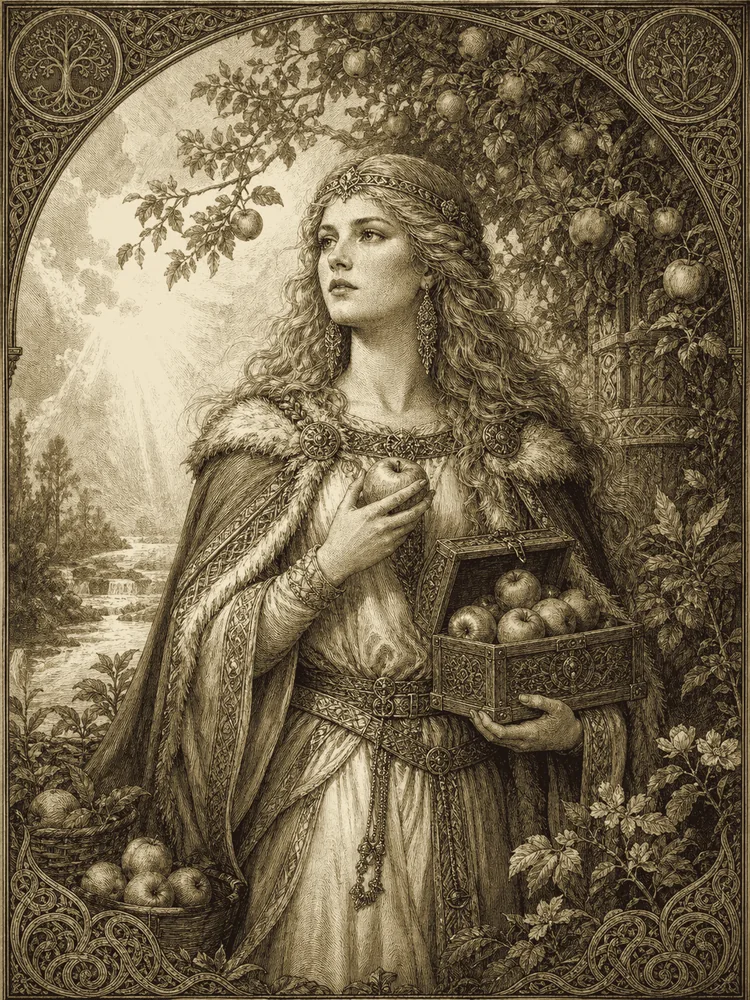
Idunn was the goddess who kept the apples of immortal youth, the apples that the gods ate to retain their agelessness. She was the wife of Bragi the god of poetry (treated below). Her one great narrative is her abduction by the giant Þjazi, who in eagle-form had once seized Loki and would not release him until Loki swore to bring Idunn out of Asgard; Loki did so, luring her into a forest with promise of finer apples, where Þjazi seized her in his eagle-form and bore her off. The gods, deprived of her apples, began to age and grow grey and weak. They threatened Loki with death until he agreed to retrieve her; he borrowed Freyja's falcon-cloak, flew to Þjazi's hall, found Idunn alone, transformed her into a nut, and flew home with her in his claws. Þjazi, returning, gave eagle-chase; the gods set fire to a great pile of woodshavings at the wall of Asgard as Loki crossed it; Þjazi flew through the flames, his wings caught fire, he fell into Asgard, and the gods killed him. The death of Þjazi was the cause of his daughter Skadi's compensation-claim treated above.
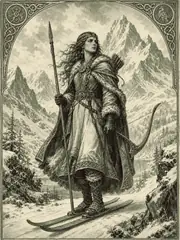 Before thisSkadi
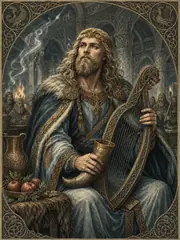 Next on the wallBragi
Curator’s note
What the sources say, and what later tradition added. The sources for this bay
The principal source is Snorri's Skáldskaparmál 1; the Poetic Edda's Haustlöng (a 9th-century skaldic poem by Þjóðólfr of Hvinir) contains an earlier version of the narrative based on a shield-painting that the poet had seen. The motif of the immortality-apples has parallels in the Greek Hesperides apples and elsewhere, but the Norse narrative is distinctively its own.
Kin in the sources
Each tie is quoted from the entry that states it.
- Consort ofBragi
She was the wife of Bragi the god of poetry (treated below).
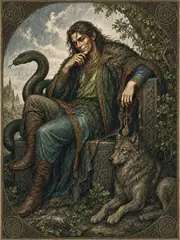 Companion ofLoki
found Idunn alone, transformed her into a nut, and flew home with her in his claws
When the sources speak
Dated witnesses for The Norse and Germanic Gods. A date marks when the evidence was written down, not when the belief began. The whole timeline
- 2nd–1st millennia BCE
- Indo-European language dispersals and regional Bronze Age cultures provide a remote comparative background, not a recoverable common canon.
- c. 500 BCE–1 CE
- Iron Age material culture, names, sanctuaries, and classical ethnography offer early but external evidence for Celtic and Germanic religions.
- 1st–4th centuries CE
- Roman inscriptions and provincial cults preserve many Celtic, Germanic, and local divine names.
- 4th–8th centuries CE
- Migration-period and early medieval conversion transform ritual institutions while heroic traditions continue.
- 8th–11th centuries CE
- Viking Age poetry, runic evidence, archaeology, and Scandinavian conversion form the core context of Norse myth.
- 9th–12th centuries CE
- Slavic, Baltic, and Finnic traditions enter chronicles and missionary accounts, often through hostile observers.
- 11th–14th centuries CE
- Irish, Welsh, and Icelandic manuscripts preserve major narrative corpora in Christian literary environments.
- 12th–16th centuries CE
- Saxo, saga compilers, Baltic chroniclers, and later antiquarians systematize or reinterpret older material.