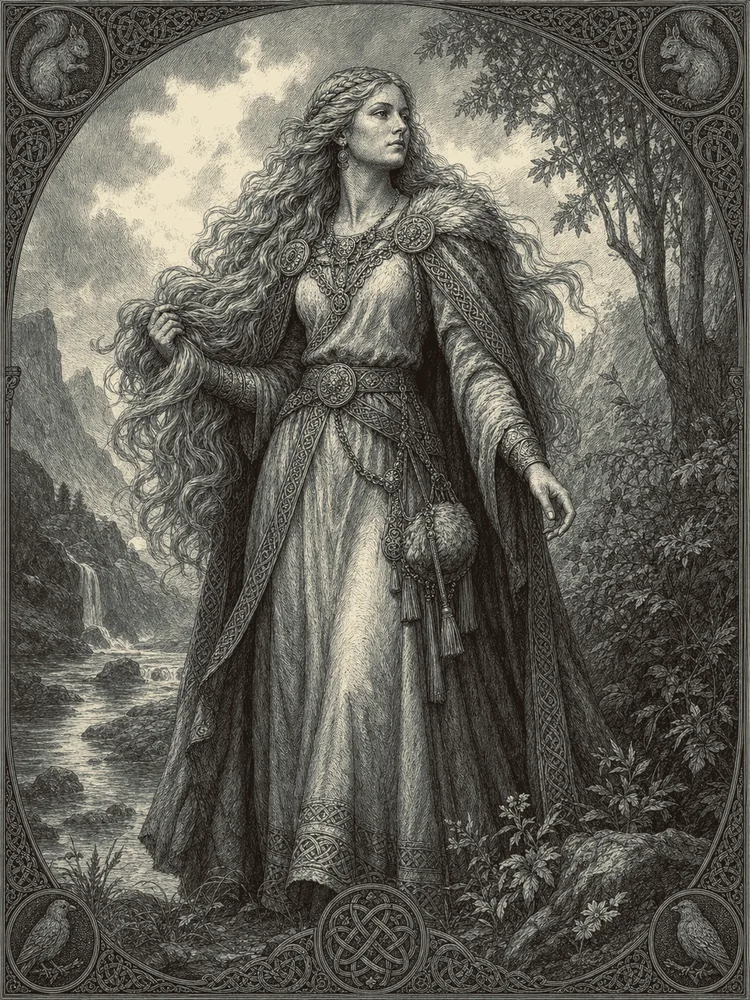
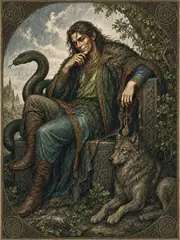
Sif was the wife of Thor, mother of Ullr by an earlier union, distinguished principally by her golden hair. In the principal narrative concerning her, Loki had cut off her hair while she slept, and Thor in fury demanded that Loki replace it. Loki went to the dwarves, the sons of Ivaldi, who made him a golden hair that would grow upon Sif's scalp like real hair; in the same expedition, in the dwarves' workshops, the great gifts of the gods were forged (Odin's spear Gungnir, Freyr's ship Skíðblaðnir and his boar Gullinbursti, Thor's hammer Mjölnir). Sif's golden hair has been variously interpreted as a vegetation-symbol (the ripe golden grain), but the Eddic narrative does not press the symbolism. She had little extended mythology of her own beyond this episode.
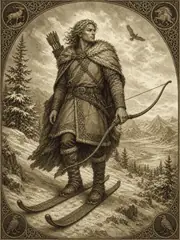 Before thisUllr
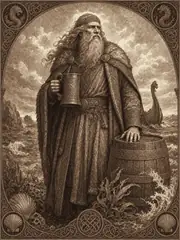 Next on the wallAegir
Curator’s note
What the sources say, and what later tradition added. The sources for this bay
Skáldskaparmál 35 (the narrative of the dwarven gifts and Sif's hair). The vegetation-interpretation is in some 19th-century Germanic-religion handbooks but is not securely established in the sources themselves.
Kin in the sources
Each tie is quoted from the entry that states it.
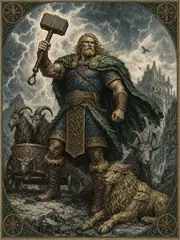 Consort ofThor
Sif was the wife of Thor, mother of Ullr by an earlier union, distinguished principally by her golden hair.
- Parent ofUllr
Sif was the wife of Thor, mother of Ullr by an earlier union, distinguished principally by her golden hair.
 Rival ofLoki
Loki had cut off her hair while she slept
When the sources speak
Dated witnesses for The Norse and Germanic Gods. A date marks when the evidence was written down, not when the belief began. The whole timeline
- 2nd–1st millennia BCE
- Indo-European language dispersals and regional Bronze Age cultures provide a remote comparative background, not a recoverable common canon.
- c. 500 BCE–1 CE
- Iron Age material culture, names, sanctuaries, and classical ethnography offer early but external evidence for Celtic and Germanic religions.
- 1st–4th centuries CE
- Roman inscriptions and provincial cults preserve many Celtic, Germanic, and local divine names.
- 4th–8th centuries CE
- Migration-period and early medieval conversion transform ritual institutions while heroic traditions continue.
- 8th–11th centuries CE
- Viking Age poetry, runic evidence, archaeology, and Scandinavian conversion form the core context of Norse myth.
- 9th–12th centuries CE
- Slavic, Baltic, and Finnic traditions enter chronicles and missionary accounts, often through hostile observers.
- 11th–14th centuries CE
- Irish, Welsh, and Icelandic manuscripts preserve major narrative corpora in Christian literary environments.
- 12th–16th centuries CE
- Saxo, saga compilers, Baltic chroniclers, and later antiquarians systematize or reinterpret older material.