A Compendium of the Ancient Gods
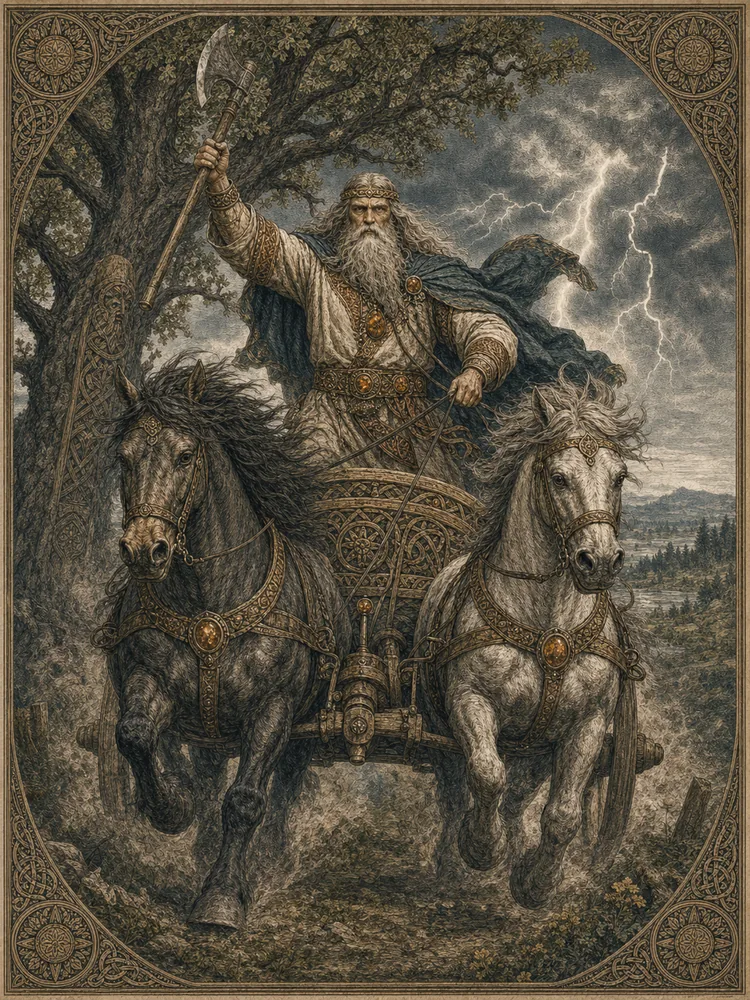
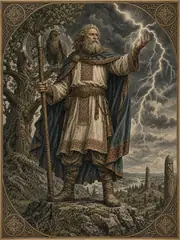
Perkūnas, plate

Perkūnas (Lithuanian) and Pērkons (Latvian) was the Baltic god of thunder — the most actively mythologically articulated of the Baltic gods, perhaps because his function was the most concretely visible (every storm was his work). He was a warrior-figure in red armor, riding through the heavens with hammer and axe, hurling stones at the demons and the trees of the dark spirits below. His enemy was Velnias (treated below), the chthonic-and-underworld figure whom Perkūnas pursued through every storm — a striking parallel to the reconstructed Slavic Perun-Veles cosmic conflict, suggesting an inherited Indo-European storm-god-vs.-chthonic-adversary myth. Perkūnas's name corresponds etymologically to Slavic Perun, Vedic Parjanya, and possibly to the Norse Fjörgyn (Thor's mother).

His sacred tree was the oak, struck by lightning more often than other trees; his cult-images stood in oak-groves; his sacred fire was kept by priestesses (the Vaidilutės) in his sanctuaries, of which the most famous was at Romove in pre-Christian Prussia. He was widely honored across the Baltic territories, and his cult was substantial enough that the Christianization of the Balts had to make special provision for the suppression of his sacred groves. The Baltic peasants continued to invoke him after the conversion, with Saint Elijah of the Old Testament becoming his Christian-period substitute (parallel to Slavic Saint Elijah-as-Perun).
Curator’s note

What the sources say, and what later tradition added. The sources for this bay

The principal sources are the Latvian dainas (where Pērkons appears extensively); the medieval chronicles (Henry of Livonia 7.5, etc.); the Jesuit missionary reports (Jan Łasicki, De diis Samogitarum, 1582). The Romove sanctuary is described by Peter of Dusburg, Chronicon terrae Prussiae 3.5; whether the description is accurate or partly invented for missionary purposes has been debated. The IE etymology is in standard handbooks.

Kin in the sources

Each tie is quoted from the entry that states it.

When the sources speak

Dated witnesses for The Baltic Pantheon. A date marks when the evidence was written down, not when the belief began. The whole timeline

2nd–1st millennia BCE
Indo-European language dispersals and regional Bronze Age cultures provide a remote comparative background, not a recoverable common canon.
c. 500 BCE–1 CE
Iron Age material culture, names, sanctuaries, and classical ethnography offer early but external evidence for Celtic and Germanic religions.
1st–4th centuries CE
Roman inscriptions and provincial cults preserve many Celtic, Germanic, and local divine names.
4th–8th centuries CE
Migration-period and early medieval conversion transform ritual institutions while heroic traditions continue.
8th–11th centuries CE
Viking Age poetry, runic evidence, archaeology, and Scandinavian conversion form the core context of Norse myth.
9th–12th centuries CE
Slavic, Baltic, and Finnic traditions enter chronicles and missionary accounts, often through hostile observers.
11th–14th centuries CE
Irish, Welsh, and Icelandic manuscripts preserve major narrative corpora in Christian literary environments.
12th–16th centuries CE
Saxo, saga compilers, Baltic chroniclers, and later antiquarians systematize or reinterpret older material.

Floor plan

The rooms follow one another in the order their peoples first appear in the written record.

  1. The Cradle of Citiesc. 3400 BCE to 395 CE. 115 works
  2. The Gift of the Nilec. 4000 BCE to 395 CE. 73 works
  3. The Olympian Orderc. 1600 BCE to 750 CE. 152 works
  4. The Persian Worldc. 2000 BCE to 1010 CE. 30 works
  5. The Levantine Borderlandsc. 1200 BCE to 500 CE. 20 works
  6. The Edges of Empirec. 2000 BCE to 1500 CE. 33 works
  7. The Etruscan Worldc. 900 BCE to 750 CE. 22 works
  8. The Roman Inheritancec. 1200 BCE to 500 CE. 58 works
  9. The Northern Inheritancec. 2000 BCE to 1600 CE. 131 works