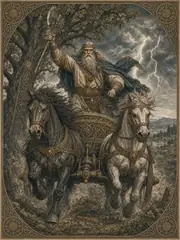
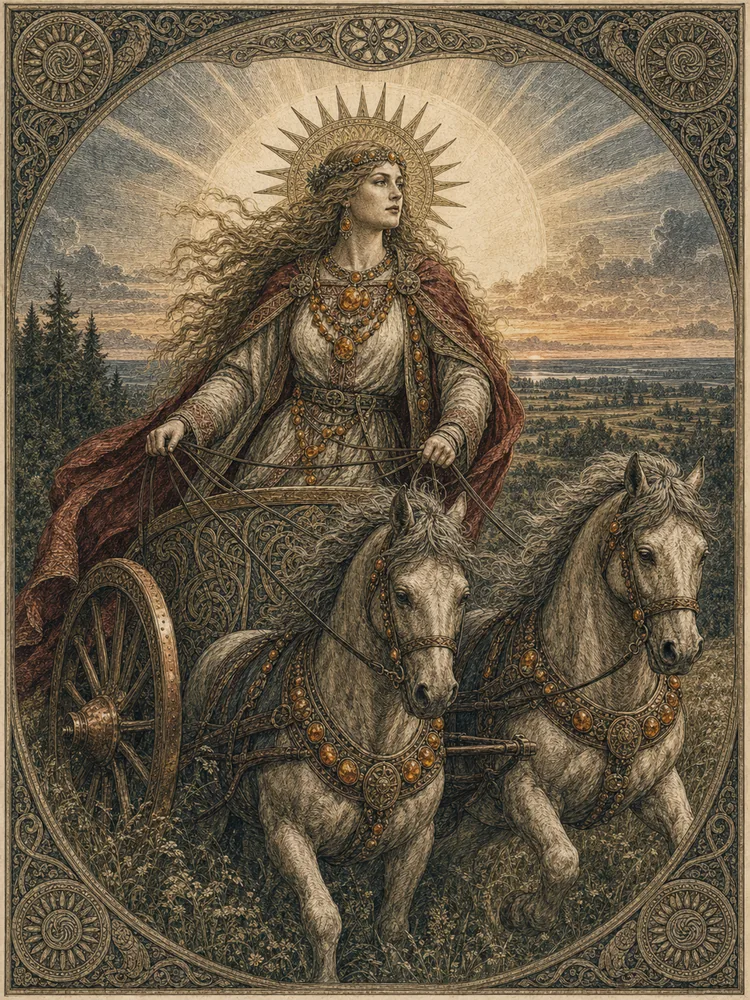
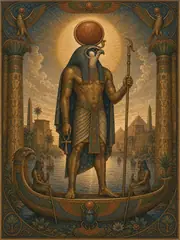
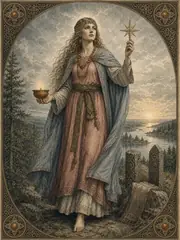
Saulė (Lithuanian) and Saule (Latvian) was the sun, conceived in Baltic religion as feminine — a striking distinction from the masculine Greek Helios, Roman Sol, and Egyptian Ra, but matched in the Indo-European world by the Vedic Sūryā (the daughter of the sun-god, sometimes the sun herself), the Norse Sól, and a few other archaically feminine sun-figures. The femininity of the Baltic sun is of considerable Indo-European-comparative interest, the Balts apparently preserving an old gendered conception that the Greek and Roman traditions had reorganized.
Saulė was depicted as a mother — a mother of the stars (her many "daughters"), a mother who drove her chariot or boat across the sky each day, who descended at evening into the western sea and rose each morning from the eastern. She was the mother of the dawn-star Aušrinė (her brightest daughter), and was associated with copper apples and amber that she scattered on her path. Her cult was extensive; the Latvian dainas treat her with great affection and frequency. She had a complicated relationship with Mēness (the moon, masculine in Baltic religion); they had been husband and wife but had separated, the moon's infidelity with Aušrinė being one cause.
When the sources speak
Dated witnesses for The Baltic Pantheon. A date marks when the evidence was written down, not when the belief began. The whole timeline
- 2nd–1st millennia BCE
- Indo-European language dispersals and regional Bronze Age cultures provide a remote comparative background, not a recoverable common canon.
- c. 500 BCE–1 CE
- Iron Age material culture, names, sanctuaries, and classical ethnography offer early but external evidence for Celtic and Germanic religions.
- 1st–4th centuries CE
- Roman inscriptions and provincial cults preserve many Celtic, Germanic, and local divine names.
- 4th–8th centuries CE
- Migration-period and early medieval conversion transform ritual institutions while heroic traditions continue.
- 8th–11th centuries CE
- Viking Age poetry, runic evidence, archaeology, and Scandinavian conversion form the core context of Norse myth.
- 9th–12th centuries CE
- Slavic, Baltic, and Finnic traditions enter chronicles and missionary accounts, often through hostile observers.
- 11th–14th centuries CE
- Irish, Welsh, and Icelandic manuscripts preserve major narrative corpora in Christian literary environments.
- 12th–16th centuries CE
- Saxo, saga compilers, Baltic chroniclers, and later antiquarians systematize or reinterpret older material.