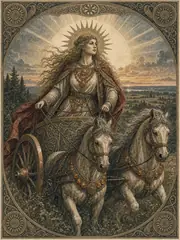
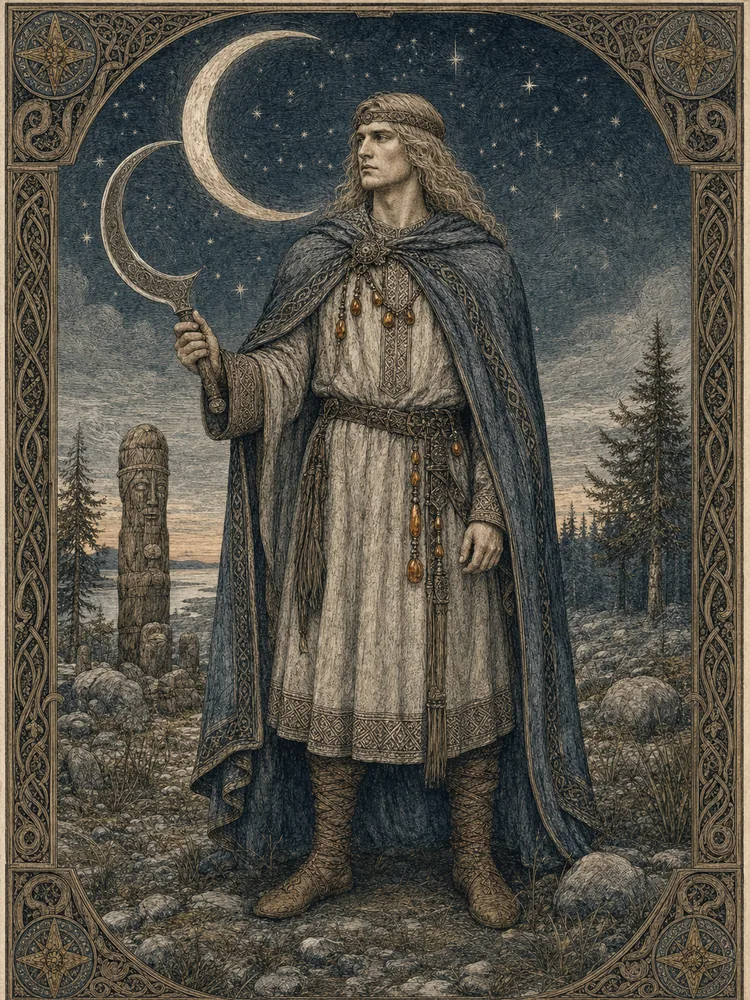
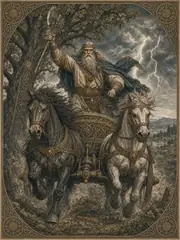
Mėnuo (Lithuanian) and Mēness (Latvian) was the moon, masculine in Baltic religion, husband of the sun-goddess Saulė. Their marriage had ended unhappily: in the principal Baltic version, Mēness had been unfaithful to Saulė with the dawn-star Aušrinė (Saulė's daughter), and Saulė in fury had taken her sword and slashed Mēness's face — the marks visible on the moon's surface still being the wounds of that quarrel. Some versions had the thunder-god Perkūnas intervening to support Saulė's grievance, slashing Mēness's face himself. The two never reconciled; thereafter they alternated in the sky, never seen together (the daytime sky was Saulė's, the nighttime Mēness's), which the cosmological narrative explained as the consequence of their separation.
Mēness was associated with the dead, with sleep, with dreams, with the night-time activities of the household and the field. His cult was less elaborate than Saulė's; he is principally the male partner in the Baltic divine couple-narrative.
When the sources speak
Dated witnesses for The Baltic Pantheon. A date marks when the evidence was written down, not when the belief began. The whole timeline
- 2nd–1st millennia BCE
- Indo-European language dispersals and regional Bronze Age cultures provide a remote comparative background, not a recoverable common canon.
- c. 500 BCE–1 CE
- Iron Age material culture, names, sanctuaries, and classical ethnography offer early but external evidence for Celtic and Germanic religions.
- 1st–4th centuries CE
- Roman inscriptions and provincial cults preserve many Celtic, Germanic, and local divine names.
- 4th–8th centuries CE
- Migration-period and early medieval conversion transform ritual institutions while heroic traditions continue.
- 8th–11th centuries CE
- Viking Age poetry, runic evidence, archaeology, and Scandinavian conversion form the core context of Norse myth.
- 9th–12th centuries CE
- Slavic, Baltic, and Finnic traditions enter chronicles and missionary accounts, often through hostile observers.
- 11th–14th centuries CE
- Irish, Welsh, and Icelandic manuscripts preserve major narrative corpora in Christian literary environments.
- 12th–16th centuries CE
- Saxo, saga compilers, Baltic chroniclers, and later antiquarians systematize or reinterpret older material.