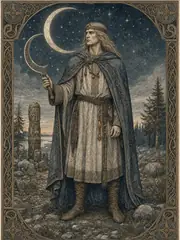
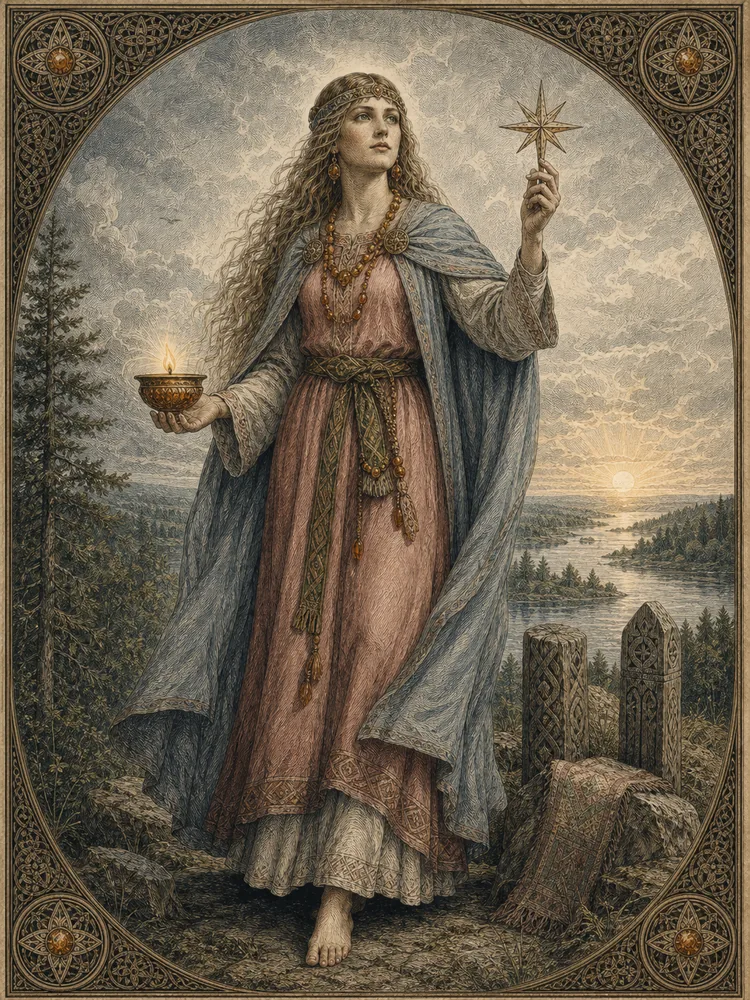
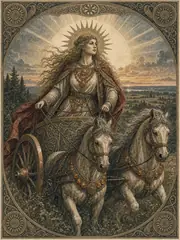
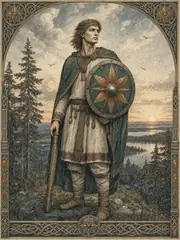
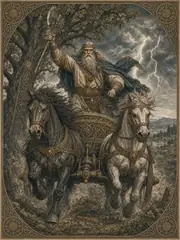
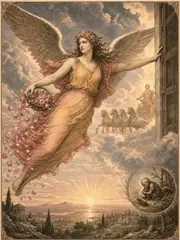
Aušrinė (Lithuanian; Latvian Auseklis) was the dawn-star — the planet Venus when she appears in the morning sky before sunrise, conceived as a beautiful young goddess, daughter of Saulė the sun. She drove a small bright chariot before her mother's, lighting the way. In the Baltic divine-marriage cycles, she was the object of Mēness the moon's infidelity (causing the rupture told in his entry); she was also (in some traditions) loved by Perkūnas the thunder-god, who pursued her in his various storm-narratives.
Her name is etymologically connected with the Indo-European root *h₂ews- ("dawn"), the same root that gave Greek Eos and Latin Aurora and Vedic Ushas. The Baltic Aušrinė accordingly preserves the Indo-European dawn-star-goddess in particularly archaic form, and is among the more clearly inherited deities in the Baltic pantheon.
When the sources speak
Dated witnesses for The Baltic Pantheon. A date marks when the evidence was written down, not when the belief began. The whole timeline
- 2nd–1st millennia BCE
- Indo-European language dispersals and regional Bronze Age cultures provide a remote comparative background, not a recoverable common canon.
- c. 500 BCE–1 CE
- Iron Age material culture, names, sanctuaries, and classical ethnography offer early but external evidence for Celtic and Germanic religions.
- 1st–4th centuries CE
- Roman inscriptions and provincial cults preserve many Celtic, Germanic, and local divine names.
- 4th–8th centuries CE
- Migration-period and early medieval conversion transform ritual institutions while heroic traditions continue.
- 8th–11th centuries CE
- Viking Age poetry, runic evidence, archaeology, and Scandinavian conversion form the core context of Norse myth.
- 9th–12th centuries CE
- Slavic, Baltic, and Finnic traditions enter chronicles and missionary accounts, often through hostile observers.
- 11th–14th centuries CE
- Irish, Welsh, and Icelandic manuscripts preserve major narrative corpora in Christian literary environments.
- 12th–16th centuries CE
- Saxo, saga compilers, Baltic chroniclers, and later antiquarians systematize or reinterpret older material.