A Compendium of the Ancient Gods
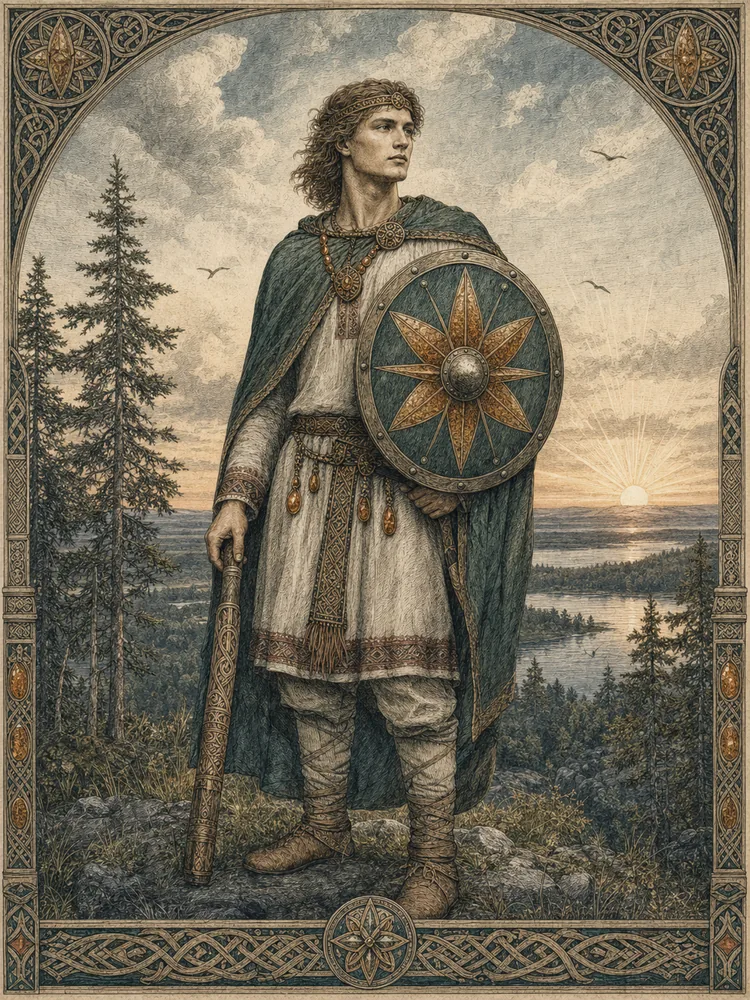
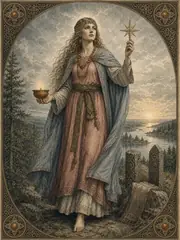
Auseklis, plate

Auseklis was the morning star of the Latvian sky — Venus when she appeared at dawn — and in the Latvian dainas (the great corpus of folk-songs) he was a young god, brother of the heavenly twins called Dieva Dēli (Sons of God), suitor of Saulė's daughter Saules Meita, friend of Mēness the moon. He rose ahead of the sun each morning, bringing news of her coming; he set ahead of her each evening, withdrawing into the heavens before her departure.

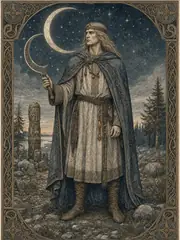
Auseklis's wedding to the Sun's daughter was the central narrative of his myth, preserved in dozens of Latvian folk songs. The wedding-feast was held in the heavens, with the moon and the stars in attendance; horses were fitted with golden harness; the groom rode in a golden chariot. But the marriage was tragic. In one version, the moon Mēness fell in love with the bride and stole her away; the angry sun cut Mēness in two with her sword, which is why the moon waxes and wanes. In another, the bride was the morning star Auseklis's herself rather than a separate figure, and the marriage was with the moon directly.

The figure of Auseklis was central to Latvian national-romantic mythology in the nineteenth-century revival, and the eight-pointed star that became the symbol of Latvian folk art and (later) of the Latvian nation derives from his iconography. He is one of the most clearly preserved examples in Europe of an Indo-European astral mythology — the morning star as a divine youth, with the sun-maiden as bride and the moon as rival — paralleled in the Vedic, Greek, and Slavic traditions, but preserved in particular completeness in the Latvian dainas because of the late survival of pre-Christian belief among the Latvian peasantry.
Curator’s note

What the sources say, and what later tradition added. The sources for this bay

Auseklis is documented chiefly in the Latvju Dainas, the great corpus of Latvian folk songs collected by Krišjānis Barons in the late nineteenth century (published 1894-1915 in six volumes, comprising over 200,000 four-line songs). The most relevant texts are the saules dainas and the rīta zvaigznes dainas. Comparative scholarship by Haralds Biezais (Die Hauptgöttinnen der alten Letten, 1955; Lichtgott der alten Letten, 1976) is foundational. The Indo-European astral framework was extensively explored by Jaan Puhvel (Comparative Mythology, 1987). The Latvian dainas are remarkable as a folk corpus because they preserved pre-Christian Indo-European mythological material in essentially intact form into the nineteenth century.

Kin in the sources

Each tie is quoted from the entry that states it.

When the sources speak

Dated witnesses for The Baltic Pantheon. A date marks when the evidence was written down, not when the belief began. The whole timeline

2nd–1st millennia BCE
Indo-European language dispersals and regional Bronze Age cultures provide a remote comparative background, not a recoverable common canon.
c. 500 BCE–1 CE
Iron Age material culture, names, sanctuaries, and classical ethnography offer early but external evidence for Celtic and Germanic religions.
1st–4th centuries CE
Roman inscriptions and provincial cults preserve many Celtic, Germanic, and local divine names.
4th–8th centuries CE
Migration-period and early medieval conversion transform ritual institutions while heroic traditions continue.
8th–11th centuries CE
Viking Age poetry, runic evidence, archaeology, and Scandinavian conversion form the core context of Norse myth.
9th–12th centuries CE
Slavic, Baltic, and Finnic traditions enter chronicles and missionary accounts, often through hostile observers.
11th–14th centuries CE
Irish, Welsh, and Icelandic manuscripts preserve major narrative corpora in Christian literary environments.
12th–16th centuries CE
Saxo, saga compilers, Baltic chroniclers, and later antiquarians systematize or reinterpret older material.

Floor plan

The rooms follow one another in the order their peoples first appear in the written record.

  1. The Cradle of Citiesc. 3400 BCE to 395 CE. 115 works
  2. The Gift of the Nilec. 4000 BCE to 395 CE. 73 works
  3. The Olympian Orderc. 1600 BCE to 750 CE. 152 works
  4. The Persian Worldc. 2000 BCE to 1010 CE. 30 works
  5. The Levantine Borderlandsc. 1200 BCE to 500 CE. 20 works
  6. The Edges of Empirec. 2000 BCE to 1500 CE. 33 works
  7. The Etruscan Worldc. 900 BCE to 750 CE. 22 works
  8. The Roman Inheritancec. 1200 BCE to 500 CE. 58 works
  9. The Northern Inheritancec. 2000 BCE to 1600 CE. 131 works