A Compendium of the Ancient Gods
Māra, plate

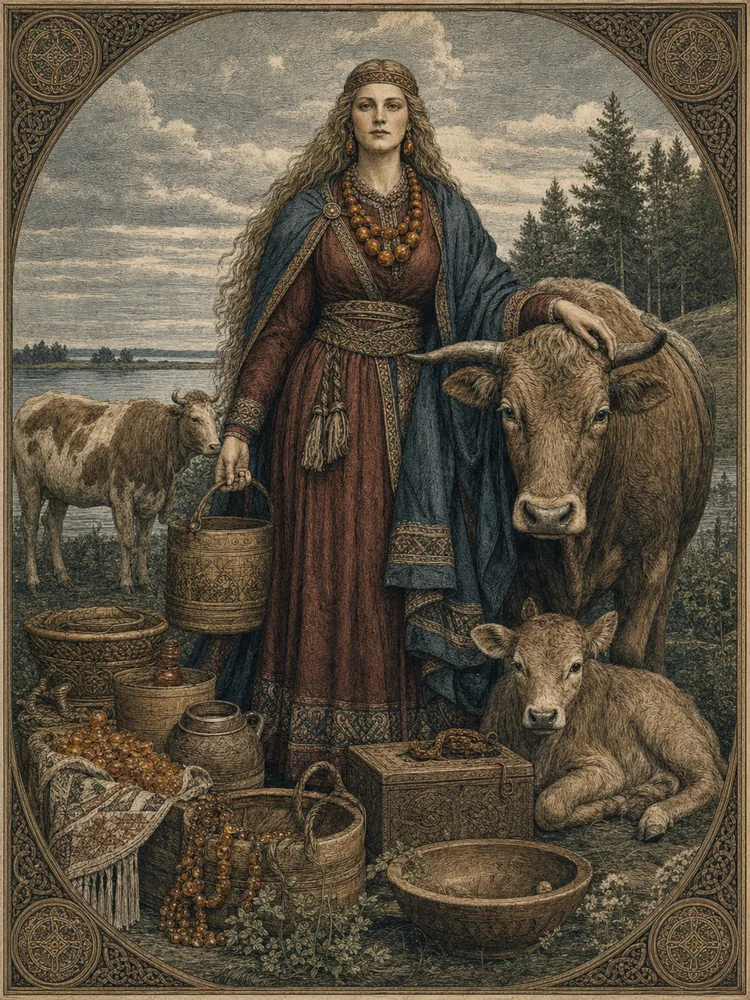
Māra was the great mother-goddess of the Latvian pantheon, an earth-mother in the most domestic and practical sense — the goddess of the cattle in the byre, of the spinning-wheel in the cottage, of the cow's milk in the pail and the wool on the distaff. Her name probably derives from the Indo-European root that gives "mother" (meaning the same word as Latin Mater, Greek Mētēr), and in folk-Christian usage Māra was identified with the Virgin Mary — a substitution so seamless that the question of which figure preceded the other in the dainas is sometimes hard to settle.

Māra had many specialized aspects, each with its own name: Govju Māra (the Cow's Mother) for cattle, Lopu Māra (the Stock's Mother) for general livestock, Veļu Māte (the Mother of the Departed) for ancestral spirits, Lazdu Māte (the Hazel's Mother) for the hazelwood. The proliferation of "-Mother" titles in Latvian folk religion is striking; nearly every domain had its presiding female spirit, and Māra was the great unifying figure who oversaw all the lesser "Mothers."

She was approached with simple offerings — bread, milk, butter, honey — set out at her places, which were typically the threshold of the cattle-byre, the doorpost of the cottage, the trunk of an old tree, the corner of a field. She had no image, no temple, no priest; she was a presence rather than a represented figure, addressed by the women of the household in private rites. Through this very privacy she survived Christianization more thoroughly than the male warrior-gods who had had public cult, and well into the twentieth century Latvian peasant women observed Māra-rites that the priests at best tolerated and at worst denounced.
Curator’s note

What the sources say, and what later tradition added. The sources for this bay

Māra is one of the central figures of Latvian folk religion, documented in the dainas (numerous songs to Māra in various aspects) and in ethnographic collections from the nineteenth and twentieth centuries. The merger with the Virgin Mary is sometimes complete (the same dainas can be sung as folk-Christian or folk-pagan depending on context). Haralds Biezais's Die Religionsquellen der baltischen Völker und die Ergebnisse der bisherigen Forschung (1954) is foundational. The proliferation of "Mothers" (the various -Māte figures) is sometimes treated as a polytheistic system in itself; Marija Gimbutas and others have used the Latvian material as evidence for an older pre-Indo-European "Goddess" stratum, though such reconstructions go beyond what the sources alone support.

Kin in the sources

Each tie is quoted from the entry that states it.

When the sources speak

Dated witnesses for The Baltic Pantheon. A date marks when the evidence was written down, not when the belief began. The whole timeline

2nd–1st millennia BCE
Indo-European language dispersals and regional Bronze Age cultures provide a remote comparative background, not a recoverable common canon.
c. 500 BCE–1 CE
Iron Age material culture, names, sanctuaries, and classical ethnography offer early but external evidence for Celtic and Germanic religions.
1st–4th centuries CE
Roman inscriptions and provincial cults preserve many Celtic, Germanic, and local divine names.
4th–8th centuries CE
Migration-period and early medieval conversion transform ritual institutions while heroic traditions continue.
8th–11th centuries CE
Viking Age poetry, runic evidence, archaeology, and Scandinavian conversion form the core context of Norse myth.
9th–12th centuries CE
Slavic, Baltic, and Finnic traditions enter chronicles and missionary accounts, often through hostile observers.
11th–14th centuries CE
Irish, Welsh, and Icelandic manuscripts preserve major narrative corpora in Christian literary environments.
12th–16th centuries CE
Saxo, saga compilers, Baltic chroniclers, and later antiquarians systematize or reinterpret older material.

Floor plan

The rooms follow one another in the order their peoples first appear in the written record.

  1. The Cradle of Citiesc. 3400 BCE to 395 CE. 115 works
  2. The Gift of the Nilec. 4000 BCE to 395 CE. 73 works
  3. The Olympian Orderc. 1600 BCE to 750 CE. 152 works
  4. The Persian Worldc. 2000 BCE to 1010 CE. 30 works
  5. The Levantine Borderlandsc. 1200 BCE to 500 CE. 20 works
  6. The Edges of Empirec. 2000 BCE to 1500 CE. 33 works
  7. The Etruscan Worldc. 900 BCE to 750 CE. 22 works
  8. The Roman Inheritancec. 1200 BCE to 500 CE. 58 works
  9. The Northern Inheritancec. 2000 BCE to 1600 CE. 131 works